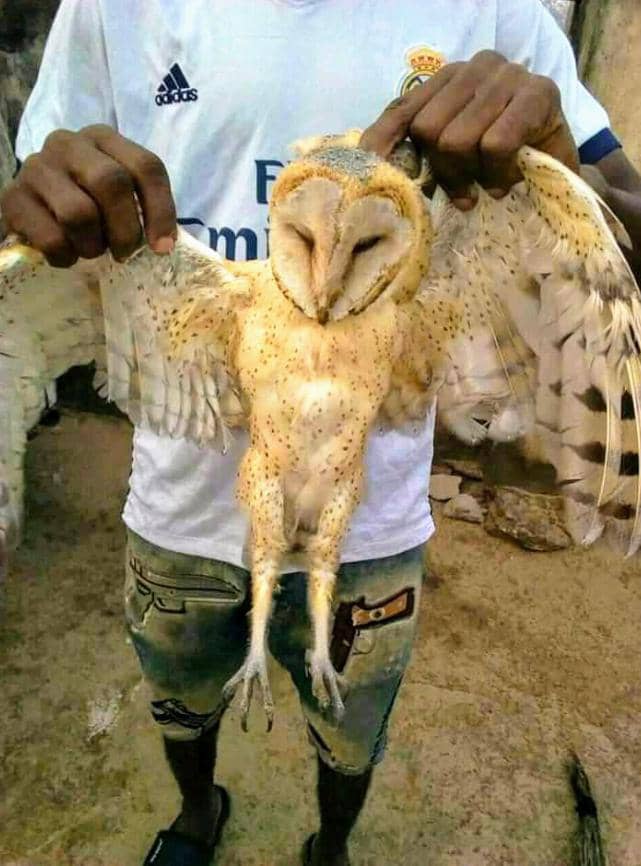
Imagine you’re a bird, not just any bird, but a Nigerian owl. Nature’s job for you is clearly defined, you are an apex nocturnal bird of prey, an often-underrated regulator of the ecosystem. You move through the night with precision, controlling rodent and insect populations, preventing crop damage, reducing the spread of disease, and quietly maintaining biodiversity. But in the eyes of many Nigerians, you are something else entirely. In their eyes, you are not just a bird, you are a heralder of the underworld’s darkest underbellies, a physical, life-sized manifestation of witchcraft and wizardry.
Your call in the night is not heard as communication, but as a warning and your presence is interpreted as an omen of things about to go wrong, and it doesn’t matter whether things have already gone to the dogs or not. It does not help that these birds, in general, are often cast as totems of witchcraft in many cultural narratives woven into the symbolic language of fear and mysticism. And you, unfortunate as you are, are counted among the least aesthetically pleasing of them. Your large, unblinking eyes, your eerie stillness, your ghostlike flight, features that evolution carved for survival are reinterpreted as signs of something unnatural.
Around you, myths and folklore have crystallized, in which you’re typecast as a dark courier, a cosmic Hermes of ill-fate, landing gently to deliver the message of evil. Religious interpretations have only deepened the stereotype. Your death in or near a person’s home is often celebrated, taken as a convenient indication that the plans of the enemies have been thwarted, that unseen battles have been won, that the forces of darkness have been subdued. It does not matter if you are forced into daylight by hunger, if scarcity pushes you to hunt outside your natural hours.
It also does not matter if, like burrowing owls or northern hawk owls, your biology simply differs from the norm and you are naturally active during the day. Nuance has no place here and context is completely irrelevant. To imagine being a Nigerian owl is to exist as a living metaphor for death in a land bursting with life. It is to be judged not by your ecological role, but by stories told long before you ever took flight.
It is to occupy a crucial position in nature while being denied recognition for it, to contribute silently while being feared loudly. And yet, the irony remains striking: the same creature that is hunted out of fear is one of the very agents that protects human livelihood. By controlling pests, you safeguard harvests. By limiting disease vectors, you indirectly protect human health. By maintaining balance, you uphold the very systems that sustain life.
There is, therefore, a quiet tragedy in your story. Not one of dramatic extinction or sudden collapse, but of a misunderstanding that is persistent, inherited, and rarely questioned. It speaks to a broader need; the need for education, for ecological awareness, for the careful dismantling of harmful myths that justify needless and wanton waste of animal lives. The owl, in these lands of ours, is thus an unfortunate bird. A creature caught at the intersection of biology and belief, of function and fear. And one cannot help but feel a measure of pity not just for the owl itself, but for the distance between what it actually is, and what it is believed to be.