
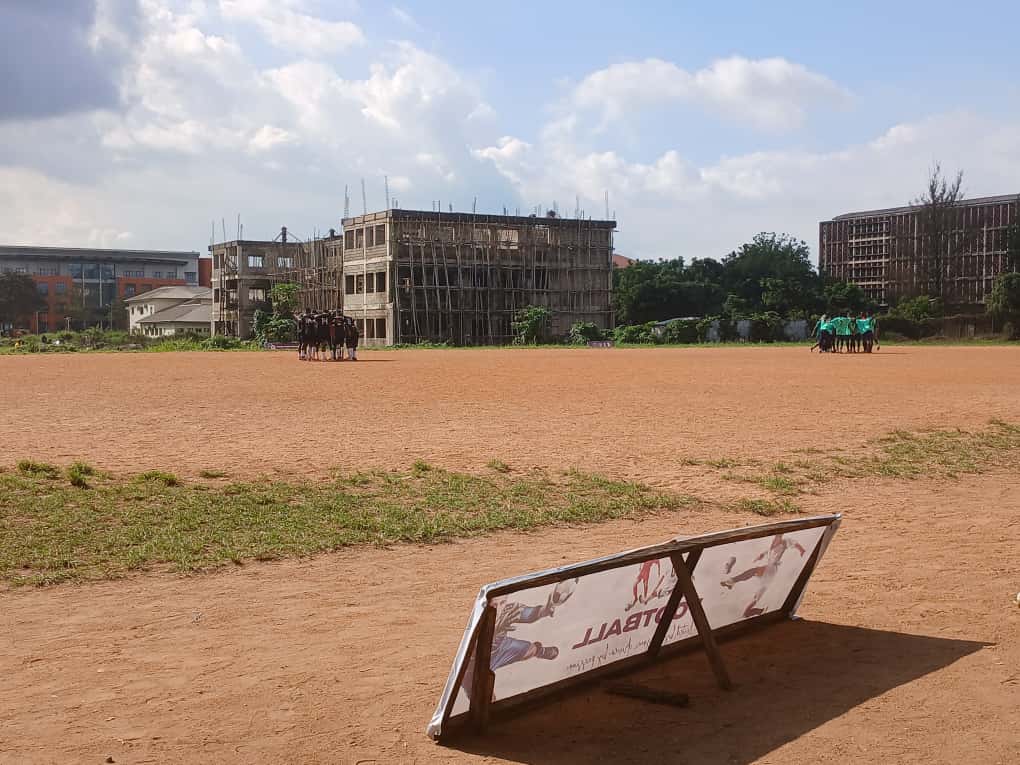
The ever-growing sports culture in UI is like a stack of bricks on a very weak foundation. The current apexes are so glamorous that it adhesively pulls the average sports-oriented freshman towards it. But far close to the base of this culture is a deficient infrastructure that is still a neglect. Our 10-month old editorial establishing a case study of sports neglect is very well valid till date. The pictures of the facilities in that article still reflect their current state, if they have not even gotten worse. And it is despite these that the sports community have hosted back to back SEALS Cup competitions, inter-hall and inter-faculty competitions, including the ones hosted by private organizations on campus tours.
Aside from the patchy fixes that these organizers do on the famed SUB pitch, they have to actively source funding to run the tournament because it has been well established that registration money barely scratches the surface of expenses. In fundraising, organizers strike conversations with private brands and the outcome of these numerous conversations is where the problem of underfunding lies.
Many people know or have heard of Ayobami Ojeniyi. Or at least, everyone involved in the sporting landscape of the University of Ibadan. Zik Hall Sports Minister in 2024. A significant presence in Sports Clique, a fast-rising campus organisation committed to the promotion of the lesser known aspects of the sporting world. 2024 SEALS Cup Chairman, and long term board member of just about every sports organising body on campus. But only a handful of people know what it has cost him, and Daniel Adesina, the UI’SU ‘23/24 Sports Secretary, known to most as Oscar, and just about every other sports enthusiast who has had to oversee the administration of a sporting competition in the University of Ibadan. The average fan sees only so much, and remembers just the spectacular: the flashes of brilliance on the pitch, the roar of the supporters as one, the moments the air feels heavy with tension. But behind the scenes of these highly popular competitions, however, an entirely different story plays out.
Now, it is a poorly kept secret, known to anyone that the vibrant sports scene in the University of Ibadan thrives in spite of, rather than because of any concerted institutional efforts. From the demolishment of the Sports Centre in 2012 to the encroachment of SUB, and even to the general disregard for the existing facilities and the state of disrepair they have been left to sink into, the message is quite luculent that sports is very near the foot, if not even rock bottom of the list of priorities. This is the unsavoury reality we have been left to contend with, and it stares us down unblinkingly.
Barring a slightly better showing during the outing for the NUGA in November last year, year in year out, it seems like generations of UI athletes are just rinsing and repeating the same old stories; delayed and unpaid allowances while representing the school, accommodation issues, having to shuttle back to school mid-competition to write tests, no provision for jerseys or training equipment, training facilities that have fallen into the chilling embrace of neglect. And perhaps the most telling of all; not a single university-organised or sponsored sports competition since 2024, not even for football, in a school where the beautiful game is almost second nature. The Seals Cup, now in its 8th edition, the most competitive and widely followed football tournament on campus barely receives any sponsorship from the management. Neither does the Interhall Freshers Cup, the CBN Cup for 100L nor does the Survival Cup. The SU and a handful of passionate sportspersons have been left to shoulder the burden, on their own. And there is only so much these individuals, who are primarily students, can do on their own. Year after year, while different individuals pass on the baton at the helm, the rains come and go, our tuition fees go up without fail but whenever it comes to sports, like a broken gramophone we only dance out slightly different versions of the same tune.
The consequences clearly show up when UI steps outside its own four walls. At NUGA 2022, the UI contingent finished in 16th place with 20 medals with just 2 being gold medals, in stark contrast to UNIPORT which topped the table with 120 medals, including a staggering 61 gold. At the 11th All-African University Games in 2024, the UI contingent competed in three categories – Chess, Scrabble and Taekwondo – finishing with 12 medals, as LASU and UNILAG, the co-hosts and known serious investors in their sporting infrastructure, finished with 84 and 98 medals respectively. The gap is not flattering for a university that calls itself the best in the country. That we achieved our highest ever medal haul in recent years at the last NUGA in Jos is not proof of a working system, it is but a testament to the sheer, utterly stubborn never-say-die attitude of our athletes. Bar this genuinely commendable showing, where we amassed a total of 36 medals to place 6th, the pattern has been consistent: the gap between UI and the universities that take sport seriously is jarringly vast, and it is not because of a gap in talent. It is a gap in investment. UNILORIN, once a peer, has quietly built its football ecosystem to the point where its school league now appears on Sofascore. UI athletes, meanwhile, have continued to show up largely based on personal motivation alone, which makes their occasional wins all the more remarkable, and their losses all the more damning of the system behind them. The disregard evidenced now reads as even more ludicrous when you realize that UI actually hosted and helped found both the first West African University Games (WAUG) in 1965 and the first Nigeria University Games Association (NUGA) in 1966. In fact, the Sports Council proudly notes that the “emergence of WAUG and NUGA games originated from the University of Ibadan in 1965 and 1966 respectively”. The first editions of these competitions were on UI soil. Since its inception, UI has hosted the NUGA a total of four times, in 1966, 1976, 1986, with the last time being in 2002. So how did such a giant pacesetter in collegiate sports in Nigeria find itself at this juncture today?
Underwhelmingly, there is no single answer, there is no one clear moment of betrayal we can point to. What we see instead is a pattern of encroachment, of neglect, of institutional indifference, that has been quietly compounding over the years till now, in the present, where it has become the water everyone swims in. This pattern created a vacuum, and as with vacuums, someone, somehow had to step in to fill it. Now, the root of most of it as it is with most things, is money, or more precisely the lack of it. Running a competitive sports competition requires a sizable chunk of funding, to book venues, purchase equipment, jerseys, medals, for logistics expenses, and such other running costs. And so, as the university provides almost none of it for these student-organised competitions, the organisers are left to do what anyone would do when faced with a gap – they go looking for someone to fill it.
And by reaching out to popular brands and organisations, that is exactly what they did, or attempted to do. The reasoning behind it seems straightforward enough: sports competitions offer these brands something valuable – the visibility they need, association with energy and youth, a local consumer base and exposure to a captive audience – a case made even stronger by the singular fact that UI enrols thousands of students. Banks have been known to ask for account sign-ups. Consumer goods brands could get logo placement on the tournament merchandise, on pitch archways, on jerseys and other brandable materials. Fintech and exchange platforms could ride the exposure too. In return, the organisers get the funding to actually run the thing properly. On paper, it looks simple enough– everybody wins.
Truly, the students’ sports administrators in school did not lack these options. There were many brands interested in sponsoring some of these competitions before the deals fell through. There was Bet9ja, whose plan to sponsor the Zik Hall League made obvious commercial sense, a betting platform, a football competition and a student audience that knows both intimately. And there was Hypo, who in exchange for their sponsorship, requested to use the campus facilities for a cleaning campaign to promote their products. There were quite a few fintech platforms, a latex brand, and at one point in the Team Amelioration administration, Access Bank was also in the picture at some point but didn’t materialise because of some bureaucratic constraints. The potentials, at least on paper, looked quite promising.
But many times it was a case of near-hits. Because what these organisers kept running into – not always loudly, not always formally, but consistently– was a wall. At times it was a direct rejection. At other times it was a quiet word of advice from a senior figure who had seen it happen before. While the mechanisms varied, the overall outcome remained much the same.
Take Hypo, for instance. The concept was simple, at least in theory, a before-and-after content shoot showing their product in use on campus facilities. The university management wasn’t in agreement. They did not want images of their bathroom and toilet facilities, in the state that anyone who has ever set foot in Zik Hall or Indy Hall already knows them to be, circulating in branded content. Then take the latex brand. A safe sex campaign, the kind that universities in other parts of the world actively champion, rejected too. Draw your own conclusions.
Now, what makes this pattern we have observed even more striking is how much of it never even reached the stage of a formal rejection. A sizable number of potential sponsorships met quite an early demise, even before they were pitched to the management, at the hands of the organisers themselves who acted based on the warnings that they heard, passed down from their predecessors who had already been burned. And so little by little, a quiet culture of self-censorship took root, one generation quietly advising the next on the boundaries of what was even worth attempting. The wall did not need to be visible to be effective. The rumours of it were more than enough.
This is worth sitting with for a moment. Because it means the true cost of institutional ambiguity is almost impossible to measure. While we can count the deals that were formally rejected, we really cannot count the ones that were never proposed. We cannot count the sponsors who were never approached, the competitions that were not properly funded and suffered directly as a result, because of the organisers who simply decided the trouble was not worth it. This silence, by its very nature, leaves no paper trail.
What it all together does leave is debt. When the 2024 Seals Cup wrapped up, the numbers told an alarming tale. Approximately ₦1.5 million was spent on the tournament, but only roughly ₦700,000 was recovered from registration fees. The rest, a balance of well over ₦800,000, surely had to come from somewhere. Part of it came from personal donations from some well-meaning students and lovers of the competition, past and present, from an alumni from Statistics (Sir Young Exchange), from Roqqu and from Payshiga, who sponsored the jerseys for the final. And when all of that still was not enough, it came from the pockets of the people running the competition. Ayobami says he must have spent hundreds of thousands, out of pocket and borrowed funds, on Seals Cup, Zik Hall League and other sports competitions he has been privileged to organise over the years in his time as a student. He also recalled Oscar, Daniel Olowu, and Victor Kolawole, did the same, to cover some of the costs of the Seals Cup 2024, and while these are only two instances, it is cognoscible that this phenomenon of student organisers bearing the brunt of the funding for these competitions is widespread in the sporting sphere on campus. And this is personal money that, as of today, may not have all found its way back to the people who spent it.
This is what the absence of institutional support actually looks like, stripped of the veil of the language of policy and process. It looks like a student reaching into his own pocket to make sure there are medals at the end of a competition he volunteered to organise. It looks like debt that outlasts the tournament, the academic session, sometimes the degree itself. It looks like passion for the sport being quietly taxed, year after year, until the people willing to pay that tax run out, or run dry.
The university, no doubt, has its regulations and stances. While we understand there are categories of sponsorship it will not entertain – betting, contraception, and any such campaigns that might embarrass the institution publicly. But that is only its prerogative, and a position like that is really only coherent if there is an obvious alternative being provided for the students. There would be little cause to go knocking on Bet9ja’s door if there was a clear funding structure in place, or even a credible commitment to contribute. If the management is going to draw a line around what these student organisers cannot do, it at least owes them a clear picture of what they can. We have had enough of those inherited whispers and those informal vetoes that keep getting passed down like folklore. We need a workable framework, a clearly outlined process, a door that is actually open, and one with someone willing to listen on the other side of it.
Almost as if on cue, some days ago, the news of the institution of a committee for the creation of a sports academy, University of Ibadan Sports Academy filtered out. The Vice-Chancellor spoke of leveraging sports as a “viable economic venture, of structured programmes to nurture talent in developed countries” and the intent to position UI as a “global exporter of sporting excellence.” The Chairman of the committee, Professor Olufemi Adegbesan, described the initiative as “phenomenal.” He then went a step further, boldly asserting that the University already possesses the facilities required to sustain this grand new initiative.
In theory, it does sound like salvation. It sounds like what every sportsperson and sports enthusiast has been hoping for. A new structure, investment and possible development of our facilities. And we want to be optimistic. We desperately do. If the Sports Academy becomes even half of what it promises to us, it would represent a shift that is long overdue in how this sport is treated here.
But we have been here before. Perhaps not with a sports academy specifically, but with the familiar, tired pattern of a sudden announcement and inauguration of a committee, the lofty language of potential. What has followed in times past is far less reassuring. This is still the same institution under whose watch the Sports Centre was demolished and has not been meaningfully replaced. This is the very same institution that has watched existing facilities sink into the states that they are now, and have left student competitions to run entirely on improvisation and the stubborn willpower of few die-hards. But yet somehow we plan to position ourselves as a “global exporter of sporting talent”.
You must forgive us then, for not immediately leaping to our feet in applause. A carefully worded press release of intent does not pay for jerseys or equipment and the optimism of the management is not the same thing as the very real financial burdens taken on by students. The organisers finding a way past unwritten sponsorship rules and dealing with the reality of inadequate facilities in real time are not asking for more vision statements.
And it is here that the disconnect becomes too glaring to ignore. To those who have spent years trying to organize competitions around dilapidated infrastructure, the assertion that the University “already possesses the required facilities” borders on the surreal. If this phantom foundation is truly in place, why then are we scrambling to make use of the pitches? Why do sponsorship opportunities evaporate under the weight of fear of repercussion? Why does something as basic as running a competition still need that we empty our own pockets to fund them?
These are not abstract musings. They are realities we find ourselves contending with. Which is why the central issue is really not whether a Sports Academy is a good idea – it most certainly is. The nagging question is whether this shiny new initiative will actually co-opt the grassroots ecosystem that has been long bleeding to keep the scene alive before now or if it will just side step it and build its own completely detached structure. Does it mean we are nearing that clear, accessible framework for investment and sponsorship? Because what we cannot afford is for it to become a well funded, well publicised entity that is completely disconnected from the students who have kept the torch alive for all this time.
So yes, we will be watching keenly. We genuinely hope the Sports Academy is real and that it delivers on its promises. That we are building for the future is great news, but if while doing so we neglect to stabilise what we have in the present then it borders dangerously on avoidance, and not reform.





This is shocking fr . Didn’t know so much has been going on underground
But we pay for sport as part of our fees, then why is it that funds to do some patches on sport facilities before starting competitions are been obtained from registration fees that students (faculty or department) pays for the competition
It shocked to even know that UNIILORIN football matches are on Sofascore. Normally if not the condition of this country, Universities sport activities should be a top notch, for example, a student that plays soccer for a University main team should be open to offer from elite clubs in the country, not that the student will just feel like playing for the school is a lesser priority than his study , then he or she will just quit being a sportsperson after schooling
This all because of lack of a better facilitation, and this should be stopped because it’s killing talent. The university should not base it’s priority on studies alone, they should provide sporting facilities for students, imagine a big school like this with no standard pitch , and we are called first and best