
On the 4th of June, 2024, the UIMSA Press published an editorial analysing the first 372 days of President Bola Ahmed Tinubu’s governance in Nigeria, examining the then living conditions of an average Nigerian, Nigerian student, and most importantly Nigerian medical student in a federal institution. Reading this will make you cackle because despite how bad it was then, the conditions are definitely worse in today’s Nigeria. And since we are making reference to what Nigeria was like 372 days in, it’s pertinent we remind ourselves of what it is like 1030 days in. Reminders because we have come to see that the average Nigerian deals with ephemeral insufficient gain-induced amnesia.
Feeding is a national catastrophe; there’s a disturbing increase in the number of beggars by the roadside, at bus stops and alarmingly in federal universities. A university student can’t survive adequately on 50,000 Naira per month for feeding, transportation, and data allowance. Transportation has become a persistent cankerworm that eats into the income of an average Nigerian. Janitors and other blue-collar workers, alike, now spend more than their daily income on commuting to their work place and back home. A car owner will spend a million Naira to fill their fuel tank ten times. In case that’s not lucid enough to a reader in their late teens, 50,000 Naira would fill up a 75-litre tank ten times in 2010. That amount can’t fill up a 75-litre tank once in 2026. Talking about tuition fees, what was a student loan act in that 2024 editorial has become the saving grace of Nigerian students. Thousands of university students are dependent on that loan because of the autonomy of university education and the average ‘intellectual’ retorts to ‘it is a no-interest loan though unlike in the US’ to defend this government. Unlike in 2024 where ASUU and NLC were the bane of existence, the average medical student’s education is at the mercy of strike actions from MDCAN, NARD, JOHESU, and NUAHP. It’s insane that despite the volume of knowledge a student is meant to acquire in medical school; they have to add worries of longer stays because of unfavourable living and learning conditions, and the owed salaries of pedagogues to it. It doesn’t even end there; you’re guaranteed to raise placards and cardboards with inscriptions begging the federal government for your salaries as house officers, after 7+ years in medical school.
What is the most baffling about these horrific experiences is that there are still people out there who think this government knows what they are doing. There are people who believe that this government should rule for a second time, come 2027 elections. And they are not even millennials like we jokingly banter, they are not our parents and their friends or workplace colleagues. They are us, they are sitting with us in classes, they are sleeping on mattresses across us in the same rooms. They are attending practical sessions with us. Not just these, they have protested against this government with us, for basic amenities like electricity. One would expect that they come to their senses amidst this suffering, but we are embarrassingly still addressing ourselves as ‘intellectuals’.
The University of Ibadan has historically positioned itself as the bastion of intellectual unionism, a space where students are not merely recipients of knowledge but active critics of power and participants in forward-thinking conversations. Yet, recent developments suggest a troubling contrary. The emergence of structured political mobilization within the student body raises a fundamental question: are these students still forward thinkers? Or herds that go where the palliatives are. The groundwork that our fat-bellied politicians send their minions to do has now increasingly and shamelessly extended to universities. And the ‘intellectuals’ welcome them with open hands under the guise of getting them to fund projects on campuses. We saw it with the Ogeleyinbo Bodurin Joseph (OBJ)-led executive council at the Alexander Brown Hall in 2018/2019. We saw it with Adewole ‘Mascot’ Adeyinka, UI’SU President, in 2023, and we are seeing it now with Law graduate Oluwole ‘Sanjay’ Ayomide and erstwhile SU President Covenant Odedele in 2026 ahead of the 2027 elections.
The recent circulation of a WhatsApp group titled “UI APC Progressives (APC UI Students)” opened the eyes of many to a truth that we’ve collectively disbelieved over the years. Created as an official platform for students aligned with the All Progressives Congress and President Bola Ahmed Tinubu, the group description is explicit in its objectives; to ‘mobilise and dominate on campus,’ ‘push the Renewed Hope agenda,’ ‘strategise for Tinubu’s landslide re-election in 2027,’ and ‘shut down opposition propaganda.’ It further declares an ambition to ‘build the strongest student political structure in UI,’ accompanied by hashtags such as #Tinubu2027, #UIForTinubu, and #RenewedHopeOnCampus. These heads have, at one point, held a principal position in the union, either in the executive arm or the legislative. These heads are the proponents of the intellectual unionism that UI has peddled over the years. It is even more insulting to you and I that a graduate of the university created the group, championing the party on a campus he no longer belongs to and ascribing the tomfoolery to a step in building the strongest political structure in UI.
Again, it’s not new, it’s CLASSIC.
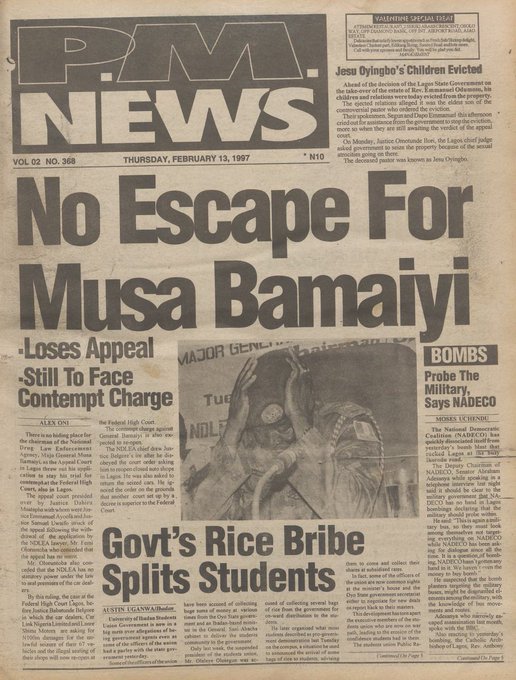
Long before WhatsApp groups, ubiquity of social media and its hashtags, the relationship between student leadership and political propaganda has always existed, evident on the front page of PM News on February 13, 1997, reposted by Archivi.ng on February 23, 2026. In that 1997 article, a major scandal rocked the UI Students’ Union government when reports emerged that union executives had allegedly collected large sums of money from the Oyo State Government and an Ibadan-based minister who served under General Sani Abacha, supposedly in exchange for delivering the support of the student body to the government. At the centre of the controversy were several bags of rice allegedly collected by the union president, Olaleye Olusegun, for distribution to students. Shortly after, he organized what many students described as a pro-government demonstration on campus and announced that students could collect rice at subsidised rates. Reports at the time also suggested that union officers became frequent visitors to the residences and offices of political officials, allegedly negotiating deals and reporting developments.
In 2019, the UCJ reported on how Adebayo Adelabu, current Minister of Power, who ran for Oyo State Gubernatorial elections at the time, promised certain hall chairpersons in UI sums of 250, 000 each on one of his political rallies. An external media house further corroborated the story, reporting that Adelabu promised ten halls of residence, 250,000 Naira each, which students could use for ‘bread and akara’. What was seen as vote buying by many considering the proximity to election day was even sadly an opportunity for student leaders to enrich their pockets. The gubernatorial candidate eventually lost and these executives’ reputation were dragged in filth.
In 2023, during the build-up to Nigeria’s general elections, the Students’ Union leadership under then-president Mascot publicly declared support for Bola Ahmed Tinubu and the All Progressives Congress without prior consultation with the student body. The announcement, reportedly made in the presence of political stakeholders including Seyi Tinubu, suggested that University of Ibadan students would mobilise support for the candidate. Students rejected the unilateral endorsement, forcing a retraction in which the president admitted error and distanced the union from the declaration, attributing the endorsement instead to a political group known as “Premier Progressives.” The backpedalling is even more insulting to the university community with an eventual ‘Personally, I’ll vote for Peter Obi’ statement. The Students’ Union, conceived as a vehicle for collective student interests, has long ago been functioning as an instrument of political alignment.
Even more recently, during the 2024/2025 blackout that affected the University College Hospitals, the Minister of Power intervened, promising restoration within 24–48 hours and failing on that promise. The intervention was widely publicised, and when power was eventually restored, it was received with relief and, in some quarters, commendation. Not long before, he facilitated the installation of solar-powered street lights within the university environment, another gesture that would seem as infrastructural support. Individually, these actions may be interpreted as governance. Collectively, however, they form a pattern that is difficult to ignore: early engagement with students during political ambition, sustained visibility during public office, and continued presence within the university space. With renewed political aspirations on the horizon, the trajectory becomes clearer.
Debacles like these make the Aweda-led Students’ Union executive council initiative, Stomach Infrastructure, even more distasteful. While presented as support for indigent students, the initiative echoed a familiar concept in Nigerian political discourse. As said in our 19-months old editorial, ‘It would seem stomach infrastructure permeates not just the wider political sphere, but the university scene too — so much for the future of Nigeria.’ These developments point to a larger truth; the University of Ibadan increasingly mirrors the political realities of the Nigerian state and campuses, alike, become a stage where national politics is rehearsed in miniature. Nearly three decades later since the 1997 report, the methods may have changed from bags of rice to political WhatsApp groups, cash donations, TV donations, etc., but the pattern remains disturbingly familiar. The more the engagement tactics, the more the dots connect – for the forward thinker. And this pattern is not even limited to one political actor or one party, it reflects a broader conundrum that describes universities as fertile grounds for farming thumbprints on ballot papers.
The danger lies not in political awareness or even the lack of it; but in the perpetual shortsightedness despite being educated and also significantly affected by the ever-continuous dilapidating economy. It further lies in the ignorance that education directly translates into intellectualism. When students move from analysing political systems to actively reinforcing them without critical distance, the role of the university begins to shift from being a site of resistance to being a site of regurgitation.
If we are to engage the proponents of this administration on what they actually stand to gain, in the face of the suffering of the common masses, there is no guarantee to hear what holds water, beyond the cheap bags of grains and near-flat envelopes of mint notes. If we are to excuse this lack of foresight for the average market trader that is uneducated and poor, whose next meal is dependent on those bags of food, what of the educated youth who has seen their tuition fees quadruple in less than three years, allowances barely worth half of its purchasing power four years ago, and years of education truncated by meaninglessly long strike actions? In the circulating screenshots, we have profiles of the erstwhile SU president, Covenant Odedele, erstwhile House Secretary, Ayomide Oluwole – the supposed big thinkers who verbally stood vehemently against the NELFUND proposition only to be seen on WhatsApp groups for mobilization of students for the same APC that introduced the student loan act. This defection, albeit spineless, shows how chaotic the political scene is. It particularly reflects the lack of ideology seen in political guns that move from one party to another, depending on which supports the agenda or their pockets at that time.


Just like in 2023 with Mascot, Covenant seems like a fixture in the Oyo State Students for Tinubu movement, confirmed by his presence on certain WhatsApp groups. It has become a pattern of SU Presidents and it’s even more shameful to the most recent who paraded himself as a paragon of intellect during his time at the union’s wheel – that the intellectual unionism we so much clamour for is dropped without conscience when political rewards are in view. We definitely aren’t so dissimilar to the generations before us, sadly.
The same goes for pedagogues in their professorial years, particularly because they have traveled far and wide in pursuing degrees and have not only seen how things work beyond shores but have also lived it. It’s saddening to see them support this government while they struggle to comfortably cater for their immediate family with their salaries. As analysed in our most recent political piece on the next Nigeria elections, it’s ironic that the son of the president is still able to garner support from different factions in the music and film industry, diaspora, academia, and even major cities/villages in the country, some of whom have relocated due to the bad governance in Nigeria, lost a relative due to insurgence, or even scaled down on cost of living for survival. But if these celebrities are far gone in their warped ideology financed by ephemeral gains, we must not be equally yoked as youths whose futures are still largely dependent on a working Nigeria. This is where the idea of intellectual unionism must be checked. Intellectual unionism is not merely about student participation in governance, it encompasses the willingness to challenge power irrespective of personal gain. It demands a level of independence that is incompatible with political patronage.
Political unionism, on the other hand, thrives on alignment. It rewards proximity to power, values loyalty over criticism, and transforms student leaders into intermediaries between political actors and the student body. In such a system, influence is negotiated, not challenged. The increasing presence of structured political groups within the university suggests a gradual shift that we shouldn’t welcome. And perhaps the most concerning aspect of this shift is its normalisation. What would once have sparked outrage now barely registers as the usual. Political WhatsApp groups are created. Students join. Strategies are discussed. Agendas are promoted.
It is important to emphasise that this phenomenon is not exclusive to any one political party. While the current case involves the ruling party and its affiliates, similar patterns can be observed across different political alignments. The issue, therefore, is not partisan; it is structural. It is about the gradual integration of student communities into the machinery of national politics. And like all machinery, it requires components such as loyal supporters, strategic organisers, and visible advocates. But history offers a sobering reminder. Those who are integrated into a system too early often lose the capacity to critique it effectively. They become invested in its continuity, even when they once opposed its principles. The University of Ibadan, as the Premier University, occupies a symbolic position in this conversation. Its history is one of intellectual resistance, ideological debate, and fearless engagement with power. To drift away from that tradition is not merely a campus issue; it is a national concern. Because if the premier university becomes a training ground for blind political allegiance, then the space for independent thought narrows significantly.
Ultimately, the question is not whether politicians will continue to engage students; they will. It is not whether political groups will continue to exist on campus; they will. The question is whether students will dare to engage politics critically, or perpetually become extensions of national political structures. If that distinction is lost, then the university risks becoming what it was never meant to be; a structure for sustaining wickedness. And when that happens, the consequences extend far beyond the campus.
Because the future of a nation is shaped not only by those who hold power, but by those who have chosen not to question the powers that be.

One Comment