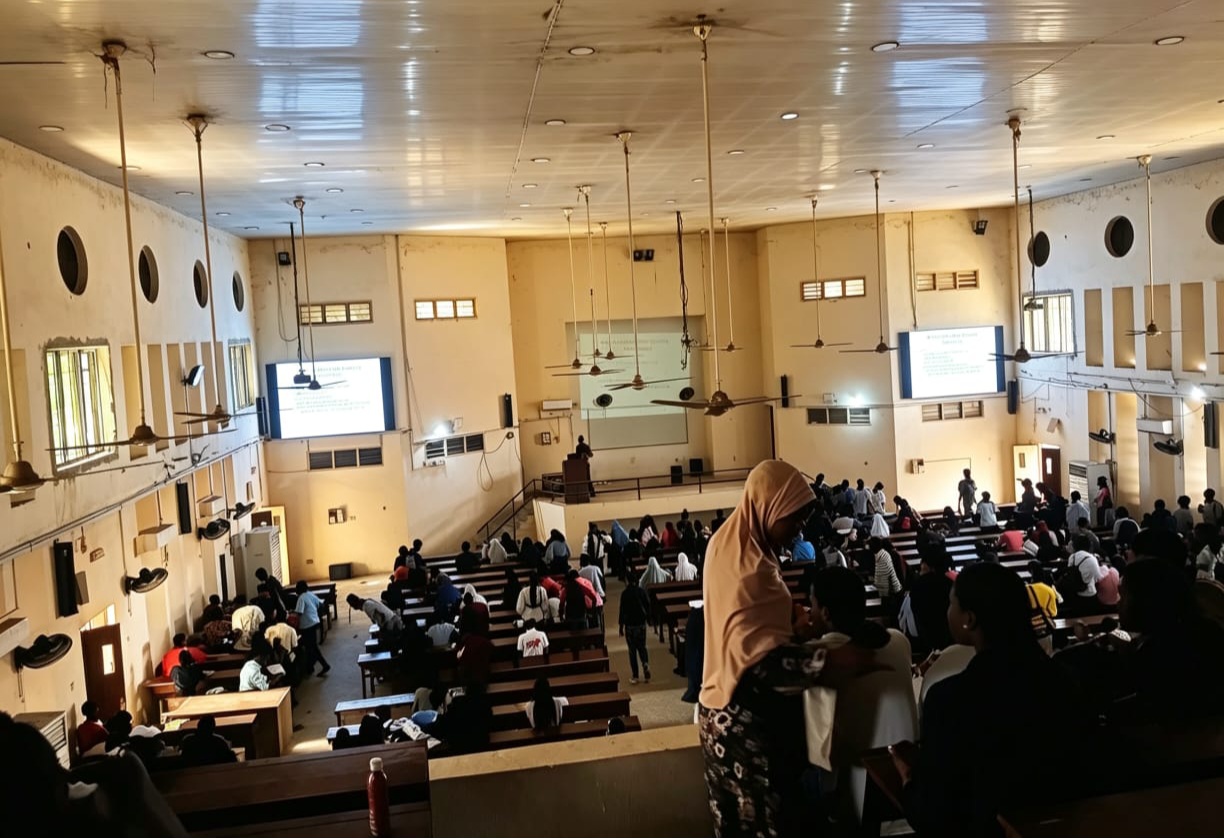
The J. Oladele Sanusi Lecture Theatre, popularly known as the CBN Lecture Theatre, of the Faculty of Science, University of Ibadan, has recently undergone upgrades aimed at improving the learning environment for students.
Complaints about the CBN Lecture Theatre have historically centred on overcrowding, potentiating heat and discomfort during general lectures taken by 100-level students in the Faculty of Science. With limited seating capacity for hundreds of students, many students are often left standing or forced to sit in uncomfortable positions during long hours of lectures, or forced to absent themselves from lectures entirely. This problem has come into the fore with an increased admission quota in the Medicine and Surgery undergraduate program in particular, which has increased the number of students taking lectures at CBN. Yet, while the issue of inadequate space still remains unresolved, the university management has taken steps towards improving the condition of existing structures.
Recent developments in the lecture theatre include opening up several sections of the enclosed building to create window spaces. This was followed shortly by the replacement of the slide projectors with modern LED display screens. This change was observed on Monday, 30th March, when classes had just resumed after a short weekend. Many students expressed their satisfaction, noting that the development has eased the stress of straining their eyes to see the lecturer’s material. “Through the LED displays, straining from the back just to see the projected screen has been reduced, or even completely eradicated,” Faruq, a 100-level student, commented.
About two weeks after the installation of the screens, exactly on Saturday, 11th April, during a weekend class with Professor O.E. Awe, the PHY101 lecturer, the Vice-Chancellor of the University, Professor Kayode Oyebode Adebowale, visited the lecture theatre. He was seen inspecting the facilities. And on Monday 13th, April 2026, electric fans were installed in various corners of the lecture theatre.
In addition, on Tuesday, 14th April 2026, craftsmen were seen constructing chairs to replace the faulty ones.

While the students expressed their appreciation to the management for these developments, many students maintain that the core issue—limited space still needs urgent attention. Kobi, a 100-level Science student, complained about the number of students exceeding the theatre’s capacity. “I think the biggest issue I still face is the students taking lectures there being more than the capacity of the lecture theatre,” she said. Faruq, while acknowledging the improvements, added that the presence of a large number of students may still cause congestion, “The wall fans have reduced the stuffiness of the lecture theatre, at least as per the first day, and students are lower in number. We do hope it really performs the function it is meant for when the lecture theatre is packed with students”.
When asked whether they would prefer the construction of an entirely new lecture theatre or further upgrades to the CBN Lecture Theatre, students gave varied responses. Some students expressed a preference for a new lecture theatre, explaining that the upgrades alone would not be sufficient to accommodate the growing student population. This is reflected in John’s response: “I think a new lecture theatre is better because a lot of students were admitted this year compared to previous years, and a lot of students end up standing.”
Others, however, believed that continued upgrades and possibly some expansion of the existing CBN Lecture Theatre would be more practical, suggesting that improvements such as better ventilation and increased seating could significantly enhance the learning environment without the need to construct an entirely new theatre. Ruth expressed this view, stating: “I feel that they don’t need to spend money to build a new one. Installing more fans—especially ceiling fans—should be alright because those side fans do not reach me, and I do not feel their presence.”
Similarly, El-Shaddai proposed that an extension could be added to the current structure, with a screen installed to display lectures for students in the additional space. Priscilla also provided an interesting perspective, noting that the condition of the environment contributes significantly to the challenges students face. She said: “The hall needs cleaning, as it is dirty, and the dirty environment affects the air. The issue with the sound system sometimes makes it difficult for those at the back to hear. If the hall were clean, people could sit on the floor at the front.”
The recent upgrades highlight some effort on the part of the institution to respond to student concerns. However, they also underline the need for more comprehensive solutions to accommodate the population of students taking lectures at the J. Oladele Sanusi Lecture Theatre.
Hawau Oladele