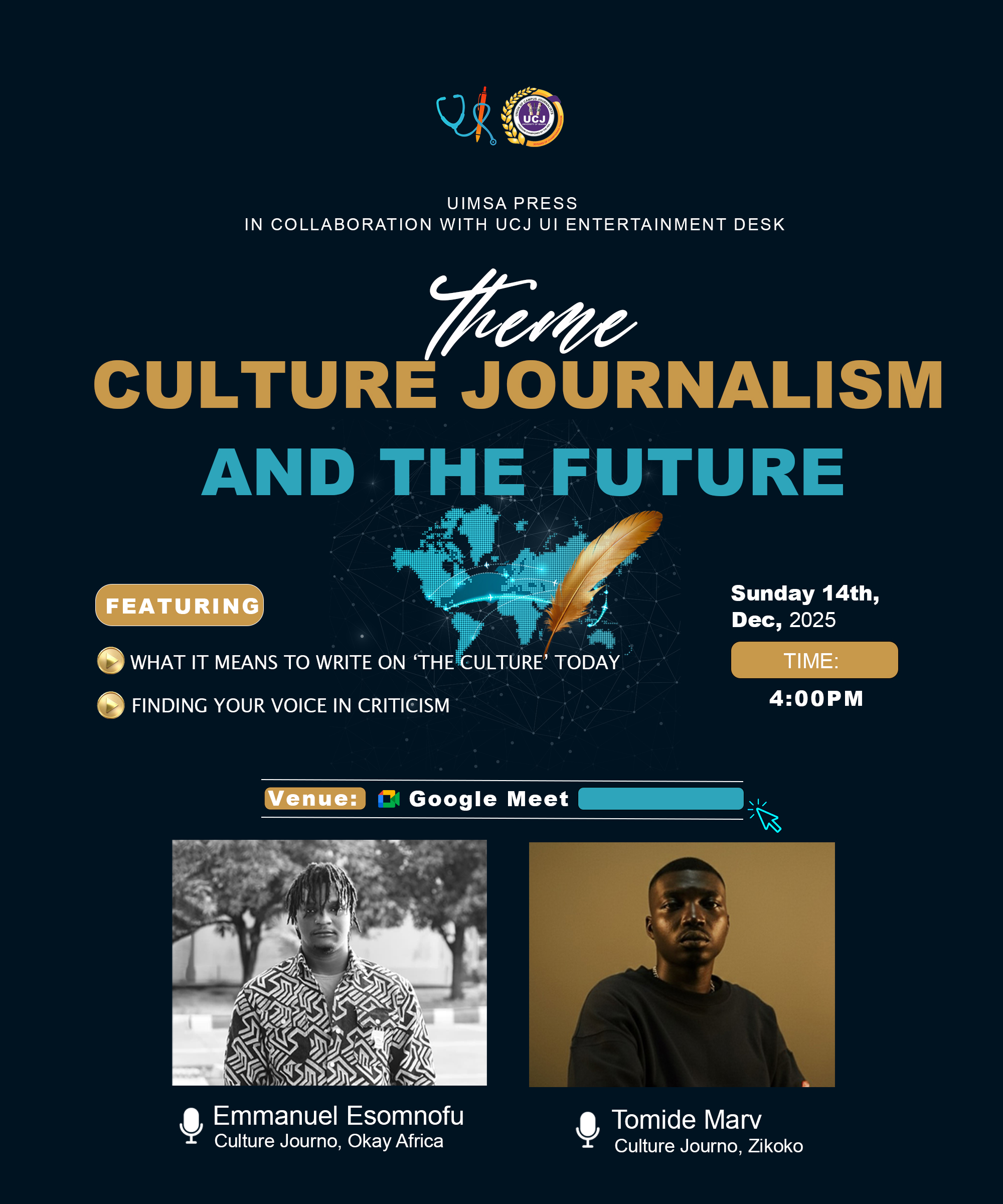
The University of Ibadan Medical Students’ Association (UIMSA) Press, in collaboration with the UCJ-UI Entertainment Desk, on Sunday, December 14, 2025, hosted a virtual webinar titled “Culture Journalism and the Future” via Google Meet, aimed at examining contemporary culture writing and equipping young journalists with insights on criticism, voice, and relevance in today’s media space.
The session, which commenced at 4:00 p.m., focused on discussions around what it means to write about culture in the present day and how emerging writers can find and refine their critical voices. The webinar was moderated by Eriomala John, former UIMSA Press Editor-in-Chief and Editor-at-Large of the UCJ-UI, who steered the conversation through its key themes.
Speaking during the webinar, Tomide Marv, a culture journalist with Zikoko, framed culture journalism as deeply personal and reflective. According to him, a writer’s position is shaped by “memory, music, gender,” adding that pop culture journalism is “more about meaning. It’s not about moments.” He further noted that cultural influence often extends beyond the arts, pointing out that “Nigerian politicians influence culture, especially with their dressing.” Tomide also highlighted the centrality of digital spaces in modern culture reporting, describing the internet as “the archive” and noting that “culture journalism today lives online first.” He stressed that culture writing goes beyond description, stating that “culture journalism interrogates,” encouraging writers to ask deeper questions about the stories they tell.
Also addressing participants, Emmanuel Esomnofu, a culture journalist with Okay Africa, drew from his experience writing for platforms such as NATIVE Magazine, Open Country Mag, NotJustOk, and international publications including The Republic and Brittle Paper. He spoke on the evolving responsibility of culture journalists to document stories with depth, cultural awareness, and contextual accuracy. He advised aspiring writers to prioritise dedication over immediate rewards, noting that “what you should look for when starting is consistency, not the monetary compensation.” On the ethics of the craft, Esomnofu emphasized that “as a culture journalist, you have an obligation to write about culture regardless of who is involved,” urging writers to approach stories with honesty and balance. He added that thorough coverage requires multiple viewpoints, stating that “to adequately cover a story, you have to look at it from different perspectives.” Touching on criticism and reviews, he described reviews as “a cornerstone of writing,” while observing that many fall short by focusing only on the work itself and ignoring the artist’s context.
In his closing remarks, Osakwe Okojie, UIMSA Press Editor-in-Chief, expressed appreciation to the speakers for taking time out of their schedules to engage with the participants. He noted that the discussions were particularly relevant to campus journalism, citing the Press’s “Spotlighting Creatives” series as an area where the insights shared could be directly applied. According to him, the session was instructive for student journalists and offered valuable lessons on how art and artists within the campus community are documented and highlighted.