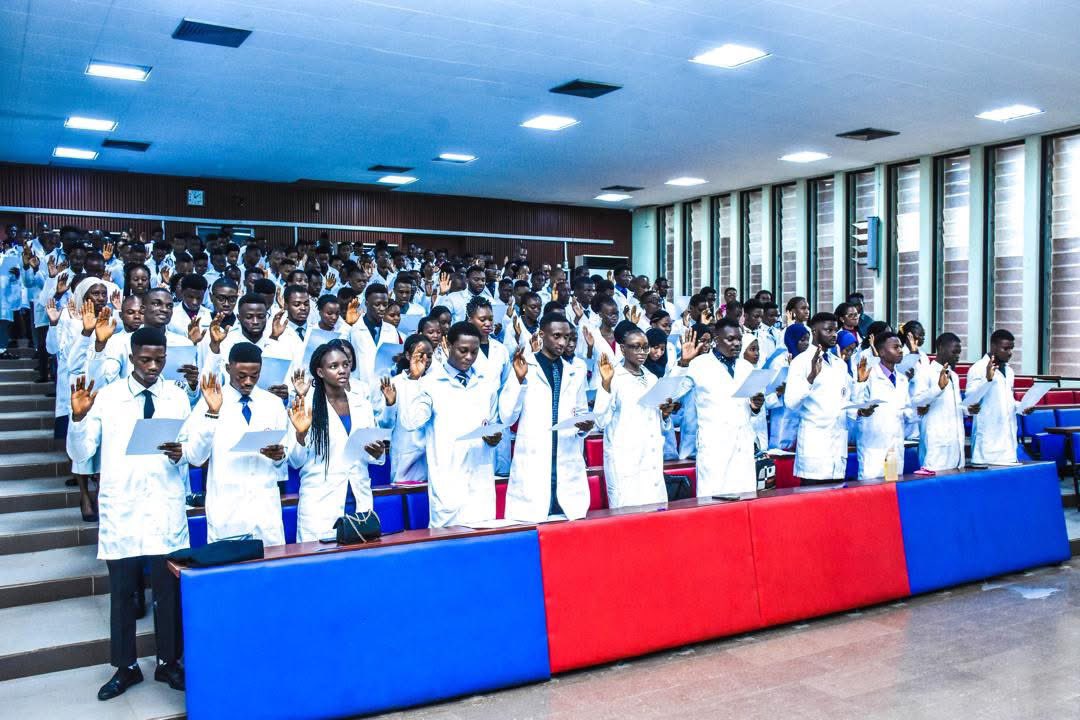
There’s often an invisible tension between inclusivity and hierarchy within UIMSA. Even when unintentional, upholding the hierarchy can unintentionally exclude junior students from certain activities. The 100‑level students are frequently reminded that they “aren’t fully medical students yet”—a fact that, while true, can motivate behaviour that contradicts the inclusivity UIMSA aims to achieve. Year after year, preliminary‑year students feel marginalised, and some seniors inadvertently treat 100‑level members as less than full members of UIMSA. This mindset—“that’s how it’s always been; you’ll soon leave 100‑level”—is outdated and harmful, yet it persists.
This issue goes beyond the preliminary year. Students in the pre-clinical classes are still subject to some of this behaviour. There are several flyers with the caption: “This is only open to clinical students.” As an ambitious pre-clinical student of UIMSA, there is a very high chance that you have come across statements like this or slight variations of it when considering applications to certain organisations. While this criterion is logical in the case of some organisations whose activities are specific to only clinical students, in others, it appears like an institutionalised subculture that strips pre-clinical students of valuable opportunities and learning experience.
Sometimes, this is purely because of the structure of these organisations. For example, public speakers in pre-clinical school do not join the Faculty of Clinical Sciences Literary and Debating (L&D) unit till they cross over to clinical school. They have to join the Faculty of Basic Medical Sciences L&D first or simply wait till they get to UCH. The reason for this is that the Alexander Brown Hall (ABH) L&D acts as a mother body to the L&Ds of the Faculties of Clinical Sciences and Dentistry. Also, the meetings are held at ABH, do not have fixed schedules and last till midnight on numerous occasions. This means that any pre-clinical student who wants to participate in these meetings must be willing to show up at ABH without prior knowledge. Therefore, it makes sense that membership is restricted to only clinical students.
For other organisations, it is not quite clear why pre-clinical students are not involved. A great example of this is the Royal Quiz Club (RQC). Quizzes are one of the most important opportunities for medical students to express their highly cerebral nature and compete outside their classes. While most medical schools draw their students from all classes, except 100-level in many cases, the RQC is limited to only clinical students despite the fact that the quizzes involve the Basic Medical Sciences and General Science, where preclinical students are likely to excel due to the recency of their knowledge in those subject areas.
The usual reason given for the exemption of pre-clinical students is that the club conducts consistent drills at UCH/ABH, which limits the participation of pre-clinical students. However, a pre-clinical arm can be created so they can conduct their drills at the UI main campus, and perhaps go to UCH/ABH occasionally to participate. In fact, an unofficial pre-clinical arm was created when the Nigerian Medical Students’ Association (NiMSA) started conducting pre-clinical quizzes. This competition led to the hurried formation of a preclinical arm for the RQC. However, it has remained moribund since its creation. It does not seem like an issue for the RQC because she has a well-documented history of stellar performance in various inter-MSA quiz competitions across the country. One can imagine that those performances will become even better if preclinical students are integrated into the system. A system that nurtures students right from their early years is bound to create giants.
Another highly impactful organisation in UIMSA from which preclinical students are unfortunately disenfranchised is the College Research and Innovation Hub (CRIH). As interest in scientific research continues to grow among medical students, CRIH plays a vital role in addressing the knowledge gap by offering strategic training, skill development, and partnerships that nurture research competence. While it is often argued that a solid understanding of clinical medicine is necessary for meaningful research, current trends suggest otherwise. Across various medical schools—including UIMSA—several preclinical students are already contributing to high-quality research and publishing impressive papers. Clearly, the potential exists. Opening CRIH’s doors to preclinical students would therefore be highly beneficial. Early exposure to structured research initiatives would not only accelerate their growth in the field but also promote a stronger culture of inquiry from the foundational years of medical training. A major reason for their exclusion appears to be the lack of proximity to UCH. While there have been rumours of a proposed preclinical arm of CRIH, no tangible progress has been seen so far.
While the aforementioned examples seem understandable, a more blatant example of elitism played out in June this year during preparation and registration for the second edition of the SURGIL (Surgical Interest Group, Lagos) Conference. This case was more direct and brazen. UIMSA was given fifty slots for the event, and while preparing for the conference, the SURGIL representative from UIMSA asked interested students to pay for transportation and put down their names since it was going to be on a first-come, first-served basis. Based on the timing of the notification, an overwhelming majority of the students who paid and registered were preclinical students. This caused disagreement from clinical students who voiced their dissent on the grounds that the timing wasn’t favourable to them. In a bid to satisfy the clinical students, the event’s coordinator simply reduced the preclinical slot by 16 and refunded some of the preclinical students who had already paid to create space for clinical students. Meanwhile, it took days to get clinical students to pay, and the 16 newly created slots were not eventually filled. The organisation was not perfect, but the way it was handled was simply elitist.
We witnessed the transformation of the UIMSA football team under Obeya as the head coach, and one of the principles he upheld was the inclusion of pre-clinical students in the team. Many of the current players got into the team while he was the coach. In fact, the starting goalkeeper, Adeoluwa, was a pre-clinical student at the time. Since his tenure, the team has emerged champions of UI twice consecutively, amongst other accolades. Truthfully, the geographical distance between UI and UCH and the lack of requisite experience may make it appear more logical to expressly prevent preclinical students from participating in certain organisations. Regardless, there is a need to consider the benefits of integrating pre-clinical students into helpful clubs and organisations early. The students would gain immense experience and exposure if allowed to participate, and consequently, these clubs will benefit from them later on. Student organisations are encouraged to employ structures that allow pre-clinical students to participate. Lastly, pre-clinical and preliminary students are just as UIMSAite as clinical students. Segregation must be condemned!
Editor’s Note: Readers should note that the opinions of this writer are not equal to the position of the UIMSA Press.
Yusuf Akinyooye