In 2017, a 500L Building Technology student at Covenant University, Segun Michaels, drowned. He would be resuscitated by his friends and driven to the university’s medical centre where an alleged nonavailability of tools like a defibrillator and supplemental oxygen, and the slow response of the medical services would gravely reduce his chances. He would eventually pass away. It would be the first major publicised case of this specific nature.
In June 2025, Mordi Nwense Daniel, a 200L engineering student, was struck by lightning while playing football. According to eyewitnesses, emergency medical attention was delayed and inadequate, with the university allegedly resorting to prayers instead of medical care. He would eventually lose his life.
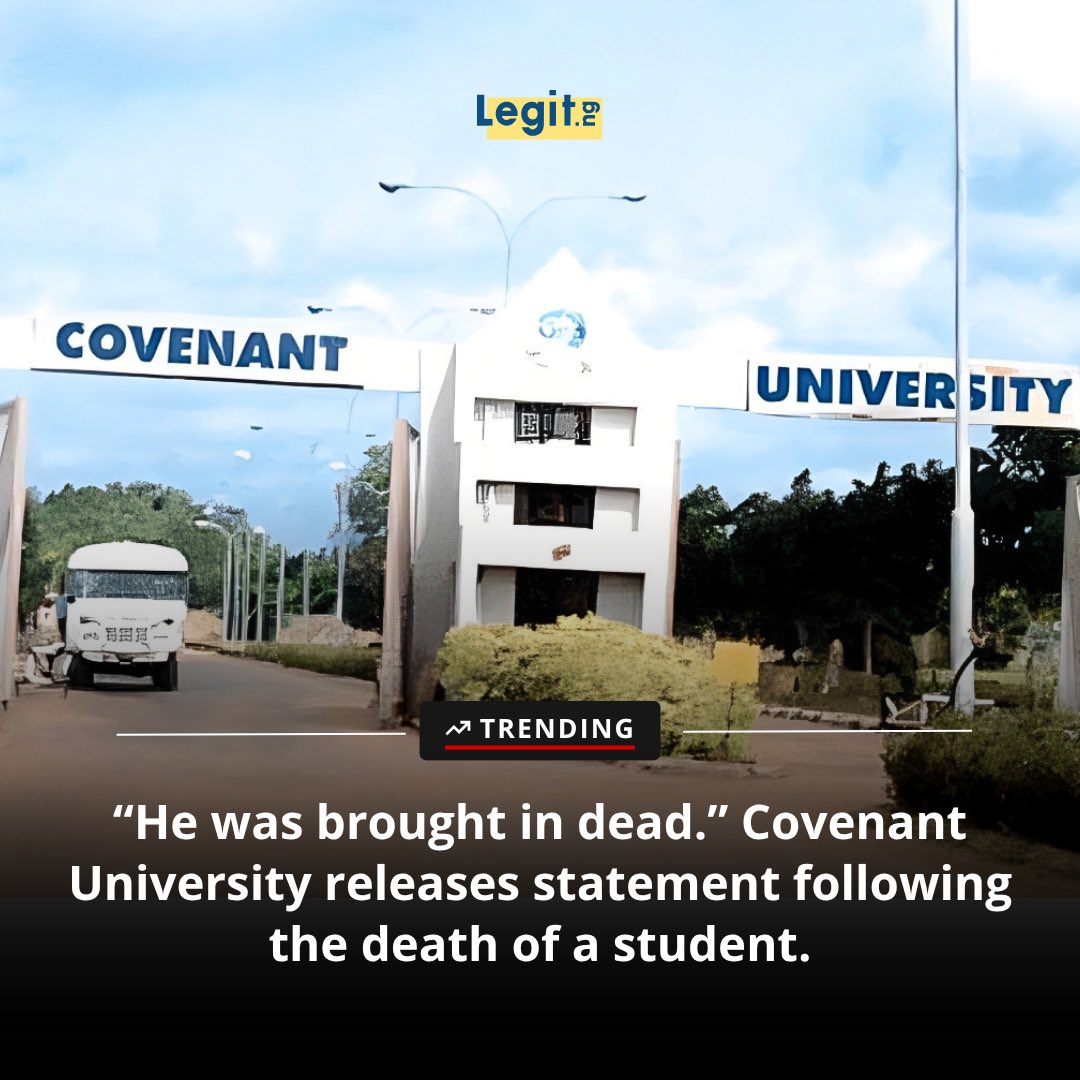
In April 2026, Toluwalase Jesutunmise, another 500L Building Technology student, stepped out to rest after exhausting himself during a Chancellor’s Cup football match. According to the official report by Covenant University, he was swiftly taken to the emergency unit of the medical centre, where cardiopulmonary resuscitation (CPR) was administered with the aid of an Automated External Defibrillator (AED), however he was reported dead on arrival due to an undisclosed heart condition. This statement was in sharp contrast to reports by students claiming he was brought in alive and that supplementary oxygen wasn’t administered and he eventually stopped breathing. In the statement released by the deceased family, there are “…material inconsistencies between the University’s narrative and the sequence of events as understood by the family.”
Three students, three different scenarios, one frighteningly consistent pattern leading to the same tragic outcome. A student is in dire need of medical attention, medical attention is insufficient and late, and the authorities are either completely silent or strategic with statements that don’t sit well with the general public.
The issue with the statement is the conspicuous silence on pressing questions, revealing the statement’s primary purpose as protective rather than transparent and accountable. What happened before he got to the clinic? What first aid interventions were performed at the pitch given that it was a university-organized football match? Was there a defibrillator by the pitch, in case of emergencies? The two earlier cases didn’t even get public statements, thus, the attempt to absolve themselves completely of any blame simply because they say they performed CPR at the clinic is disingenuous, at best.
Also, the lack of public communication in the first two cases highlights a damning pattern devoid of accountability. While these deaths were largely discussed on social media, because they were classified as “accidents,” there were no probes by the police or audits by the National Universities Commission (NUC). The cases were internally handled and ended discreetly. Even though the court of public opinion assigned blame, without formal investigation, that blame carried no institutional weight, thus failing to mobilize change — feeding into the pattern. As philosopher George Santayana warned, “Those who cannot remember the past are condemned to repeat it.”
Beyond these chronicles of Covenant, there is a larger map that exists. In 2018, Austin Okafor, a 300L Entrepreneurship student of the Department of Management Sciences at the University of Benin, died due to delayed and inadequate medical attention. According to reports, the ambulance was delayed for over 30 minutes, requiring official clearance from the Division of Student Affairs before he could be moved. The National Association of Nigerian Students (NANS) demanded an investigation, yet, no such reports made it to public light.
In 2021, Aishat Adesina, a final-year OAU foreign languages student and ulcer patient died after alleged negligence of the health officials sparking campus-wide protests. Following these protests, consistent with the pattern, they shouldered no responsibilities in all correspondence and resorted to the classic damage control strategy— indefinitely closing down the school.
Here in UI, a protest broke out in 2015 after Mayowa Alaran, a 200L student of Human Kinetics, died. According to a news article by UCJUI, he suffocated and fainted as a result of overcrowding during a football match. According to another article by the Daily Post, students around called the University Health Centre to send an ambulance over, but they refused, saying the only one they own was indisposed, thus medical students in the hostel tried their best to resuscitate in the absence of the ambulance fruitlessly. Eventually, they carried him to the hospital only to allegedly be delayed by 30 minutes because the sick student could neither produce his card nor matric number. He gave up the ghost, thereby sparking a student-led protest.
After the incident, the then UI Vice Chancellor, Prof. Isaac Adewole, gave a briefing. Once again, the culture of brand protection could be seen. He said he was sitting in the front row facing a fan, meaning it couldn’t have been suffocation. But he admits the students made a call to the UHC for an ambulance and, according to him, after they waited for about 8-10 minutes, they took matters into their own hands, and boarded a private vehicle. Eventually, the ambulance met them in the course of their journey to the clinic. To put this into perspective, the drive from Jaja Clinic to Independence Hall, according to Google Maps, takes merely 2 minutes. To worsen matters, he said there was only one ambulance on duty that night and two patients, one with a ruptured appendix — a serious medical emergency, and another with femoral fracture who were in the ambulance at the time were disembarked. ‘Disembarked’.
After getting to the clinic, the VC said he was promptly attended to, even though he was dead on arrival, and only after the certification of death were they asked to go back to his room to gather information in a bid to diffuse the growing crowd — an entirely different tale from the students’ account. This case is not without the characteristic UI element. The SU President corroborated the Vice Chancellor’s story rather than the students who were eyewitnesses, leading the students to complain of a pattern of betrayal when it comes to the SU responding to the plight of students – one of the accounts of which we can draw a line from the cowardice of union officers to the rotting of unionism itself.
If it were just these public universities, one would say the problem is money. But it is definitely not. The sessional school fees at Covenant University typically range between 1.5 to 2 million naira. With over 8,000 students, money isn’t a scarce resource. If money was the variable, CU would or should be immune to it, yet they aren’t, bringing to light the silent culprit — clinical governance. Clinical governance is the system of protocols, training, accountability structures and standards that determine how a health facility responds to emergencies. You can have equipment, yet no one knows how to use it, or worse still, not have them at all. The facility might exist yet administrative bottlenecks steal away the critical window that should be used for stabilization. Referrals may be conducted late or in ambulances not designed to stabilise patients.
There is a nationwide systemic failure of clinical governance, and this is not limited to medical facilities in universities. In the proposed 2026 budget, a meagre 4.2% (2.48 trillion naira) was allocated to health. To put this into perspective, at the 2001 Abuja Declaration, African Union (AU) members made a commitment to allocate at least 15% of their annual budget to their health sector. This abysmal deviation, or more specifically cut down, from the set standard demonstrates the slapdash manner in which health is governed nationwide. Naturally, this slips into slices everyone must occasionally bite from.
Accountability is the maintainer of pristine clinical governance, when the arbiters, therefore, fall short of even their own standards of allocation to health, who then shall we turn to for enforcement of accountability? So naturally, when the third estate demands explanations, improvement, accountability, this is the response.
Makuochukwu Eze and Joy Ezeugwu, health assistant trainees at Ezzy College of Nursing in Enugu, were suspended indefinitely in April 2026, for being whistleblowers. Their damning crime was calling for the improvement of the facility as it had poor electricity, and other essential welfare services. They highlighted the cascading effect it could potentially have on patient outcome, and the response was not just silence on the fundamental issue, but silencing the critics.
Sadly, this is not a one-off occurrence. After Jesutunmise’s death, Covenant University allegedly turned off the school WiFi in a bid to control the sort of news that got to circulate, given that students are already prohibited from purchasing personal data and browsing outside the school’s Internet Service Provider (ISP). As highlighted earlier, after the protests in OAU in 2021, OAU shut down indefinitely, with the goal of having their energy diffused before bringing them back on campus, effectively silencing the critics.
In the University of Ibadan, silencing is second nature. It looks like the UI3’s suspension for a peaceful protest, Adekunle Adebajo’s suspension for writing an article on the dilapidating nature of UI public hostels and Ojo Aderemi’s suspension for leading a peaceful protest.
What does silencing actually do, especially in a case that involves lives like these? It doesn’t make the problem disappear, but makes the next death more likely. Because, if you can’t talk about what went wrong, in a system where external accountability is almost nonexistent, nothing gets fixed.
UI has not had a publicised emergency death in some years, but the conditions necessary are present — health centre delays, a culture of silencing dissent and a national system of clinical governance so weak that not even private universities are insulated from it. If clinical governance isn’t prioritised, a crisis very well might just be in the corner, waiting for the right time to happen.
When lives are at stake, you don’t just leave things to chance. At the institutional level, every university must have a well-written publicly available emergency response protocol guiding actions during such cases. Emergency situations must also be critically considered when organizing events. They should be properly equipped and not just be manned with the regular first aid box. University clinic staff must be equipped with the necessary tools and also trained on how to utilise them, and administrative bottlenecks should be catered for after the situation has been assuaged, not before.
The 11-year old UCJ’UI article on Mayowa Alaran’s death, pointed out the culpability of the limited access points to tight spots, yet, in 2026, not much has changed. In the briefing given by the then UI VC after Mayowa Alaran’s death, he said the university was working with the German government to set up a power generating plant. This project was first heard of in 2013 and the goal was for UI to be trained on solar power and to start generating their electricity independently. In May 2016, the German Ambassador to Nigeria, Michael Zenner, said that the project would commence in July of the same year. As though prophesying, an article, by The Guardian reads, “More importantly, students’ unrest over power outage and unavailability will be a thing of the past; consequently, there will be peace on campus.” It’s been 10 years, and we’re still riddled with epileptic power supply, even in our teaching hospitals. In May 2025, the Federal government, in a news article by Indy Press, was set to facilitate a 24-hour electricity scheme across University of Ibadan and other federal and state tertiary institutions in Nigeria. It’s yet to be seen how well that news will age.
Every case documented in this piece was internally handled. None produced accountability, and the pattern continued. At the regulatory level, deaths on campus must trigger mandatory independent investigation, not merely internal handling. When it comes to campus clinics, there is a regulatory vacuum. The Ministry of Education via the NUC cannot effectively cater for their clinical nature. While they might care about the number of beds and doctors, they cannot effectively cater for all the variables that go into clinical governance. As for the Ministry of Health, since university clinics are treated as internal units of autonomous universities, they cannot effectively regulate it as well. For instance, shutting down a university clinic as they would a hospital will require closing the entire school as they cannot operate without a clinic. This leads to a system where even though the clinics aren’t properly furnished to manage emergencies, proper regulation also fails to exist.
These issues can’t be fixed without a restructuring from the head. Nigeria must meet the Abuja Declaration commitment of 15% health budget allocation, as that is the bare minimum for working towards a functional national health system. Without this, proper systems and allocations cannot be made. The impact, thus, is status quo. Even if the health budget allocation is met, it will not be surprising to find bureaucratic straws siphoning the funds.
Importantly, whistleblowers must be protected, not dispirited. Especially in a nation that operates democracy, feedback from the third estate is fundamental to building effective systems. Silencing students in cases of emergencies shouldn’t be the foremost concern, but fixing the root cause of the problems faced. After the uproar sparked by Jesutunmise’s death, despite claiming they were not culpable in his death, Covenant University restocked their oxygen supplies, according to students on X. Without a functional system put in place to maintain clinical readiness even in the face of calm, we just might be having this conversation again in a few years to come – with of course more tragic incidents in even more universities across the country.