At the University of Ibadan, a rather curious pattern has emerged on the chess scene. In the last few years, it is now becoming increasingly common to find medical students dominating the 64 squares. From the numerous chess tournament circuit wins to representing the university on the national stage at the Nigeria University Games 2025 (NUGA ‘25), students from the MBBS and BDS programmes have largely formed the backbone of both the men’s and women’s university chess teams.
Of course, this didn’t just happen overnight. It’s the product of an enduring culture, one that stretches far beyond any formal competition, one deeply rooted in the nightly games and informal rivalries that constitute the thriving chess community within the medical student population. It’s been a long time coming, and medical students — and by extension the entire university community — are reaping the rewards of a legacy built over decades by generations of UIMSA chess enthusiasts, who left their marks on both the campus and national scenes.
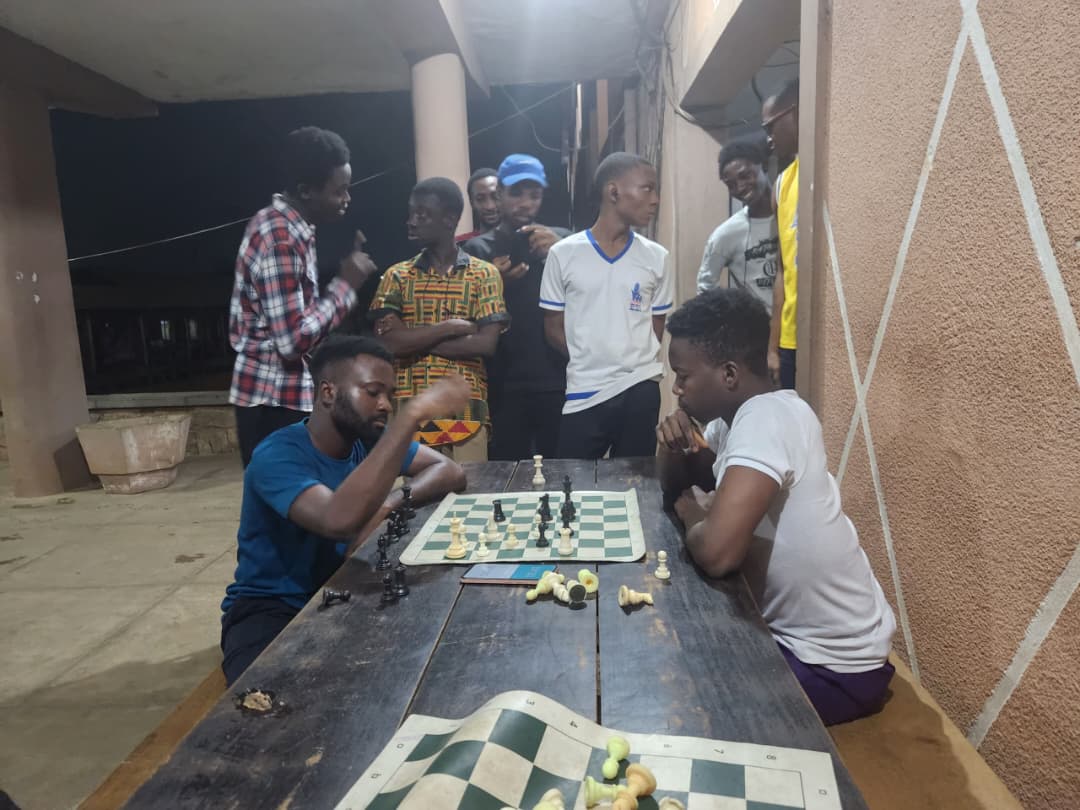
Today’s chess stars aren’t walking this path alone, they stand on the shoulders of these greats, continuing a proud tradition whilst writing their own history. Quite obviously, much of this culture has its staple in the Alexander Brown Hall, the official residential spaces of the best and brightest in the College of Medicine, University of Ibadan. On many evenings, chess boards appear almost instinctively at the quadrangle, drawing small crowds of players and spectators alike. What begins as casual games often stretches late into the night with students analysing positions and the merits of gambits, whilst challenging each other to have yet “another go.” Over time though, these nightly encounters have evolved into something a lot bigger than just the mere recreation it may seem as, at first glance, bigger than just a way to pass the hours, and certainly more than just a fleeting distraction from the daily routines of medical school. They have become the gruelling training camp of where newbloods in the world of chess make their entry into the UI chess circuit, and where stronger players attempt to better their craft through constant gruelling competition.
And it isn’t just students either. Many a time, a house officer has been spotted in the ABH quadrangle, locked in a fierce endgame, with a bead of sweat charting its swirling course across their temple, threatening to betray the iron focus in their brow, and even among them you may find the odd registrar that drops in to see whether they’ve still got it. Apart from these nightly encounters, the culture is reinforced by yearly chess vigils: the highly anticipated “UCH Chess Vigil” organized by the UI Chess Team in collaboration with the UCH Chess Jungle, and held in ABH, alongside other independent events like the cage matches, the Christopher Osunbote Games, and more recently the ABH Chess League, which we shall get into soon — each of them contributing to a system well placed to identify talent early, and to thrust them into consistent, exacting practice, ensuring the College of Medicine continues to churn out these highly competitive players.

It is from this crucible that today’s champions emerge. In the University of Ibadan’s NUGA ’25 chess contingent, medical students overwhelmingly filled the ranks. On the women’s team of six, two were MBBS students and one was from BDS, with the BDS representative — Blessing Ojo, being long regarded as the strongest female player on campus. One of the other female representatives, Favour Osuntoki, having only made her debut at the edition, finished with a silver medal. On the men’s team, just like it was in the NUGA ’24, three of the six players were from MBBS, led by the UI Chess Captain Abraham Oguntona, alongside his Vice-Captain Akporherhe Blessing, popularly known as Mattace on the circuit and a gold medalist in NUGA ‘25, and Simeon Okojie, the highest-rated player in UI and the UCH Chess Captain, who is a NUGA and FASU medalist. Although the overwhelming majority of these players are in their final or penultimate years of study, on paper nonetheless, this perceived dominance is showing no signs of slowing here just yet, and there remains a likelihood that up to another three medical students — two males and one female — given their recent performances, may yet join the team in time for the NUGA later this year, as the team aims to build on its team silver finish in ’25.
The ABH Chess League
Presently, this culture of constant competition has recently taken on a more organized form through the novel ABH Chess League, an initiative spearheaded by the hall’s chess coordinator, Michael Paul. According to him, the idea was borne out from the rivalries that had already begun to define chess life in the hall. “There was always banter about who was stronger,” he explains. “Even among beginners, people wanted a proper way to prove themselves.” And so what began as informal challenges and as many so-called ‘cage matches’ between players gradually evolved into the structured league system that is obtainable now, designed to accommodate everyone — from absolute newcomers up to seasoned competitors.

The league is divided into three tiers, each tier reflecting a stage of a player’s development. Now a new player in chess is called a fish, and the league tiers are modelled after this theme. At the top of the pyramid sits the Stockfish League, which is named after the world’s strongest chess engine and is reserved for only the hall’s most formidable players. Right below it is the Shark League, which he says is arguably the most competitive division, as it comprises the majority of the regular chess players in the hall, the majority of whom were at the forefront of the push for a structured league. The entry point is the Piranha League, a knockout competition designed for beginners taking their first plunge into the waters of competitive chess.
While the top two divisions are run in the traditional ‘home-and-away’ league format, with a player facing each of their opponents twice, once with the white pieces and once with black — the Piranha division uses a double-legged knockout system, a novel way to make certain the new players remain engaged and motivated enough to continue participating. The matches in the two higher divisions — the Stockfish and the Shark — are played in the blitz format, with a time control of 5 minutes with 3-second increments, in a fast-paced variant of the classical, while the Piranha operates the slightly slower rapid format, with a time control of 10 minutes with 5 second increments to allow the players a bit more breathing room and time to think through their moves.

The system also incorporates promotion and relegation between divisions, ensuring that players who perform well can rise through the ranks while stronger competitors continue to face worthy opposition. In this current edition, only the winners of the lower divisions will earn the right to compete at the bigger leagues and those rooted to the foot of the table will be condemned to relegation.
Participation has already exceeded expectations. More than thirty players registered across the three divisions in the league’s inaugural edition, a remarkable increase from the handful of active chess players only a few years ago. According to Paul, much of that growth stems from just leaving chess boards permanently in the quadrangle. People are naturally inclined to indulge in what they see, perhaps even more so true for medical students who might not otherwise seek out a game, what with the rigours of medical school and clinical postings, and so many a flame has been rekindled on that same quadrangle floor. Curiosity plays a huge part, and passers-by would stop to watch, often enthralled, and by and by even a small crowd might gather, someone might sit down to try their hand, and so gradually the game gained more and more traction till it had successfully infected a huge chunk of the community. According to Paul, the renewed enthusiasm has even inspired creative projects: “There’s now even a chess book written by one of us, Jiga, titled WWJD – What Would Jiga Do?”
Back to the competition itself, the organisers were also deliberate in trying to make sure that the tournament had meaningful incentives for its participants. Cash prizes are to be awarded to the top three finishers in each division, alongside medals, plaques for the winners of each league, and certificates will be presented to all participants. The prize pool for the Stockfish League stands at ₦42,000, with ₦32,000 for the Shark League and ₦26,500 for the Piranha League, the latter which also includes a ₦5,000 award for the best female competitor in the division to encourage greater participation among women.
Like many chess tournaments organised within the community, the league has been funded largely through independent efforts. Participants in the Stockfish and Shark divisions — 9 in the former and 14 in the latter — each paid a ₦1,000 registration fee, while the 16 Piranha League players registered for ₦500, generating a total of ₦31,000 towards the organisation of the tournament. Additional support has come from members of the wider chess community and former residents of the Alexander Brown Hall. Among those who have contributed are former ABH chairperson, now Dr. Ayotunde Oni, who pledged ₦5,000 towards the Piranha League prizes; Medical Laboratory Scientist Philip Arogundade who donated ₦10,000; former ABH chairperson aspirant Moshood Salam who promised to cover the cost of the plaque for the Piranha League winner and Mr. Ayobami Adekojo, owner of Hamines Supermarket and Restaurant UCH, who pledged ₦50,000 in financial support for the tournament. However, these funds are not yet sufficient to fully cover the tournament, and organisers are still actively sourcing additional sponsorship to meet all its associated costs and further enhance the competition.

As the league progresses toward its conclusion, attention has naturally turned to the players most likely to claim the titles in each division. In the Stockfish League, the favourite remains Akporherhe Blessing whose recent successes at the NUGA have reinforced his reputation as one of the strongest players on campus. However, one potential dark horse is Victor, who has already produced a surprise victory over the favourite in what many described as a controversial but memorable encounter.
The Shark League has proven far more unpredictable. Maxwell and Aluko currently appear among the strongest contenders for the title, though challengers such as Ifeoluwa and Ibrahim have begun mounting strong late pushes after inconsistent starts to the competition. Meanwhile, the Piranha League has had its fair share of upsets as well and has produced some of the biggest surprises of the tournament. Several expected favourites were eliminated early, leaving an unexpected final pairing and demonstrating how quickly newcomers can grow within the ABH chess environment.
Reflecting on the league’s success, Michael Paul says, “Looking back, I’m just proud of how far we’ve come from 3–4 players to over 30+ good chess players. People even started calling me to ask for more boards at the quadrangle.” He credits the community’s effort, from the WhatsApp ‘backrank’ group to alumni sponsors, for sustaining the culture: “I just want to acknowledge what we have reached here in the ABH community. Looking back when I came into the whole scene, I wouldn’t have expected us to achieve this much but I would like to appreciate everyone who has played a part. It’s the little steps that amount to something big—ABH Chess even got verified on Instagram”.
Paul also talks about his thoughts on the growth and culture he met, “When I started, the chess scene was almost dying. Now ABH is the home of good chess in UI. I really like to see people grow at chess and I really like idea of chess tournaments and healthy competition because I believe that’s one of the best ways people can get better at chess.” He acknowledges the legacy left by predecessors, from those who procured the chess boards and the tables at the quadrangle to the founders of the Chess Jungle. He also appreciates external supporters like Coach Madueke Emeka and Coach Bode, who provide equipment and arbitration for major events, and even link them up with former UCH and ABH chess alumni for sponsorships.
And it seems this wave of chess is about to sink its roots even deeper. The UIMSA Chess and Scrabble League, set to be launched by UIMSA, will provide another avenue for UIMSAites to display their acumen and compete across all classes. The tournament is still in its planning stages, with official announcements and more details expected soon but it promises to further strengthen the thriving gaming culture.
With such a vast lineup of chess events like this, it is no wonder that UIMSAites, have largely remained at the forefront of the chess scene at the University of Ibadan, and it stands perfectly primed to ensure that this dominance continues like so for the foreseeable future. Paul sees a link between the nature of medical training and chess excellence: “The competitiveness of meeting the cutoff for UI Medicine means we admit not only the brightest but the most determined minds, who can beat anything they set their minds to”.
The result is a thriving, self-sustaining chess ecosystem. Down from the early “cage matches” to the official ABH Chess League now and added to events like the chess vigils and the COG games, which are always hosted in ABH, students are continually challenged, inspired, and drawn into the game. Every matchup, from Jiga vs. Abimbola to Micky vs. Macus, has added layers to a culture that now spans decades, producing champions and keeping the hall — and by extension UIMSA — as the flagbearers of the University of Ibadan’s chess scene.
As the UIMSA Chess and Scrabble League prepares to welcome students from all classes, the stage has already been set for the next generation of champions. With structured competitions, mentorship, and a vibrant culture, the College of Medicine looks perfectly poised to remain a powerhouse not just academically, but also on the 64 squares and now, even on the Scrabble board.