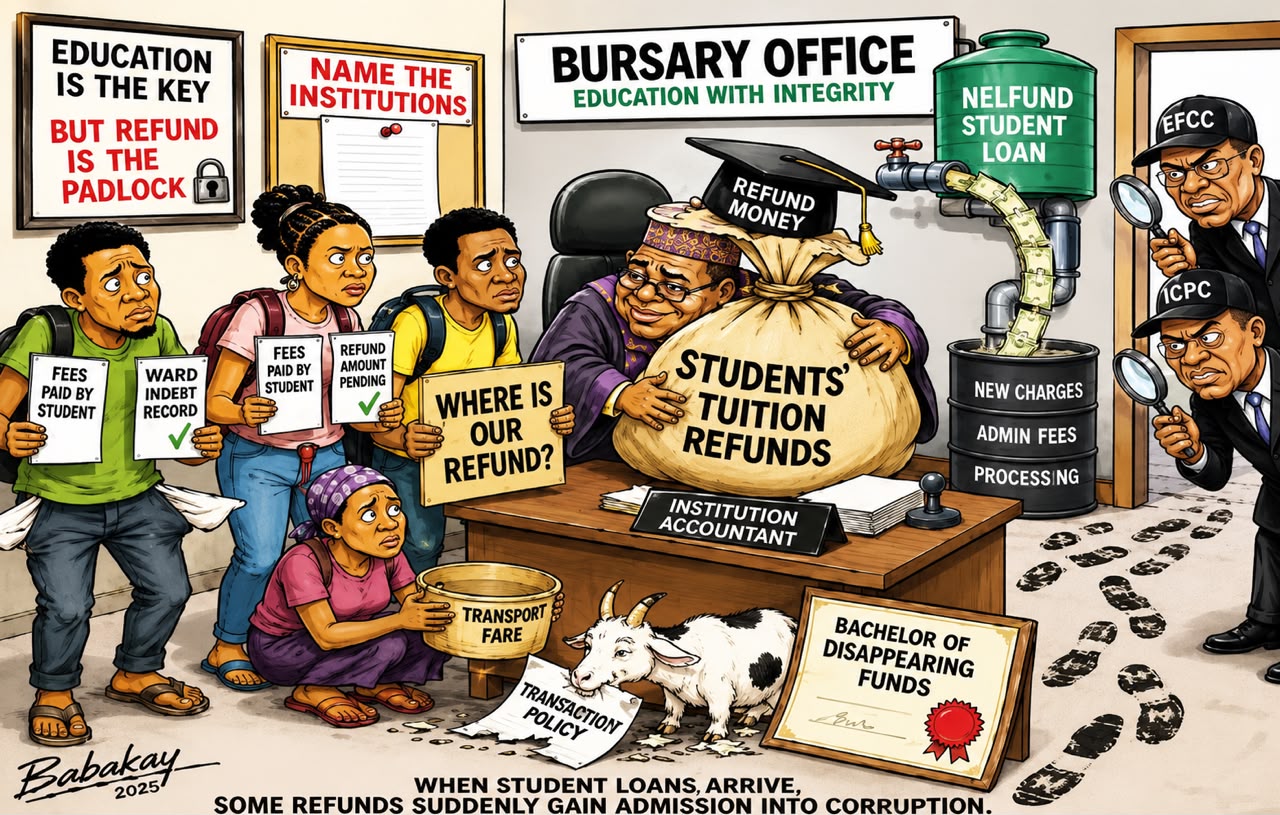
On the 3rd of June, 2025, the UIMSA Press published an editorial titled “NELFUND is Anti-Student. It must be discarded.” In that piece, we argued that a loan scheme is not education funding and that saddling a generation with debt in a country where the formal sector accounts for barely 7.3 percent of employment opportunities is simply just an act of institutional recklessness and a general lack of care for education completely. Furthermore, the existence of the scheme and the events that followed were a product of the federal government’s abdication of their own constitutional duty to fund education.
Fourteen months later, we are writing about the same scheme again, except that the argument no longer needs to be made by us. It has been made by the students the fund exists to serve, who spent June and July of this year being owed money they had been promised and who then, on being paid, thanked the president for it. That sequence of praise for what should be their basic rights is what this editorial is about. But that’s not all that happened. Because running alongside the NELFUND monthly upkeep fund of 20,000 naira that was delayed for two months, there was another issue whose cost affected students far more financially: the refunds. Two distinct sets of victims, one scheme. Once again, showing just how anti-student this NELFUND is.
NELFUND was established under the Student Loans (Access to Higher Education) Act, 2024, which repealed and re-enacted the hurried 2023 law President Bola Ahmed Tinubu signed within days of assuming office. It does two things, and the distinction matters for everything that follows: it remits institutional charges directly to the institution, and it pays 20,000 naira monthly into the student’s own account. It charges no interest, and repayment begins two years after the student’s NYSC service year at ten percent of their income. This money is deducted at the source, and because the 2024 amendment removed vicarious liability, the graduate alone carries whatever the ledger says he owes.
As of the 3rd of July 2026, the Fund had disbursed ₦303.91 billion, with ₦190.06 billion going to institutions and ₦113.85 billion as upkeep to 1.64 million beneficiaries. But regardless of this, our position does not change; this year’s events have hardened it. A loan is not funding. It is the privatization of a public obligation dressed nicely to us on a plate of national generosity. The federal government starved the universities, and the universities responded with fee increases of 450 to 750 percent under the convenient fiction of “autonomy,” and the same government then offered students money to pay the fees its own neglect created on terms that make a student as young as 17 or 18, and not the state, the debtor. Chapter 2, Section 18 of the 1999 Constitution still declares that government shall provide free tertiary education at all levels.
This does not mean the money is trivial, however. It isn’t. As little as 20,000 naira a month might seem, its impact on the lives of its beneficiaries cannot be overstated. In the first week of August, days after the arrears landed, we asked beneficiaries across this university how much of their lives that ₦20,000 carries. The answers that came explain the importance much better. Ada*, who joined the scheme in 2025/2026, told us, “100%. No support from home at all,” signifying that they were completely dependent on the upkeep funds for survival. Meanwhile, Ife* answered, “Heavily, because that is what I’m using to pay my expenses due to the county situation.” This goes to show that for most beneficiaries, this 20,000 naira is not a supplement to an allowance; it is the whole of it, covering transport to postings, feeding, data, and rent. That so many students now organize survival around a single federal transfer is not a measure of the scheme’s success. It measures how completely the state has withdrawn from its responsibilities and how much damage becomes possible when the thing it withdrew into is unreliable.
And it is unreliable. Take the first of the two failures, the upkeep. We asked students in the University of Ibadan which months they were owed, and by the first of August, the answer was the same across the board: June and July. Ada* explained what the waiting actually does to a student’s finances and the sad reality of students that were affected by the delay. “The money doesn’t come in at the right time; one must have suffered for so long before they send only one payment from, like, 2 previous months. The money is so small and is not enough for the month, and it’s still being delayed. One can’t use it to budget; you would have bought everything on credit and be owing so much that when the money comes in, you’d have to use it to pay debt. It’s not fair.“
When the arrears finally came in (at least for some), it was framed as a relief, as something to be celebrated. Let us be clear here. It is not relief; it is settlement. The money arrived already spent, owed forward to whoever had fed the student through June. Kunle* described the same trap from the other side: he relies on the upkeep. “A lot, but because of payment inconsistencies, I’m forced to use almost all of it to clear debts incurred during the month.” A payment that merely clears the debt its own lateness created has relieved nobody. It resets the student to zero in time for the next delay. This is the mechanism by which a scheme can disburse ₦113.85 billion in upkeep and still leave its beneficiaries permanently behind, and it is why the lump sum, far from being evidence that the system works, is evidence of how badly it does.
To make matters worse, the Fund did not offer any explanations during the period of delay. In late June, Punch obtained from a source within NELFUND the concession that “we have a system glitch, and we’re trying to reconcile.” On the 11th of July, the Fund did issue a public statement that acted as a denial of a forged suspension notice circulating online. It attended to the falsehood and left the substantive question untouched. Meanwhile, the National Association of Nigerian Students (NANS), to its credit, escalated: on the 20th of June, its president, Akinteye Babatunde Afeez, threatened nationwide mass action, including occupation of the NELFUND head office, if the arrears were not cleared. The threat was never carried out. By the 11th of July, NANS was assuring students that payment would resume “between Monday and Friday next week.” The funds did not, however, and by the 25th, when the money finally moved, the same office was declaring, “As I assured you, every outstanding backlog will be paid.“
This is also not the first time this is happening. Chidi*, a beneficiary since 2023/2024, went unpaid “throughout my 2024/2025 second semester session, from July 2025 to December 2025” and when asked how he copes, answered only, “I just do.” Funmi* received no upkeep throughout the 2024/2025 academic calendar. Segun* reported plainly, “Last session I didn’t receive any upkeep payment.” Tunde* described payment arriving “one month on, one month off.” Yemi* opted in during her 400-level session and “never received any of the months until I was asked to change my bank in this 500L second semester.” Beyond Ibadan, students at Bayero University, Kano, told the News Agency of Nigeria in late July of a four-month backlog caused by a mismatch between the university’s calendar and NELFUND’s; students at the University of Uyo said they had received nothing since January. June and July are not an aberration in a working system. They are evidence of the fact that NELFUND is simply not a pro-education scheme.
The gravest of what students told us, however, has nothing to do with the delay. Kunle* reported that before his session had even begun, his dashboard already recorded him as owing 240,000 naira, which adds up to twelve months of upkeep at 20,000 naira per month despite two plain facts: first, the University of Ibadan session routinely runs shorter than twelve months, and he had not been credited for several of those months. Funmi*, who received nothing across 2024/2025, told us, “I didn’t receive any upkeep throughout the 2024/2025 academic calendar, yet the amount on my loan dashboard is showing the exact amount I am expected to pay. What these accounts describe here is some form of reconciliation failure, where the ledger and the wallet disagree, and the fall guy becomes the student who has to pay back money they never received nor spent.
These failures are not merely speculation. The fund has admitted to them in the past. At a press conference in Abuja in January, the MD of NELFUND disclosed that a reconciliation exercise conducted after the 2024/2025 session had found 11,685 students with outstanding upkeep payments totaling ₦927.98 million, attributing the shortfall to network downtime, failed transactions, and unvalidated bank details rather than any policy failure. We accept the explanation as far as it goes. But note what it concedes: for an entire session, nearly a billion naira that the fund’s records treated as disbursed had not reached the students it was owed to, and the fund only discovered this by going looking. The students who told us they received nothing in 2024/2025 are not outliers. They are inside that ₦927.98 million. And the obvious question follows: if the money was recorded as paid and was not paid, what does the student’s repayment ledger now say? The Fund has told us how many students it failed to pay. It has not told us whose debt it corrected. The obvious question now becomes whether an entry reading 240,000 naira stands uncorrected against 120,000 naira actually received. This is important because a young doctor will begin repaying, around 2031, money that never reached her. A loan transfers value and reclaims it; an arrangement that reclaims value it never transferred is not a loan, and the country should be honest about what to call it instead.
Now, the second failure. A student facing a registration deadline pays her fees herself; weeks later NELFUND remits the same fees to her institution, which has now been paid twice and owes her the difference. UI students have waited months, some beyond a full session. One who owed 90,000 naira received 40,000 naira because “the portal kept showing 40,000 naira, which was wrong.” Nearly half of those polled were still unrefunded, and the bursary answered neither letters nor emails. Nor is this peculiar to Ibadan. On the 29th of June, NELFUND itself condemned “unethical practices” by institutions delaying refunds; on the 8th of July, NANS named 43 institutions that had collected tuition from the Fund without reimbursing students who had already paid, among them UNN, EKSU, UNICAL, and Uniuyo. EKSU replied that refunds were “ongoing in batches.” That is precisely what it said about the upkeep: everything here is always ongoing in batches, and nobody will tell you which batch you are in. Not everyone has suffered for it. Rachael, a 200-level veterinary medicine student who joined in 2024, reported no discrepancy on her portal and no month unpaid. Where this scheme works, it works quietly. What nobody at NELFUND can explain is why it worked for her and not for the rest
Yet set the two failures side by side, and the asymmetry is impossible to unsee. The upkeep was 20,000 naira a month, cleared loudly and nationally within eight weeks. The refunds run from 40,000 naira and beyond, money the student advanced on the government’s behalf, and they drag on with no deadline and no announcement. Both were live at the same moment; both were the Fund’s to resolve. Then the issue of the general public’s reaction to the lump sum disbursement. Within days, a TikTok video captioned “Tinubu must stay” and “Nelfund oyeeee” gathered 166 comments. One commenter writes the line that contains this entire editorial: “Tinubu must stay oo, but I never see my own oo.” We will not mock them. But we also refuse to treat the pattern as coincidence. The mechanism, in line with the renewed hope agenda, requires nobody to be corrupt, only that money be withheld; that the delay manufacture anxiety; that the release manufacture euphoria; and that the euphoria stand as proof of benevolence. Only the timing is managed. And the harvest was underway before the arrears were paid: in May, NELFUND beneficiaries in Anambra endorsed the president for a second term and handed over ₦10,735,500 towards his expression of interest form. Students carrying federal debt, raising millions to buy a politician a form.
We do not say that anyone deliberately withheld money to engineer gratitude. But a system that could not explain itself for two months suddenly becomes a tool in the mechanics of a re-election campaign. We are not required to prove intent to find that intolerable. But it’s highly laughable that a scheme this careless with the poorest people it serves has been so carefully timed, so loudly announced, and so quickly converted into political capital in the year before an election. You can call that a lot of things; welfare is not one of them.
And yet, if you spend an hour on Nigerian Twitter, the testimonials keep coming in one after the other. Each testimony filled with praises for the scheme, from clips of the students of Yobe celebrating after disbursement to medical and engineering students alike posting phrases like “NELFUND is a lifesaver.” And we understand why. But look closely at what is being praised. A fund that sometimes goes silent: irregularities in the disbursement. While some might argue that NELFUND is better than nothing, we also have to ask ourselves why we have been reduced to celebrating a loan that does not even work as it should. It’s not a good thing to be wrongly maligned, but a low bar, and we have now begun to be taught to clap when that bar is cleared.
It was always for the students’, ideally in the form of tertiary funding but sadly as a loan that the said students now accrue as debts. A debt honored late earns no thanks, only the temporary absence of complaint, and no student should mistake the settlement of an old obligation for the granting of a new favor. Check what your portal says you were paid against what reached you. And when the next alert lands and the campuses sing, remember that the singing is the point and that somebody is counting the voices.