
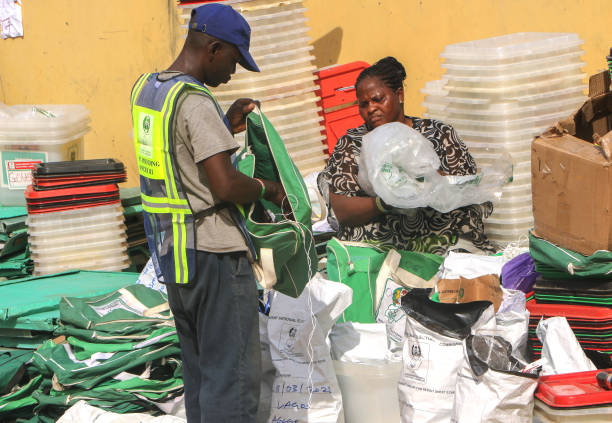
With the memory of the 2023 Nigerian general election still fresh, Nigeria is already on the path toward another defining moment. The 2027 elections may seem distant, but their implications are already unfolding in policy debates, political alignments, and institutional preparations led by bodies such as the Independent National Electoral Commission (INEC)
In a country grappling with insecurity, economic strain, and growing youth dissatisfaction, the upcoming general elections are being met with mixed reactions. While some observers view this election as yet another hopeless exercise, to others, it still represents an opportunity for change and national redirection.
Amongst Nigeria’s domestic crises, youth dissatisfaction takes the lead. In the face of the vulnerability of our economic structures and rising unemployment, the discontent in recent years has been evidenced by successive protests, from End SARS to End Bad Governance. This situation, further compounded by a poor youth representation within government, has prompted questions regarding the future of a country where due to sordid life-expectancy figures, youths make up a majority of the population.
This discontent was evident in the low voter turnout recorded during the 2023 elections, where only a small percentage of young people—one in four registered youth—actually came out to vote. At the same time, the rate of brain drain in the country is increasing rapidly, especially among young professionals. Today, an overwhelming amount of university graduates aspire only to japa, and at the same time, those trained abroad have no desire to return.
Despite these challenges, INEC has begun routine preparations, introducing several novel innovations. An amended Electoral Act (2026) has been signed into law to guide the 2027 elections, and in addition, a nationwide voter register revalidation exercise is currently ongoing. The institution is also working to implement some technological advances, including the BVAS (biometric accreditation system) and electronic transmission of results.
Yet, the electoral law, amended by President Bola Ahmed Tinubu, seeks to make electronic transmission now optional rather than compulsory, and in addition, allow voters to download their voter cards online. This amendment is aimed at resolving issues faced during the last election, such as PVC collection problems, network failures, and general election logistical failures.
Still, the intense public demand today for electronic transmission of election results is rooted in the controversies of the 2023 elections. INEC had initially promised that results from each polling unit would be uploaded in real time to their online portal, IReV (INEC Result Viewing Portal). Yet, they defaulted on this, and after elections in certain areas, results were not uploaded while collation was actively taking place. INEC cited glitches and issues with uploading the presidential results, much to the chagrin of the Nigerian citizenry, and this operational failure triggered significant political tension, leading major opposition figures like Atiku Abubakar and Peter Obi to critically challenge the final results.
The National Assembly plays a role as well in election preparations. It is actively reviewing and amending the Electoral Act, organising public hearings, and holding stakeholder consultations. The body is proposing reforms focused on e-transmission, anti-fraud measures, and strengthening INEC, even as it faces backlash over delays in passing the necessary amendments.
Security agencies are also mapping out safety operations, in recognition of the fact that security failures directly contribute to election disruption. Attacks on polling units and ballot snatching grossly disrupt the voting process, and logistical issues such as delayed/missing materials and the inability of officials to access certain areas needlessly complicate the electoral process.
These security issues were highly visible during the last elections. The South-East, for instance, contended with sit-at-home orders and attacks on INEC facilities. The North-West faced challenges from banditry and disrupted logistics, while the North-East battled insurgency. Collectively, these security threats contributed to a low voter turnout, as many citizens were afraid to participate.
Meanwhile, the political parties are refining their strategies, forging necessary alliances and coalitions. Political alliances have become a defining feature of Nigeria’s electoral landscape, shaping both the strategy and outcome of elections, none more prominent in recent times than the emergent coalition designed to front a united opposition—the African Democratic Congress (ADC). Dominant parties such as the All Progressives Congress (APC) and the Peoples Democratic Party (PDP), alongside emerging platforms like the Labour Party still rely heavily on coalitions to expand their reach and influence. The core significance of these alliances is their ability to reshape the political balance of power. By consolidating support, coalitions mitigate vote splitting and improve the chance of meeting constitutional requirements for broad national spread.
Despite efforts by regulators and political actors, the 2027 elections remain threatened by reduced public trust, with concerns centred around the reliability and transparency of electoral technology in the aftermath of the 2023 elections. Concerns persist over whether the incumbent President, Bola Ahmed Tinubu was indeed the victor in the 2023 elections, with many believing Peter Obi should have been declared the winner. Questions such as “Will our votes actually count?” and “Will it change anything?” still remain within the public consciousness.
That lack of trust now extends to the new technological innovations. Will the new tech live up to it’s promises in reality? Could Nigerian internet connectivity prove a challenge to efficiency or transparency? Much skepticism remains in the face of these innovations.
As 2027 approaches, Nigeria stands once again at a familiar crossroads. The outcome will not depend solely on candidates or campaigns, but on the collective choices of its people. History will record the decision, but its consequences will be lived.
Ayomide Bello



Okay, here’s it…
Firstly, I want to commend the writer of this article — Ayomide Bello (a friend). This is a very nice piece, well crafted and structurally appalling. You did a great job.
Now, as regards the real issue itself, I’d love to make a contribution:
In this country, part of the issues we have is political apathy. And as it has been clarified in the article, that apathy has, over time and again, been fuelled by the things we’ve seen in the past (events that created concerns about transparency, credibility, et cetera, especially in the 2023 election) — and it is understandable because we citizens are humans and humans tend to stay off the grid in a system where their trust has once been shattered, and this also means that it is inevitable that we’ll have a lot of people who will not be actively involved in the procedures in 2027. For those categories of individuals, I’m writing this in hope that it will communicate something to you.
It is an undeniable fact that the system has failed us. We’ve trusted it and it has failed us again and again. These days, we now have to struggle with various challenges influenced by the economic state of the country — from tariffs on airtime and data subscription to cost of feeding and transportation and hindrances to our access to basic amenities. Things have come to become a little worse over the years, and we’ve all felt the weight and the consequences of the failure of the system. We’re all here. We’ve seen it, we know it.
For many, sentiments have taken over their judgements. As highlighted in the article, many now ask questions about whether our votes truly count, and the fact that a positive response isn’t guaranteed has been a major inspiration for indifference and apathy.
However, beyond all of this, a major question sits right in our face, one that we can’t afford to leave unanswered: Does apathy ever solve anything? A stoic person would respond by saying, “is voting going to change anything?” These two only lead us to a bigger question: Are we going to just let things continue this way?
My opinion is that we need to start addressing things at grassroot level. Each of us needs to understand that leadership, as it is, starts with us. If someone is going to lead a difference in this country, that person is going to be one of us who are currently citizens. And even for you who doesn’t have intention of holding a leadership position, you have to start by recognising the fact that your merely being a citizen contributes something to the economy and the whole system and infrastructure of the country at large. Let this challenge you because one day, a change is going to rest on your decision, and indifference is not going to help things in such a situation.
Think about it. What if, in the 2027 election, there’s going to be a “lucky” candidate who has the best of intentions but hasn’t ever gotten a chance to express those intentions, and the chance he’s going to need (which affects all of us consequentially) is a margin of 1 vote to defy all odds and have his way? What if, just what if, the reason that person will not win is simply because a vote is needed and one person decides in the corner of their room that indifference is the best choice for them?
Voting may not change anything now. But if there’s ever going to be an opportunity that will make our votes create a change, will yours be there? Or are we going to lose that opportunity simply because we couldn’t reach the defining mark because you didn’t cast your own vote?
Voting doesn’t hurt, so please cast yours in anticipation of a positive turnout.
Thanks for reading.
Thank you, UIMSAPress.