Long ago, in a forest far from here, there lived a family that was known throughout the animal kingdom. The head of the family was an old Àjàgà. He had lived for many seasons, and for many seasons, the animals had seen him sitting beneath the biggest tree in that part of the forest. Àjàgà had a nephew called Ìjàpá. Now, Ìjàpá was not the biggest animal in the forest. He was not the strongest. He did not own the biggest tree, nor did he have the longest tusks.
But Ìjàpá had a mouth. And what a mouth it was. When Ìjàpá spoke, the monkeys stopped climbing to listen. When he shouted, the birds carried his words to the other side of the forest. One year, trouble came to the forest. There was a quarrel over who should sit beneath the biggest tree. The animals gathered. They argued and shouted. And from the other side of the forest came Kìnìún, the great lion.
Ìjàpá did not like Kìnìún. He went from tree to tree, telling the animals that Kìnìún should keep his nose out of their forest. He shouted at the birds. He shouted at the monkeys. He shouted at Kìnìún. “Leave our tree alone!” he cried. The forest loved him for it. Everywhere Ìjàpá went, the animals cheered. Then one evening, the matter was settled. Àjàgà would remain beneath the tree. The animals celebrated. Ìjàpá celebrated the most. He climbed onto a small rock and reminded everybody how loudly he had fought.
The following morning, Àjàgà and Ìjàpá went to the far side of the forest. Kìnìún was there. Àjàgà bowed his head. Ìjàpá bowed too. They greeted him warmly. The animals watching from a distance looked at one another. They did not question it. After all, there are some things the forest is too old to ask about. So, they went back to making noise. And Àjàgà, Ìjàpá and Kìnìún went on talking.
Anyways, let’s leave the forest, and come to Nigeria. Where?
Osun State. The 2026 Osun State gubernatorial election was held on August 15, with incumbent Governor Ademola Adeleke seeking a second term on the platform of the Accord Party. Adeleke had resigned from the People’s Democratic Party (PDP) on December 2, 2025, and formally unveiled Accord as his new platform on December 9, with his main challenger being APC’s Bola Oyebamiji. The dates leading up to the election itself was a comical streak on Musk’s X, as a considerable part of Adeleke’s campaign awareness hinged on the involvement of his nephew, David ‘Davido’ Adeleke. This was beyond genealogical strings as official positions had politicised Davido’s involvement in Osun affairs. In April 2026, Adeleke appointed Davido as Head of Youth Mobilisation for his re-election campaign. By May, Davido was inaugurated as Chairman of the Imole Youth Mobilisation Campaign Council and formally joined the Accord Party. He subsequently campaigned for his uncle both on the ground and across his social-media platforms.
This was not Davido’s first involvement in Governor Adeleke’s political career. He had also played a prominent role in his uncle’s 2022 campaign, campaigning physically and online as Adeleke defeated the then-incumbent APC candidate, Gboyega Oyetola — a win he defended through a tribunal challenge, an appeal, and a Supreme Court ruling that upheld it in March 2023.
But there was another political relationship in the background. In March 2026, months before the Osun election, Adeleke publicly reaffirmed his support for President Bola Tinubu’s re-election bid in 2027. He said he had “no problem” with Tinubu, described him as a leader of the South-West and said his endorsement was in the interest of the region. So, as the Osun election approached, the political picture was already more complicated than a simple Adeleke-versus-APC story, or Davido lending his voice and influence to his favourite uncle’s ambitions.
Perhaps that is where Davido’s stint in all this becomes interesting. Because while it is easy to describe Davido as a celebrity who speaks about politics, it is harder to describe him simply as an ordinary citizen with an opinion. By the 2026 election, Davido was not merely supporting his uncle from the sidelines; he had formally entered the campaign structure, involved well enough to state that his music career would be on hold to focus on the campaign. His involvement was therefore not limited to the occasional endorsement or appearance at a rally. He was part of the machinery of a political campaign, with real responsibility and a direct interest in the outcome.
And this is where political voice becomes different from or probably gets inevitably intertwined with political stakes. Davido has always had the former, by the mere virtue of being one of the critically acclaimed ‘big 3’ in Afrobeats. Fame gives him an audience that most people do not have. A post from him can reach millions, attract national attention and put pressure on a political conversation almost instantly. But in Osun, he had the latter too. Several of Davido’s posts on election day showed just how involved he was in the Osun contest. He repeatedly called on INEC to upload results, questioned delays on the IReV portal, directed Accord Party agents to submit results from polling units and wards, and publicly criticized individuals he believed were interfering with the process. In a now deleted tweet, he addressed President Bola Tinubu directly: “U no try @officialABAT.” In a separate post, which remained live, he accused the administration of undermining the electoral process: “MR PRESIDENT TINUBU! UR KILLING DEMOCRACY.”
The posts were particularly striking to this writer because of the political relationship within Davido’s own family. Adeleke had publicly endorsed Tinubu’s bid for a second term in 2027 months before the Osun election. And this is where the question of Davido’s political voice becomes less straightforward. Davido had not been completely silent on national issues before the Osun election. In May, he criticised Nigerian entertainers, including himself, for not doing enough to speak about insecurity and injustice. He also defended his friendship with Seyi Tinubu after being accused of hypocrisy, insisting that he was not part of the “City Boys” movement and that his personal relationship did not determine his political position.
So, while it would be somewhat inaccurate to say that Davido only became interested in politics when his uncle was contesting an election, given that there are existing relationships between his family and the stakeholders in the incumbent government, there’s no telling that he might lend his voice at unsuspecting intervals to avoid backlash when these relationships are thrown at the masses’ faces in photo ops. The more interesting question is why his political voice became particularly forceful when his uncle’s election was directly at stake. It’s not so far-fetched, right? This is his favourite uncle, but perhaps this is where we should move beyond Davido.


Because this is not only about celebrities. It is about people with influence. In Nigerian politics, influence has always been a social currency, even more evident in political spheres. A prominent politician, traditional ruler, former office-holder, wealthy individual or even a well-connected public figure can throw their weight behind a candidate, and that endorsement can mean access, visibility, legitimacy or votes. Sometimes, the connection is ideological. Sometimes it is based on competence. And more often than not, as we have seen repeatedly, it is simply because the candidate is a friend, ally, relative or someone whose success serves the interests of the person endorsing them. The UIMSA Press article On ‘Godfatherism’ and Interest-driven Endorsement makes a similar argument in examining how influential figures endorse candidates with whom they have personal connections or interests, turning influence itself into political currency.
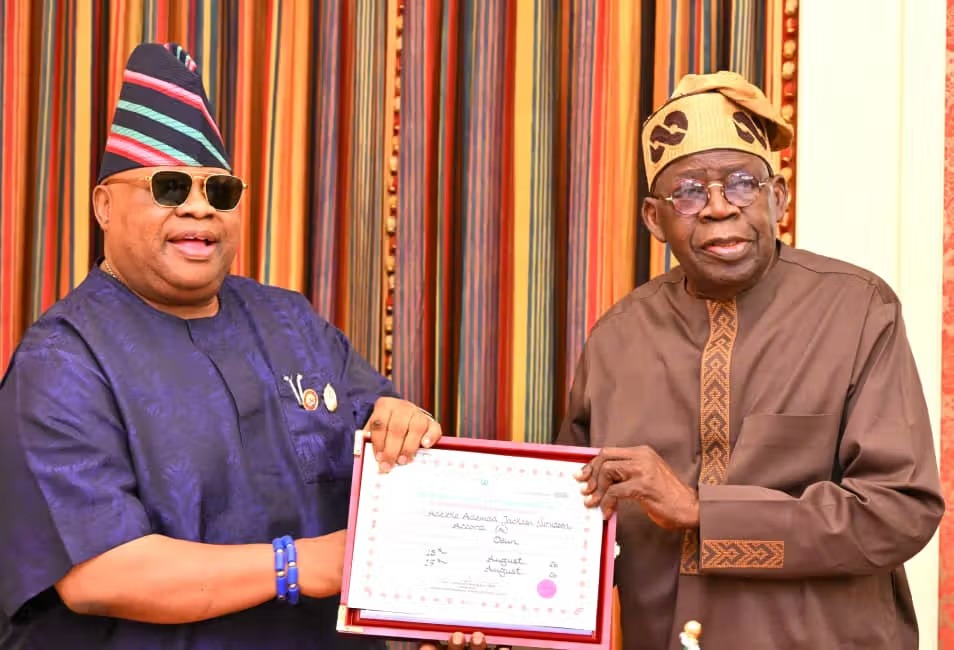
Like many expected, Osun elections ended with Adeleke securing his second term but the political relationships did not end with the result. The day after the election, Adeleke reaffirmed his support for Tinubu’s 2027 re-election bid. And days later, he was at the Presidential Villa meeting Bola Ahmed Tinubu. He would later visit Nyesom Wike, with Davido alongside him. Davido joked that he had “beaten” Wike’s camp in the election, before prostrating to greet him. If anything, the average thinker can see through the ‘political activity’ shown by celebrities during build ups to elections. They rub shoulders and share laughs with the same figures they call out in tweets. It is really never that deep for them, unlike you and I, whose lives are largely affected by the economy.
Adeleke had defeated the APC in Osun while maintaining his support for the APC’s presidential standard-bearer. He could then move from the ballot box to the Presidential Villa, and from there to a meeting with Wike, one of the figures on the other side of the political contest. This is the part of Nigerian politics that an election result does not show the networks of influence that survive beyond the ballot. It is also where the idea of godfatherism becomes relevant and where the distinction between having influence and having a political stake becomes important. The people who matter in these networks are not always the people on the ballot. Sometimes, their power comes from their ability to influence who gets on the ballot, who wins, and who remains useful after the election.
The twist and turns pre and post election further reinforces one thing. The Crème de la crème will continue to dine with each other, and even when it appears that one decides to rebel or behave contrarian, you can guess that there’s another gain or motive more covert than the obvious – which is of no significant good to the collective. Beyond the loaves of bread and bundles of mint thrown at the impoverished masses, that is the more reason we need to be self aware of our advantage in numbers. Because we fail to recognise that even with the influences of celebrities, we have to make a conscious decision to want change and demand it by action. Maybe we think influence directly translates to thumbprinting and perhaps that is what makes people with influence so fascinating to the rest of us. We like to hear them speak. Not necessarily because they know more than we do, but because they can say things in rooms we cannot enter, to people we cannot reach. Sometimes we do not even need the person to do anything beyond speaking. We are not just listening to influential people. Sometimes, we are begging for their influence. Their voices give our own frustration a face. Their opinions give our opinions a reach. Their access gives us the feeling of being closer to the people making decisions. Which is why we are not debating whether influential people should speak but why we have become so eager for them to speak for us.
We have allowed the talking to become bigger than the doing. Not because speaking out is meaningless, it isn’t. But these days, our activism begins and ends on a screen. We have made political participation incredibly easy to pontificate on and remarkably difficult to practice. The more uncomfortable question would not be why influential people are not doing enough in speaking for the masses but why we wait for them to do it at all? We are the ones who live here. We are the ones dealing with the worst of it, the roads, the insecurity, the universities, hospitals and policies we complain about every day. “Ẹni tí ẹ̀gún gún lẹ́sẹ̀ ni ń ṣe lákànlákà tọ̀ alábẹ́ lọ” which means, “It is the person whose foot is pierced by a thorn that limps to the person with the knife.” Whether we like it or not, we are the ones with a thorn in our feet. And perhaps it is high time we stopped waiting for someone else to limp for us. We should speak more but more importantly; we should act more.
Jolamade Adetoro