
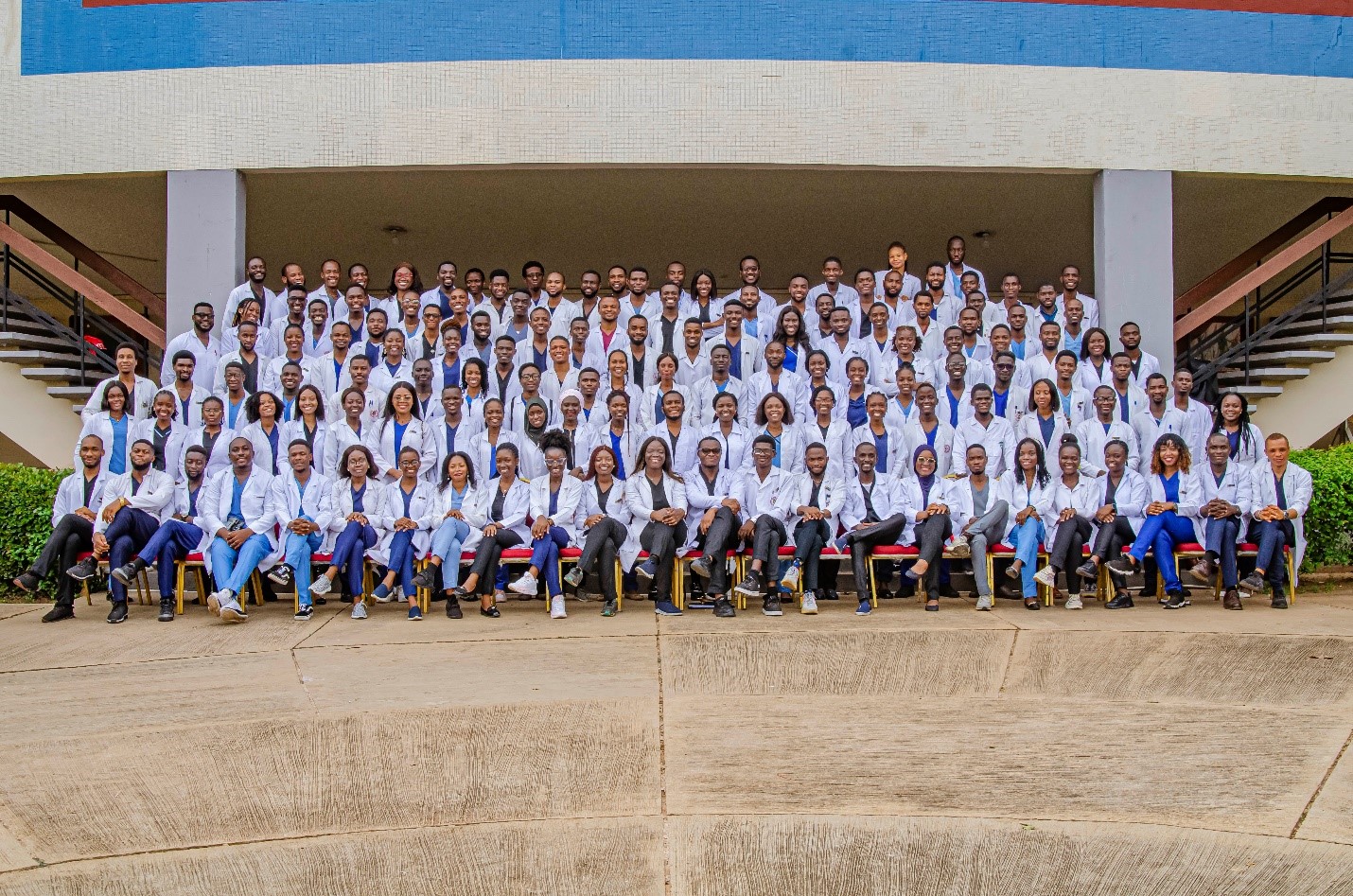
The allure of the prestigious ‘Medicine and Surgery’ course often captivates young minds and even the adults alike. It is often romanticized in the minds of eager high school graduates. They see the white coat, the stethoscope and the honor, but do they exactly comprehend the path that essentially lies ahead? Hearts bubbling, they inscribe the course on their UTME forms–some once, some as many as four times or more–oblivious to what waits in the shadows and how the timeline of their lives is reconstructed by that subtle decision. Medical school is not just a series of classes and exams; it’s an endurance test where sleep becomes a luxury and every moment spent not studying feels like a step backward. Medical students trade the vibrant chaos of university life with an overwhelming volume of information to master, a solemn dance with the dead and the undead, and the emotional weight of human suffering. Indeed, it is a commitment to a lifestyle where personal sacrifice is the unspoken prerequisite. In this article, I shall explore the opinions of UIMSAites on whether the dream of medicine matches the reality of medical school for we, who decide to pursue it, nonetheless.
Q: What motivated you to pursue a career in Medicine?
Anonymous, 600L: Easy decision to make. I grew up with a doctor as a father. Best in the science class and typically opted for the ‘highest potential’ course. I also had a few people I looked up to already studying the course.
Faith, 500L: I was very intelligent and liked Biology in school. I also had sympathy for beggars with weird conditions on the street. Medicine was the natural option.
David, 400L: I was majorly driven by the avenue to help people and studying medicine brings that. The financial advantages didn’t exactly cross my mind, then.
Bolaji, 300L: A lot of things, actually. A combination of parental and peer motivation, being intelligent in school, interest in science and a flair for interacting on a more deeper level with humanity and preserving it’s existence when they’re vulnerable. Medicine is just different from other courses.
Q: Were you aware of the emotional and psychological toll of medical education before starting?
Anonymous, 600L: No, I wasn’t aware. It may be cool to say that I don’t engage in schoolwork a lot, but the truth is that I suffer mentally because I’m constantly overthinking. I’ve also realized that it’s a difficult pill to swallow knowing that you don’t know your ‘stuff’ and that you’re average, especially when you were raised to aim high in everything you do. Unavoidable humblings always come along the way.
Faith, 500L: It was obviously mentioned to me but I wouldn’t say I was really conscious. I just concluded I’d wing it like I had, all through high school. It wasn’t explained in explicit terms.
David, 400L: I was aware but not to the level we all encountered later. I feel that one might not know the depth of certain things except through one’s personal experience. The emotional and psychological toll of preparing for MB exams alone cannot be understood by other students no matter how much empathy they show.
Bolaji, 300L: I had some ideas, spoke with a few seniors, read some articles about the situation but firsthand experience was quite different. It made me realize the importance of self-care, self awareness, self motivation and having a good support system. This will surely make sure you go through, less emotionally or psychologically damaged.
Q: How did your expectations of med school compare to the reality?
Anonymous, 600L: Honestly, I didn’t expect it to be this long. I’ve done so much and been so much in 6+ years. Also I didn’t expect it to be so self-directed in that you decide your own goals and interests. Additionally, I didn’t expect that it’s a daily battle to prove to oneself that greatness is within reach.
Faith, 500L: The difference is clear. Med school is a lot harder than ‘inside people’ make it out to be and it is also a lot easier than ‘outside people’ make it out to be. I don’t know how to explain it but I think we have it easier than some other courses in the university based on the sheer number of courses they have to offer and even borrow while we already focus on our core interests from the very beginning. Meanwhile, the said courses are a lot harder to even ‘just pass’ than other courses outside. It’s interesting.
David, 400L: I didn’t expect what I saw in the clinical side of the journey. The reality was way different from expectations. I didn’t know the sight of blood would get me turned off and that I could not stand a needle injection without wreaking a nerve. Then, it’s all repetition. I got bored at a point having to do same thing over and over again.
Bolaji, 300L: High expectations met with many differences. I already envisaged the worst but I also thought it would be do-able or enjoyable at least. It is indeed challenging but the only solution is to keep moving forward. The journey is a really transformative one and it helped me discover certain things about myself.
Q: What was the biggest challenge you faced in your first year?
Anonymous, 600L: The biggest challenge was the disillusionment I experienced on realizing that I may not want to be a doctor as much as I thought before I gained admission. This meant that I didn’t go to classes and spent time doing extracurriculars more than my academics. Also, I think the freedom of 100L was also strange to me. The ability to decide how your day goes was maybe too much for me to handle. I wish I had the mindset of pushing myself harder at the time.
Faith, 500L: The transition from high school to university was brutal for me. I suddenly had all this freedom and was eager to test it at every juncture. I skipped classes to see what would happen, went late, didn’t study to see how intelligent I was without studying, didn’t go to church to see if God would punish me for not going, and things like that.
David, 400L: Biggest challenge in 100L was the stress the university’s mode of registration came with. I had to unnecessarily endure standing in many long queues.
Bolaji, 300L: I had a long break after high-school before I resumed so I had to learn how to be a student all over again. This was also coupled with the fact that I resumed second year directly and was bombarded with loads of material to cover. I had to go back to the drawing board and learn study habits and how to adapt to university life like a fresher when I was already in medical school. I didn’t have the luxury of finding my foot in preliminary science courses before transitioning to our core courses.
Q: How many hours per week do you study outside of class?
Anonymous, 600L: If averagely over my medical school journey, less than 10 hours a week. Typically, I read mainly during the week of an end-of-posting test/intensely over weeks/months to an MB. I won’t recommend because it depends on factors like how great your short-term memory is and what you’re optimizing for in terms of school. If you want to practice medicine clinically, this isn’t a great option, but if you already have defined interests outside of medicine and are okay with excelling at that field while being average with school, this is a nice tactic.
Faith, 500L: Right now, outside of class, it’s roughly 4-6 hours.
David, 400L: I can’t really say, as I barely read or I don’t read consistently. I read majorly few days to most CAs except in moments surrounding MB1 exams. When I actually do read, I can read round the clock.
Bolaji, 300L: Variable values. During academically tense periods like before tests or exams I can go up to 6 hours daily, but when I’m in less danger let’s say 2-3 or none per day. I have done without reading for a full week.
Q: Do you think more preparation or information should be provided about the rigors of med school before admission?
Anonymous, 600L: I think the experience is better lived than explained. If anyone had come to talk me out of doing medicine or informed me of the ordeals of it, none of it would have prepared me for the disillusion I’d experience. However, the process may give one people to reach out to when one is experiencing the disillusion. Also, one just has to be prepared to fight for their love for medicine. If someone wants to enjoy their time in medical school, they have to fight for it.
Faith, 500L: Yes.
David, 400L: I think so, yes.
Bolaji, 300L: Yes, a lot of information should be made to aspirants so that they can assess their capabilities and have a realistic picture about how the journey actually is. They shouldn’t just think everything is all about the grades they get. I think this will help them to reconsider and I think there are different challenges medical students face based on the medical school they are attending. So I think it should also be tailored to the medical school they have in mind to attend. I think some countries have workshops for college aspirants regarding this.
Q: What advice would you give to someone considering medical school?
Anonymous, 600L: One, you must find proof as early as you can that you can do hard things. Reading and preparing for medical school exams/tests in a bid to get distinctions is hard. Learning a skill and attempting to make some money from it is hard. Contesting for and growing capacity in a leadership position is hard. But doing these things early and doing them well sets a tone for excellence that you’d be grateful for. Also, please have another life you maintain while in medical school. Be it as a writer, researcher, you’d find that it’d keep you grounded and confident when medical school is stormy. Who knows if your teachers will go on a strike and that skill you have struggled to stay consistent at may feed you or simply, keep you busy and engaged. Also, embrace the principle of seasons. There’d be times you’d be swamped with school and have no time for anything else. There’d also be times where you’d have little or no school. Remember to fight for your ‘other loves’ regardless of the time you have (30 minutes when school is tough, 6 hours when school is easy). Also, studying in a public medical school is particularly testing. It’s crucial to develop skills that can alleviate financial pressures, ensuring you don’t grow to resent medicine due to financial stress or the slow pace of academic progress.
Faith, 500L: Unless you’re really passionate about it, don’t do it. It’s not worth it. It takes the better part of your life studying for it, and takes all your life practising. It is a jealous lover and it is incredibly hard to excel at other things while doing medicine. The money in it is a myth that only those at the top enjoy as a reality. Also, even if you want to do it, don’t do it in a Federal University that embarks on periodic strikes. Just don’t.
David, 400L: Well, I don’t think I have personal advice. To me, medical school is not something you can really assert you’re cut out for until you go through it. You can be pushed by your parents and it ends up being the best spot for you. And it can be a strong personal appeal and then you feel out of place along the way. It takes more than knowing how to read and immense love for helping people. You have to love it and you can never be too sure until you experience it. I feel self discovery could either come early or evolve along the journey.
Bolaji, 300L: You can’t be too sure when you want to do it if you want to, just ask for information and assess yourself well so you won’t make decisions rashly. Also have interests aside medical school and people that you can rely on or that can keep you going through the tough times. Most importantly have a genuine heartfelt reason why you would want to study Medicine.
In the end, the journey through medical school is as much about self-discovery as it is about mastering medicine. Whether you enter with dreams fueled by passion, pressure or a blend of both, the true test begins once the textbooks open and the nights grow long. The rigors of this path are not for everyone, yet they forge those who endure into healers, leaders and lifelong learners. To any prospective medical student, remember: your journey might reveal strengths you never knew you had, or it might reshape your path in ways you never anticipated. But one thing is certain — through every challenge and triumph, you’ll not only learn about medicine; you’ll learn about yourself. So, venture forth with an open heart, a curious mind and the readiness to adapt, for the journey of medicine is one of the most profound odysseys of self and service.To the medical student reading this, here’s a question for you. “If you’re given a chance to go back and decide again, would you choose Medicine?”
Note that pseudonyms were used and the interviewees are now in different phases of their education.





This was truly delightful to read. I strongly agree with the advice, will be referring to them in the nearest future, and, although needless to say, I almost covet the writer’s prowess.
This was captivating. I believe orientation should be given to MBBS Aspirants, to prepare them for the freedom of 100 level and tediousness of the other levels, advice on how to use their time well from different successful MBBS students in different aspects.