Of all the spontaneous conversations my roommates and I had last semester, none sparked quite as much energy as sleep paralysis. Suddenly, everyone had a story, and maintaining a quiet room became impossible as we all tried to chip in at once. In a full house of six people, at least three of us had personally experienced this phenomenon.
I don’t remember exactly how the subject was broached, but Tinuolu’s account immediately took centre stage. She recounted seeing ‘beings’ in that half-awake state, insisting to the best of her memory that three distinct figures had materialized, all shrouded in black. Frantically, she did the only instinctive thing anyone in that situation would do: she tried to scream. Or, at least, she thought she was screaming. How she finally snapped back to reality was a blurry recollection, but the hallucinated presence of those black figures eventually faded. As for how often this happens, she noted that it rarely occurs anymore, with her last episode dating back to secondary school.
For Daniella, however, “rare” was far from the reality. She explained that her episodes, while irregular, occurred quite often. For example, she had dealt with them a couple of times during her stay at the hostel, which she felt was far too frequent to be considered rare. Regarding her symptoms, she noted that the paralysis restricts every physical ability of her body, restricts her normal breathing and only keeps her eyes open. Overall, she described the experience as dreadful, characterizing it as “literally just a confusing state of mind.”
As for my own experience, it was just as terrifying as anyone would outright acknowledge. Because I don’t lose my ability to think clearly amidst all the physical control I am robbed of, I constantly find myself questioning: How is it that I suddenly cannot control my body? I can perceive movements around me and hear nearby conversations loud and clear, yet I am entirely unable to respond. My eyes momentarily steal the spotlight of a much larger organ, demanding an incredible amount of energy just to slit open–though in the end. They never do, not until the episode is finally over. This contrasts with Tinuolu and Daniella’s accounts, as both claimed their eyes remained open during the ordeal—proving just how wildly these symptoms can vary.
Whether I can actually move my body or not, I can’t afford to be definite about. After all, if I truly had been moving, surely anyone walking into my room would have noticed the strange, erratic jerks and swung into action. But every time it happened and I could swear someone was nearby, they remained oblivious to it. It leaves me with two possibilities: either my mind deceived me into believing I was moving, or my physical movements were so sparse and minute that I appeared perfectly still. It has been nearly a year now, and the once‑constant visitor has not returned.
While the desperate urge to snap out of our semi-conscious state was a shared struggle, our individual tactics varied completely. For Tinuolu, the best strategy was simply to surrender—to let nature take its course, comforted by the knowledge that the episode was only temporary and would eventually pass on its own. I, on the other hand, chose to fight it; I would frantically squeeze my shut eyes even tighter, mustering every ounce of mental force to finally shut the gap between reality and the semblance of it. Daniella took a third route, preferring to bypass the struggle entirely by putting herself back to sleep, fully assured she would wake up normally on her second try. We agreed, jokingly, that it was one of those times when life communicated it could do with us as it pleases and there was nothing we could do about it.
I am now in a better position to understand that everything we experienced wasn’t a haunting or supernatural anomaly I used to entertain; it was a perfectly documented neurological transfer, let’s say a glitch. Sleep paralysis occurs when there is a breakdown in transition between REM (Rapid Eye Movement) sleep—the stage where our most vivid dreaming happens—and waking consciousness.
During a normal REM cycle, the brain stem cleverly paralyzes our voluntary muscles to prevent us from physically acting out our dreams. But in an episode of sleep paralysis, the waking mind suddenly clicks ‘on’ while the body’s REM switch remains stuck on ‘off.’
This hybrid state of consciousness perfectly explains our collective symptoms. Tinuolu’s terrifying black figures were “intruder hallucinations”—a result of the hyperactive amygdala, the brain’s threat detector, projecting dream imagery onto the real world. Daniella’s vocal restriction and my own frantic eye straining were classic signs of motor atonia, where the brain’s chemical paralysis locks down the body, leaving only the tiniest muscles capable of effort. Even my confusion over whether I was actually moving or not is a recognised phenomenon known as vestibular-motor hallucination, where the brain’s sense of spatial awareness gets completely distorted.
If you’ve experienced something like this, you would want to know what triggers such an event. Well, various health sources have linked the likelihood of these episodes to factors such as highly irregular sleep schedules, high levels of stress or anxiety disorders, underlying sleep disorders such as narcolepsy or sleep apnea, and the theory I was only recently exposed to—lying flat on your back.
Just to reiterate, these factors do not directly cause sleep paralysis, but they’ve been shown to significantly contribute to its occurrence. As regards lying flat on the back, in the supine position, so to speak, this posture promotes minor breathing restrictions and physical discomfort, which can trigger partial awakenings during REM sleep.
Studies show that approximately 8% of the general population experience at least one episode of sleep paralysis in their lifetime. However, for students and young adults, that number spikes to about 28% to 40%, typically first occurring between the ages of 14 and 17. This is precisely why we, as students, are the primary case study. And perhaps, the better accustomed we are to its mechanism, the faster we can mentally disarm the panic.
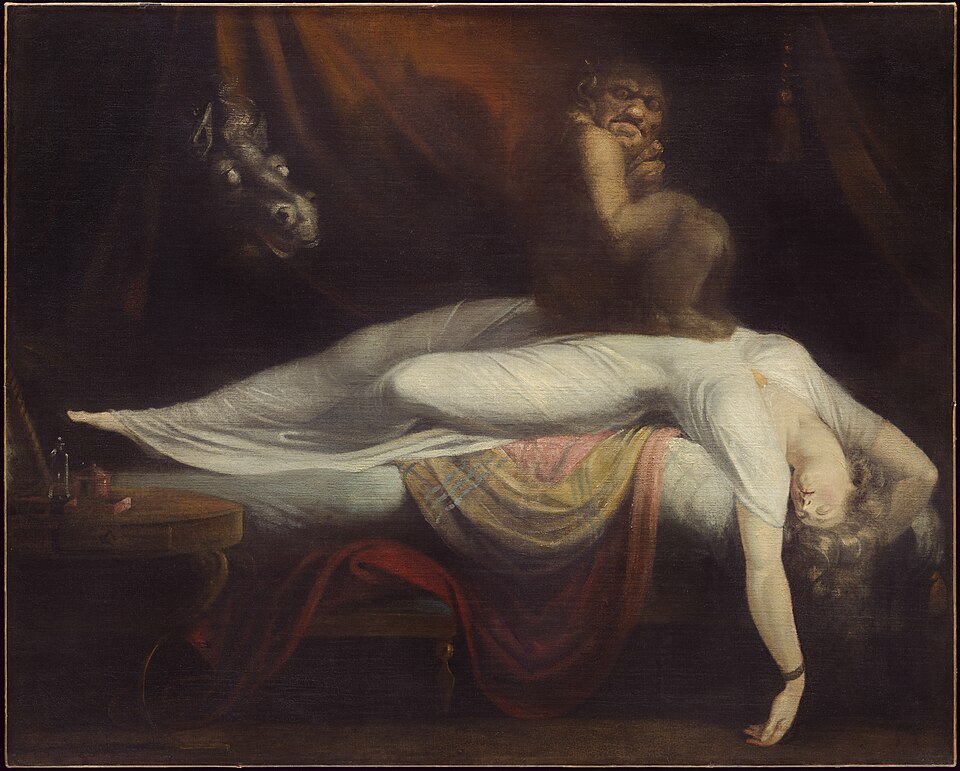
Yet, it is entirely understandable why so many of us and the cultures we grew up in instinctively point to the supernatural. For centuries, across different societies, sleep paralysis has been deeply tied to tales of night hags, demonic visitations, and spiritual oppression. In fact, if we had lived in an era when supernatural beliefs reigned supreme and these episodes were rampant, our little hostel room would have been a prime target for an exorcism. In our local context, it is almost reflexively chalked up to spiritual warfare or dark forces sitting on one’s chest. For example, in Southwestern Nigeria, it is sometimes attributed to a nocturnal spirit called Ogun Oru. Egypt, on the other hand, calls this spirit entity a Jinn. Similarly, in Western folklore, this terrifying presence was historically referred to as the ‘Old hag’—giving rise to the term ‘Old hag syndrome’ to describe the sensation of an ugly, malevolent witch sitting heavily on a sleeper’s chest.
This link between what we believe and what we physically experience is backed by modern science. A 2015 study published in the journal Culture, Medicine and Psychiatry highlighted how deeply our cultural backgrounds shape our encounters with sleep paralysis. The researchers noted that when we view this phenomenon through the lens of local myths, the experience itself gains a sort of psychological momentum. In other words, the more a society is conditioned to fear these episodes as spiritual attacks, the more frequent, intense, and terrifying they actually become.
Hence, as much as these episodes are culturally associated with spiritual influences or, broadly, anything beyond the ordinary, sleep paralysis itself is not a cultural or supernatural phenomenon. It is a universal, psychological event—it is simply the stories we wrap around it that change.
In such light, a way forward would be to put aside these complex beliefs and focus on practical, healthy habits to reduce the occurrence of these events. As students, we are more prone to unhealthy sleep patterns in the name of late-night study sessions, tight deadlines, and general academic stress. However, the value of sticking to a regular sleep schedule still stands to be one of the most effective measures in combating these sporadic episodes, as it simply helps to keep your body clock steady.
Also, getting rid of the tendency to sleep on your back might help mitigate the chances of these episodes happening. And lastly, stress management demands that we invest time in reclaiming our hours of chaos, pressure or unrest by giving our body the benefits of “full recuperation.” Though that might sound pretty far-fetched to practise in a school where there scarcely seems to be enough time to get the necessary schoolwork done, it is often about finding those low-stakes hours we can easily trade off. Swapping these near-empty moments of mindless scrolling, idle chatting or procrastination for a quick walk, catching up on sleep or just sitting quietly and relaxing won’t cost you anything academically, but will offer immense physical relief.
In conclusion, demystifying sleep paralysis allows us to face it with substantial understanding rather than fear. I trust my roommates and I to find another flagship topic to discuss this semester.
Names have been changed to protect identities.
Ifeoluwa Omotesho