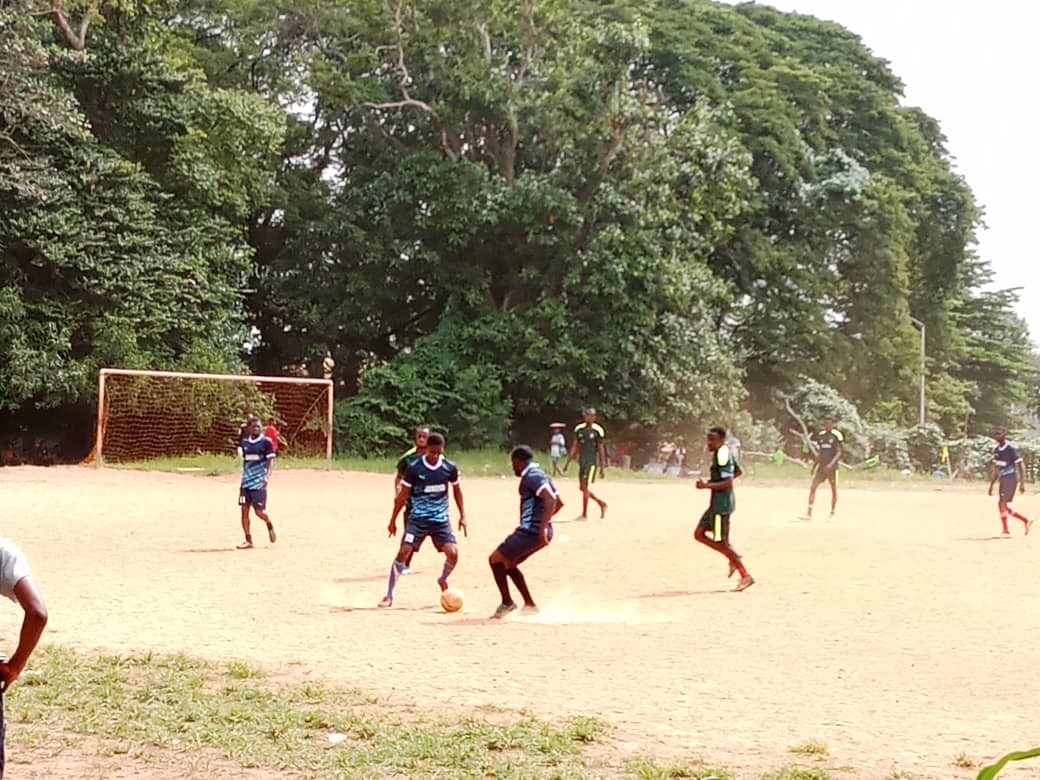
On your average evening at the University of Ibadan, across hall pitches, improvised turf patches, and the famed Old Football Pitch (SUB), students squeeze into fast-paced, high-intensity games, chasing quick passes and timely strikes – never minding the well of exhaustion that comes after. Football is arguably one of the most vibrant extracurricular cultures in the University, and undoubtedly its most popular sport. But rather anticlimactically, both now and in times past, facilities have struggled to keep up with this still-growing demand.
For many years, the SUB pitch has been the epicentre of student football. But with so many tournaments, faculty competitions, and even casual kick-abouts competing for the same space, congestion has become inevitable. The ongoing construction of the new Faculty of Arts Extension has placed additional pressure on this limited space, further worsening the situation.
Small-sided football has long been a core part of the rhythm of campus football, from the fiercely contested ABH League, dubbed ‘Blood and Sand’, to the packed evenings at the Bello and Zik Leagues. However, these games have often been played on modest, makeshift facilities built more out of necessity than design. Now, a newly constructed 5-A-Side Arena Stadium promises to raise the standard.
The project is another landmark in the long history of UI alumni supporting their alma mater. Conceived and delivered by the Ex-University of Ibadan Footballers Association (EXUIFA), the arena was a collaborative effort led by the EXUIFA executive committee — including President Edwin Evbie, Vice President Vitalis Odozor, General Secretary Lawrence Osuagwu, PRO/Project Manager Henry Duru, amongst others.
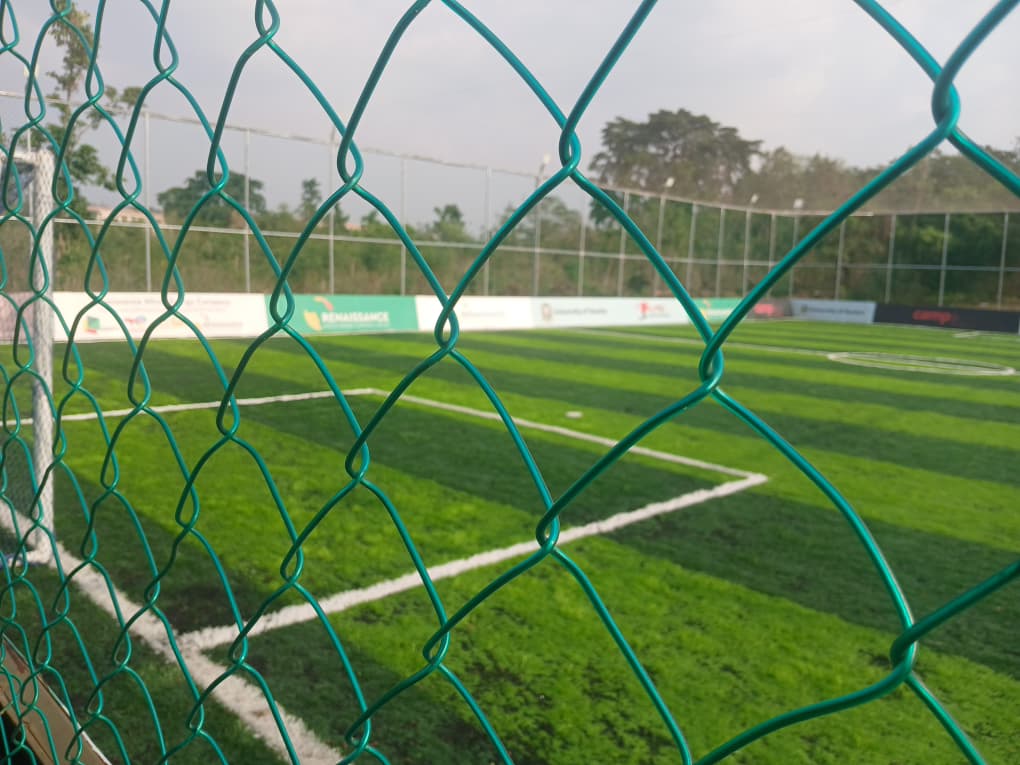
The project was made possible through the corporate social responsibility (CSR) contribution of Renaissance Africa Energy Company Limited, headed by CEO Chief Tony Attah, himself a UI alumnus. Officially commissioned on November 21, 2025, the facility features a modern artificial turf, solar-powered lighting, and a spectator stand named in honour of Dr. Abiodun Isiaka Salami.

Located directly opposite Gongola Road, along Awo Stadium Road, The Renaissance Africa Energy Company 5-A-Side Arena introduces the most modern small-sided football facility currently available on campus. Its remote location is part of larger efforts around to move sporting activities from the Old Football Pitch to the New Mini Sports Complex area near Awo Stadium.
Unlike many of the sandy 5-A-side pitches scattered across school hostels, this turf is purposely built and laid with an artificial carpet covering designed to withstand heavy student use and a surrounding perimeter fencing to help keep the ball constantly in play, a feature very necessary for maintaining the high tempo that has come to be associated with small-sided matches.
The facility also boasts solar-powered floodlighting, allowing matches to continue well into the evening, as well as compact goalposts suited to the fast-paced format. These elements come together to transform what is usually an informal hostel pastime into something very closer to the structured environments that is usually found in professional indoor football and futsal arenas.
While the pitch has already attracted attention across campus, details surrounding the necessary procedures for its booking, how accessible it will be for students and how it will be managed long-term have not yet been officially published.
Why the 5-A-Side Format Matters
While the new pitch might not do much in decongesting the weighty lineup of 11-A-side matches the SUB pitch is known for, it most definitely opens up inclusivity that accommodates competitions that are better suited for that format. Unlike the regular 11-A-side matches at SUB, 5-A-side is played on a smaller field with smaller goalposts and a reduced timeframe. The game is faster, more intense, and infinitely more technical.
With fewer players on the pitch, and the close-quarters in which it is played, players not only average more touches but have to be able to manoeuvre the ball quickly enough in the tight spaces afforded them. This alone makes 5-A-side football a heavy favourite of the world’s elite professional coaches. Dutch legend Johan Cruyff built much of his philosophy around small-sided games, believing that tight-space play forces players to master quick passing and movement. Ex-Arsenal boss Arsène Wenger similarly argued that smaller games dramatically increase the number of touches each player gets on the ball, accelerating technical development. And the most decorated tactician of modern times, Pep Guardiola, echoes this idea, noting that training in reduced spaces leaves players with little time to think, forcing quicker decisions and sharper control.

The format has also become particularly important for women’s football, where smaller squad sizes often make 5-A-side competitions the most practical option. At the University of Ibadan, this has largely been the case. Aside from the first 11-A-side female football competition — the Female Inter-hall Tournament held in November last year — the major women’s football competitions on campus have typically been played in a 5-A-side format.
For many students, the burning question, no doubt, is who gets to play there?
University football culture thrives on accessibility, as is greatly evidenced by students enduring preference for the SUB pitch as against the more modern Awo Stadium. Hostel leagues, faculty competitions, and spontaneous evening matches all depend on spaces that are open, easy to access and organize around. The immediate past UI’SU Sports Secretary, Victor Kolawole, says that while the pitch would be made accessible to students, it would take on a structured booking system and will come at a cost, given the scale of the project and the need for its maintenance. However, the affordability for students will determine whether it will truly become one of the busiest sporting venues on campus, or it will simply remain a showcase project.
Pricing aside, perhaps the most significant game-changer is the introduction of solar-powered floodlights. Traditionally, the sun ruthlessly has dictated the football schedule, with matches forced to end as soon as it slides behind the towering dark outline of the Faculty of Arts, its last orange rays spilling across the SUB pitch before the field is slowly swallowed by dusk. For students trapped in lectures and practicals until late in the evening, the chance to play competitive football was often a logistical impossibility. A dedicated ‘Under-the-Lights’ midweek league could finally provide a home for the late-night athlete, allowing the beautiful game to thrive long after the Sun has gone for its daily roost.
Another of such explorable avenues would be high stakes “Blitz Tournaments”. Regular 11-A-side competitions like Dean’s Cup and Seals Cup usually take weeks to conclude. The-5-A-side format allows for a ‘sprint’; a high-octane knockout tournament where many teams can battle from morning till trophy presentation in a single day, just like the Faculty of Technology’s Gala Cup.Beyond organized leagues, the pitch stands as a potential training hub for the university’s elite teams. Instead of the monotonous running of laps often seen at SUB training sessions, hall, faculty and departmental teams can now utilize the new turf for specialized “rondo” sessions and high-speed conditioning drills. By mirroring the setups of professional European academies, this new facility has the potential to become the primary site of technical training camps and would undoubtedly raise the overall standard of footballing in UI.
The five-a-side format could also provide a natural home for women’s football competitions on campus. As many of the female teams are already accustomed to playing small-sided matches, the new pitch offers a facility specifically designed for the format they most frequently use. Beyond informal games and training sessions, the venue could host structured women’s blitz tournaments or inter-faculty competitions, helping expand participation and visibility for the women’s game within the university community.
Football is already woven deep into the fabric of everyday life at the University of Ibadan. The arrival of the 5-A-side Arena therefore represents a huge step towards improving football infrastructure in the university. If properly managed and kept accessible, the facility could help consolidate the scattered small-sided football scene across campus and provide a central venue capable of hosting higher-quality competitions and training sessions, most especially at the dawn of a session when the campus is flooded with fresh bloods.
The pitch may also encourage the growth of new formats of competition, further enriching the thriving culture of football within the university community. The new arena promises faster games and brighter nights. But its true success will be measured by one simple question; will it remain accessible enough for every student with a pair of boots?