The other day I was speaking with Joba, a friend who had just broken up with his girlfriend. I have known him to be somewhat eccentric in some of his choices, but I could vouch for him any day as being a cool headed guy. They had been dating for close to six months, and because I sort of knew how things were going, I was quite surprised when things went south. She was the kind of girl he wanted—coolheaded as well, smart, supportive, reserved, a lethal face-card—and their relationship was blossoming. Or so it seemed. When I asked why, he told me that he himself didn’t quite understand. As he tried to relate to me the turn of events, and as I struggled to follow without being judgmental, I remembered a random reel I saw sometime ago about self-sabotage. The summary of what I could glean from his narration was that she seemed too perfect and he felt he was going to jinx it. So, since “it would probably end anyway,” he decided to end it sooner.
Now, it’s not exactly my intention to analyse Joba’s moral standing, even though I personally don’t think he’s a terrible person. Sure, he has some flaws, but I don’t know him to be the kind to intentionally lure a woman into a relationship just to end it for the sake of ending it. I know this because he’s been in at least three relationships that I am aware of, and in each case he has been the one on the negative receiving end of the relationship. Not to bore you with the details, but each experience he had was with an emotionally unavailable partner. According to him, this particular one had begun similarly, but after some time, things changed and the relationship started becoming emotionally intimate. My guess is that he couldn’t handle the intensity, panicked, and checked out.
As you hear this, you may perhaps be thinking he is out of his mind. Moreso, if you’re a lady who has had — or knows someone who has had—a nasty experience before. Perhaps you know of someone — and I have a female friend — whose boyfriend switched on her overnight. (The receipts were there.) They’re revelling in romance one moment, there’s a minor (trust me when I say minor — virtually insignificant) rift, and the next moment he’s calling it quits. That was perhaps the most abrupt breakup I’d witnessed. There was no history of serious misunderstanding or disagreement. Yet he left a breakup paragraph that read like he’d been harbouring beef for decades—and still failed to identify what exactly she was guilty of. My assessment was that he had been looking for an excuse to leave. I don’t know what was going on in that guy’s mind, but I know this wasn’t the situation with Joba.
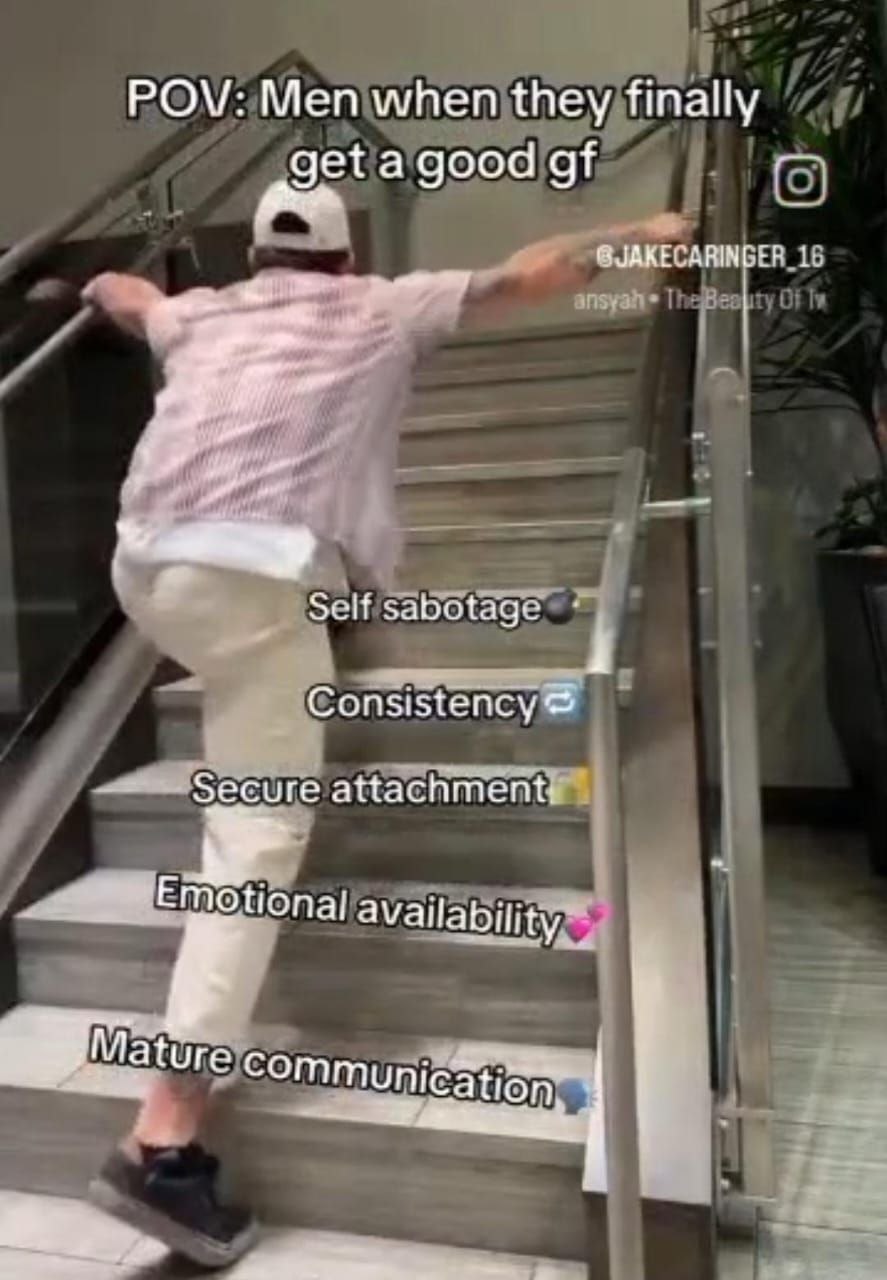
Well, I have decided to address the elephant in the room. Why do people—often without fully intending to — behave in ways that undermine a relationship they actually want or value? This phenomenon is called self-sabotage, and based on the information I have about the two scenarios above, a distinction is in order as to why one and not the other is an instance of this. Joba was guilty of self-sabotage. The distinguishing factor is that he actually wanted the relationship. The other guy didn’t. And this is what often makes this phenomenon mind-boggling. If you really want something, you would actually work to keep it. Or so we think. Let me be clear. I’m not defending Joba. I think what he chose was definitely not the best course of action. But I also think that we tend to not realise that there’s often a lot going on behind the scenes such that a “he’s only being irrational” is reductionistic and doesn’t do this experience justice at all.
There are at least five reasons why people embrace self-sabotaging behaviour. First, which I think is what may have been in Joba’s case, is familiarity with unhealthy relationships. People don’t always gravitate towards what is healthy. They can gravitate towards what is familiar. It is the same reason why a lady can find herself in a cycle of toxic relationships ridden with abuse. Someone who grew up around conflict, emotional unpredictability, neglect, or unstable relationships may unconsciously associate intensity, jealousy, emotional highs and lows, or conflict with love. Such that a calm, secure relationship can feel strangely boring or even “wrong” and they would rather unconsciously recreate the chaos they’re accustomed to. This may look like deliberately instigating unnecessary arguments.
Second, which is ironically the opposite of Joba’s case, is perfectionism and unrealistic expectations. Someone may have an idealised picture of what romantic love should feel like, such that when the inevitable imperfections appear — arguments, boredom, differences in personality, competing priorities — they conclude: “Maybe this isn’t the right person.” As an ancient philosopher once said, Everyone has their sh*t that they’re trying to get together, and as long as you’re actively trying to get it together, that’s all that matters. Self-sabotage rears its ugly head when perfect becomes the enemy of good. And so they leave, find someone else, experience the same realities of relationships (because, hello! we’re humans), and voila! The cycle continues.
Third is difficulty tolerating uncertainty. Let’s face it. Romantic relationships involve enormous uncertainty. Questions like the following continue to haunt one’s mind: Does he really love me? Will we still be together in five years? What if she changes? What if I get hurt? Some people try to eliminate that uncertainty by controlling the relationship—testing their partner, demanding reassurance, checking their loyalty, creating situations where they can prove whether the partner cares. Well, as you may already know, these kinds of behaviour could be exhausting and damage trust. Deliberately putting your partner in a situation where they can cheat on you just to prove that they won’t cheat is probably not the best way to gain their trust and make the relationship flourish.
Fourth is fear of abandonment. Someone who has experienced rejection, abandonment, or inconsistent affection may develop the expectation that people eventually leave. So when a relationship becomes important, vulnerability increases, and this vulnerability creates fear. They might unconsciously think, “If you’re going to eventually leave me — which I think you will — I’d rather leave first.” And so they end a relationship that they actually wanted. Closely related to this is a fear of intimacy. Some don’t primarily fear being abandoned. They fear being known. A serious relationship requires someone to see your weaknesses, needs, insecurities, and perfections For someone uncomfortable with that level of vulnerability, intimacy can feel threatening. They may therefore create distance whenever the relationship becomes too emotionally close.
Fifth is low self-worth. Someone may genuinely believe: “Why would someone like this actually choose me?” If their partner treats them well, that can actually conflict with their internal view of themselves. They may therefore search for evidence that their partner doesn’t really love them — or behave in ways that eventually cause the partner to leave. It’s sometimes easier psychologically to believe: “They left me because I knew they didn’t really love me” than “Someone loved me, and I was terrified that I wasn’t worthy of it.”
In all these, there’s an important distinction that must be made. Sometimes someone leaves a relationship because the relationship isn’t genuinely good for them. Sometimes distrust is justified, incompatibility is real, or a partner is just a*s. And sometimes what gets labelled as “self-sabotage” is actually a person’s reasonable response to an unhealthy relationship. So the question isn’t just about whether a person did something that damaged the relationship, but whether they repeatedly behaved in ways that undermined something they actually wanted, particularly when the relationship became more vulnerable or meaningful.
Perhaps you can resonate with some of what I’ve described above, either personally or with someone you know. It’s useful to consider that they’re probably not consciously embracing the sabotage but the protection it provides. And that often solves a short-term problem while creating a much larger long-term problem. So you shouldn’t be surprised that telling someone “You’re pushing away someone that loves you” often doesn’t change the behaviour. The underlying fear or belief has to be addressed. In case you have a partner who seems to be struggling with any of these, it may be useful to exercise patience and urge them to have the difficult conversations. And remember most of all the words of a wise man, “There is no safe investment. To love at all is to be vulnerable.”
Happy relationshipping.
(Looking for more relationship advice? Here’s some I wrote for Valentine’s last year.)
–Klaus