The University of Ibadan is one of the few institutions with a rich history of activism, conscientization, and victimisation, sadly. Either due to the length of her existence and/or the calibre of management that have governed her affairs since inception, the fourth estate has had to constantly reflect on the labours of our heroes past and present, the re-emergence of similar pitiful scenarios from the 70s, 90s, and 2000s, and the sensitization of the average student that has experienced paradigm shifts in student activism. It is already quite depressing that voices are begged to speak, to remind ourselves of the work that has been done to keep our head high against unfair policies and victimisation over decades. And since the fourth estate has not backed down in constant reminders and documentation, just as we’ve made reference to the immortalised Kunle Adepeju in 1971, Kunle Adebajo between 2016-2018, Ojo Aderemi between 2017-2019, and many more historical events, we are now compelled to make reference to the UI3 between 2024 and now.
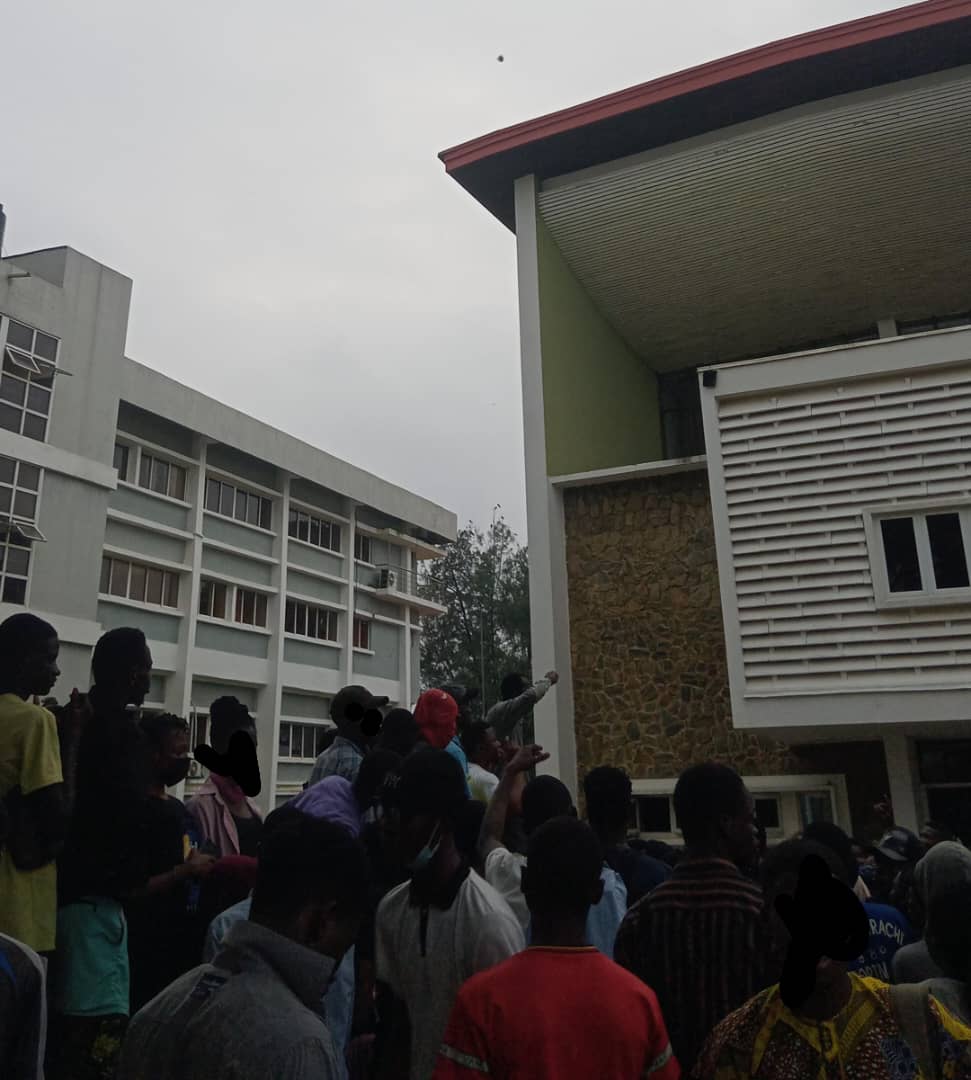
It’s been two years since the protest that erupted at Nnamdi Azikiwe Hall on July 16, 2024, materialised into a congress in the middle of the night, and resumed on July 17 with an initial march and eventual convergence at the senate building. That historical event was also slightly over two months after the harassment of the famous UI3 at the inauguration of erstwhile SU president, Bolaji Aweda. For many people, till date, what they know best about the genesis of the protest was that some noise started coming from Zik Hall, sounded like shouts of dissent, and they joined the group, after being oriented mid-march that there should be no lights and digital recordings. However, before the march materialised, there was a memo, subsequently distanced from by the management, about electricity rationing from the Department of Works which had sparked conversations across halls. The memo was sent out before 10 p.m. and it stated that the school will only be powered between 10 p.m. and 2 a.m. at night, and between 8 a.m. and 2 p.m. in the day. A countdown started in Zik Hall in anticipation of light at 10 p.m., even though what was going to happen after – light or not – was not so clear to the residents because for the most part, all that could have just been Zik’s routine communal chatter. At exactly 10pm when the light wasn’t restored, someone started some call and response solidarity chants, and some other residents responded in unison. People were urged to come downstairs and a march started towards Independence Hall, came back to Zik, then back to Indy for the second time, before going to other Halls like Bello, Kuti, etc.
At Queens Hall, power came on in school but the protest didn’t stop. However, some protesters turned back and at the same time, some people locked the Queens Hall main gate to prevent any movements in and out of the hall, depriving the march of extra numbers. There was a confrontation that the act was an exact replay of May 2017 when Ojo Aderemi wanted to protest and they came to Queens Hall and Queenites shut the gate against the protesters and against their fellow residents that wanted to join the protest. From the turnout of events that night, to the turnout of students the following day, and sequelae over the last two years, we have a lot to unpack and at the vertex of it all, we need to ponder on how conscientious we are as a group.
The march continued towards other parts of the school and converged at the Vice Chancellor’s lodge where a congress was formed. The group asked the then UI’ SU general secretary to write down the resolutions and asked someone else to document on their end because that administration had adulterated the resolutions of a previous congress in that tenure. Afterwards, the President of the Union was compelled to release a statement that the protest will continue later that morning. There were demands made in that resolution such as adequate electricity and no victimisation, the latter which has become recurrent in the University of Ibadan since that incident. In that historical night, the crowd kept ‘compelling’ her leaders to take certain actions to prove to them that they (leaders) are on the side of the students. That was already a problem in itself; for people to coerce their leaders to amplify their voices even more for the collective good of the Union they claim to serve.
On July 24, 2024, the UIMSA Press published an article on a lesson for CoMUI students as regards a two-day protest that unfolded seven days before. As hard as it was for the Union leaders to boldly frontline the protest, so was it for College students to show up at the protest ground on July 17. The article highlighted the poor representation of the college at that protest. In fact, that poor representation was not a one-off act, subsequent congresses at the SUB foyer had little representation from the College, save for a few persons in the capacity of the Press or SRC. This extends to further conversations around the politics of administration vs politics of activism further discussed in that article. Student leaders are quick to hold stakeholder meetings on the transfer of power – legislative or executive – to the College side of the University, just like how the unwritten rule of regional power alternated between Southern and Northern Nigeria plays out. Less thoughts are given to the efficiency of the said person so far one of them is at the seat, and this has always bit us in the back where it matters.
At the convergence in the senate building, one of the seven resolutions reads “A stop to victimization of UI students.” In response to the protesters whose displeasures the then SU president communicated, the then DVC, Professor Olapegba, said “the University had not in any way victimised any students, adding that all it had done was to request the affected students to explain their actions in line with the University’s rules and regulations.” Apart from the fact that the statement was a very diplomatic way of still saying that whenever students explain their actions, it is never in line with the university’s rules and regulations so a suspension/rustication has to come out of it, subsequent Student Disciplinary Council meetings say otherwise as we have now seen with the eventual turnout of the UI3 case. Not just that, Professor Olapegba is the newly appointed Vice Chancellor, set to succeed Prof. Kayode O. Adebowale as the 14th VC of the school, the same person that told students to their faces that the University had not victimised any students. As the congratulatory messages and memo circulate, let the thinker beware of what the next couple of years in UI will look like.
If we are to situate our minds on the last of the five stages of grief – acceptance – and be at peace with the fact that the university will always be ruled by people that are not ashamed to uphold anti-student policies, the best thing we can do is stand with each other as much as possible, never forsaking one of ours to the ruthless tooth of the management. This is where we question the attitude of the Union leaders whose administrations witnessed the first SDC hearing on the UI3 case and the hearings after, before the eventual four-semester suspension verdict. In the accounts documented by press organizations and the UCJ, there was no solidarity for these victimised students at any point; the best of the lot tried as much as possible to appear diplomatic while the worst brazenly put out ridiculous statements siding the VC – not even the university management – on matters involving the victimisation. If we excuse fear of getting victimised as the reason for diplomacy when we needed a voice, what of far more subtle collaborations like dropping the Union’s bus for transportation to the Federal High Court on the day of the hearing? The bus in question has been used for different associations’ and faculties’ events, SEALS Cup, and many more. Why is the line drawn at seeking justice for one of our own?
For all our intellectualism, we barely recognise how regressive we’ve become in thoughts and actions. This is the reason someone the university student populace elected as their SU President said the March 31st Federal High Court ruling doesn’t stand because “the judgement was passed while the other party (the VC and the university) was not in the court, which implies the judgement is not holding.” It is incredibly preposterous that the SU President of a self-acclaimed intellectual union does not understand that a court ruling does not depend on the appearance of either parties at the court hearing, so far they are ably represented by legal associates. We are not angry enough, we are simply not angry enough; and a two-year anniversary of a historical protest should throw us into deep reflections of where we stand as a Union. Because with the recent appointment of a VC who could not but rely on diplomacy to discard aggrieved students, and the election of leaders who are simply not conscientious enough, we are snowballing into unfavourable times, rapidly and surely.