

To many of us, excellence has different definitions. To some, it means having above 50 and not having to resit an exam, balancing academics with extracurriculars perfectly, or watching the entire class pass together and to a few of us, having distinctions in our courses. These varying definitions and approaches to success are the beauty of medical training. It helps to produce doctors who are ready to give themselves wholly to the medical practice. While excellence differs from one person to another, there is a need to identify what definition and approach we would like to take to it. What better way to refine and review our own methods than to hear from people who we all believe have been successful in Medical school?
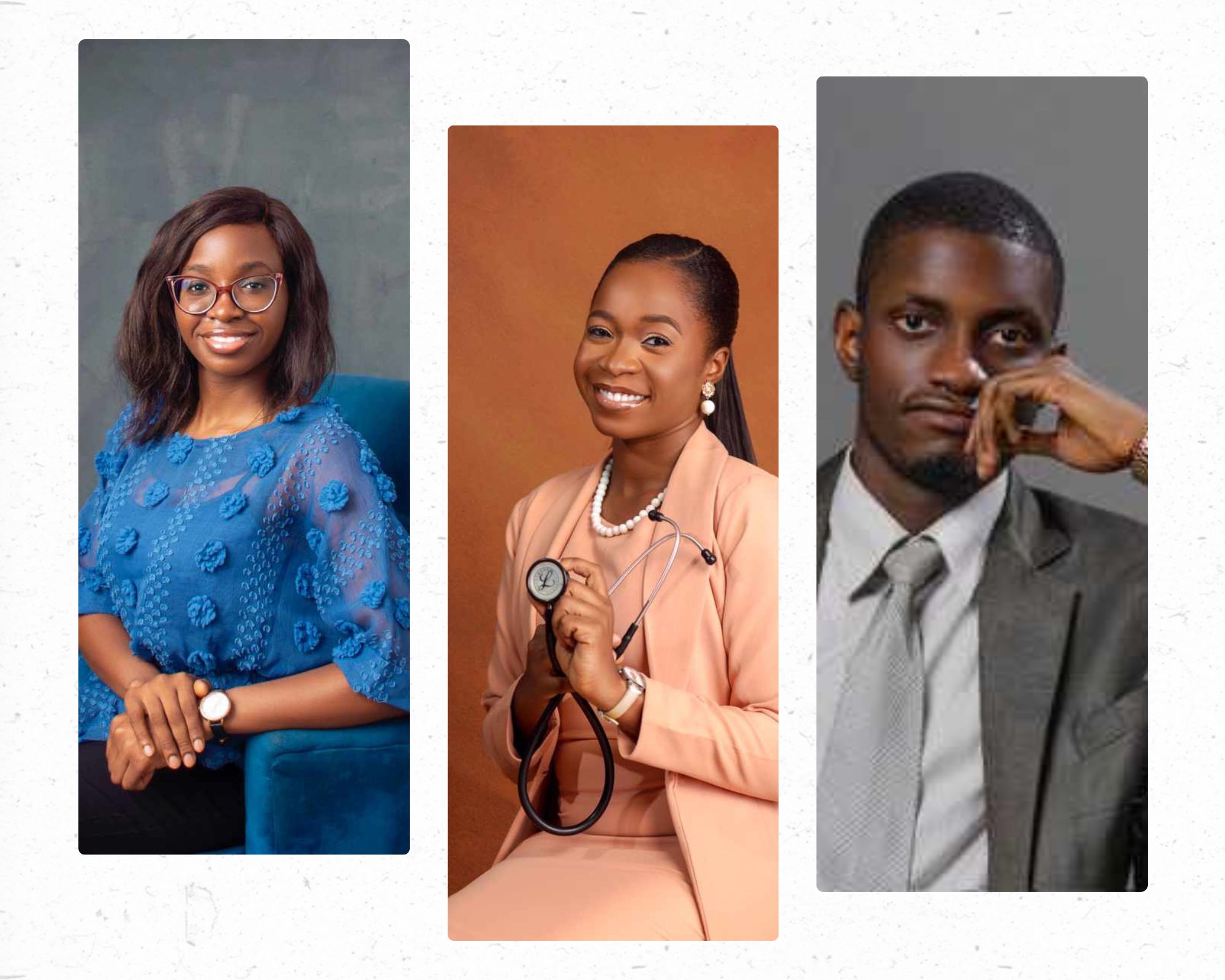
It is with this in mind that the UIMSA Press set out to interview the members of the recently inducted class (Excelsior) who graduated with distinctions. They include Dr. Ifeyinwa Ogbogu, Dr. Oluwatunmise Alasadewe, Dr. Fisayo, Dr. Kelechi Ughagwu and Dr. Efosa Iyawe. A round-table interview session was held and they gave perfect, humane answers to the questions asked.
The first set of interviews was held with Dr. Fisayo who had a distinction in Anatomy and is a member of the Royal Quiz Club, Dr. Ifeyinwa who had a distinction in Psychiatry and was the administrator of FAMSA and Dr. Oluwatunmise who was awarded as the best student in psychiatry for the 2023 Ibadan doctors.


Congratulations on completing your medical studies. You wrote your final Medical board exam a couple of weeks ago and you’ve been free since then. How has that been for you? What have you been up to?
Ifeyinwa: I’ve not been doing anything important. I went home and then came back to school for clearance. I’ve been watching some movies. I just finished Flatmates. I’ve also been spending a lot of time with family.
Fisayo: I’m still in school, doing my clearance. I’ve not been doing a lot. I’ve been relaxing, watching movies and reading novels.
Tunmise: I have been in school, traveling for different activities. I’ve not been doing anything
academically. I’ve been trying to do some research on what I want to do after school too.
What inspired you to pursue a career in medicine, and how has that motivation evolved throughout your journey in medical school?
Ifeyinwa: Initially, I was a science student in secondary school. I strongly considered changing to the arts because I could not see how the sciences were applicable in real life but I stopped believing that long ago. I didn’t like engineering or computers or design processes so medicine was the obvious choice. I had a sister with a heart defect with a background of Down’s syndrome. We went to the centre a lot. I wanted to be a cardio-thoracic surgeon for her. I had an uncle in the speciality already so I told him and he said I couldn’t go to school to study cardio-thoracic surgery. *laughs*.
He said I had to study medicine and then specialize. That was my initial motivation, to help children with Down’s syndrome. Of course, getting into medical school, that has now changed. I do not even want to do surgery at all. I saw that medicine was very wide and that there’s a lot of good that we can do. I also believe that the core values of medicine relate to the virtues my religion demands of me.
Tunmise: This is a question that I do not know how to answer. I didn’t know what medicine entailed as a young child. My dad was a pharmacist. I just knew there was a career called medicine. I played around with my dad’s stethoscope a lot and everyone just thought I was going to be a doctor. It was nothing deep for me, not that I was inspired by anything. It just felt like the right thing for me. I prayed about it too. Coming into medical school, I realized that I wouldn’t have done anything else. I mean, I love Medicine. “Laughs” I know, contrary to popular opinion. I’ve ended up falling in love with almost all the specialties in medicine and it’s now hard to pick which one I want to do. I love medicine, the humanity you put into it, I love the science behind it, I love seeing people get better. I’ve grown to love it.
Fisayo: When I was in secondary school, all the subjects came easily to me. It was a dilemma trying to decide what to study in the university. I had an aunt who was a medical doctor, nearly all her children were medical doctors. I loved reading biology, I enjoy reading everything *chuckles*. The motivation is not as strong as before. We have faced a lot of ups and downs. Our armor has gotten stronger.
As graduates with distinctions, what were some of the key factors or strategies that you believe contributed to your academic success?
Ifeyinwa: I got into biochemistry in 100l. I was initially discouraged but my parents encouraged me. It was a situation of just putting in my best. If I couldn’t cross to medicine, I’d come back for my
second degree in medicine. I could not play as much as a lot of people would. It was a priority for me to attend all classes and that has continued through medical school. I had notes for all subjects throughout medical school. I needed to understand all concepts so I read textbooks. I studied a lot. I had friends in medicine and dentistry who I studied with. They accepted just 5 people from biochemistry and physiology and I was one of the 5. I retained these methods throughout medical school. I loved psychiatry, the interactions with the patients, and the morning meetings with the residents. I believe this affinity to psychiatry helped me get a distinction in it.
“…believe that it is possible. Do the necessary work, set a goal and write it down. Goals
are not solid until you write them down. Let the goal be the driving factor.
When you’re driven hard enough, you’ll do the required work.”
Tunmise: I didn’t sit down to prepare to have a distinction in psychiatry so I’ll be speaking in
retrospect. I give all glory to God. I had an accident in the 100 level and still finished with a 6.9. I cram a lot too, I did that with my preclinical classes. I resumed psychiatry with a lot of positive resolutions. I read a lot, and asked a lot of questions. I didn’t know what to read two days to test because I had previously read everything. I didn’t feel as prepared for my psychiatry 2 test so I went back to my table and planned for the MB. I wasn’t even expecting a distinction but I knew I was going to do well.
Fisayo: My distinction was in anatomy. I was reading anatomy all the time because I found it more interesting. I had no idea what we were going to start with in 100 level and that’s how I started reading human anatomy. I resumed and found that we had to start with physics, chemistry and zoo. “Laughs”. I didn’t use Keith Moore as much as other people did. I used Cunningham’s more especially for head and neck, lower limbs, and upper limbs. I think it was the persistence in reading anatomy that did it for me. I read it a lot.
How did you balance academic demands with extracurricular activities or personal life during medical school?
Ifeyinwa: Todo lists worked for me too. In UIMSA, there’s a lot of pressure to be involved in a lot of things. I prioritized and I focused on the important things. I prayed before all classes and I committed everything into God’s hands.
Tunmise: I can not claim to have been completely balanced. I had struggles. Having a to-do list really helped me, praying was a good coping strategy for me, and having friends who could relate. I wasn’t balanced throughout. I also try to avoid impromptu activities a lot. I will also mention that compared to some of my classmates, I wasn’t involved in a lot of extracurricular activities.
Fisayo: I wasn’t involved in a lot of extracurricular activities. The todo list helped me too, time
management essentially.
What were some of the most memorable experiences or moments during your time in medical school?
Ifeyinwa: They weren’t really in medicine but they happened when I travelled for FAMSA. The WHO event too. Those were very memorable experiences because I got to meet people that I would not normally have met, people I only saw on TV.
Tunmise: For me, it was the accident I had in 100 Level. That was how I met Dr. Adeoye, my mentor. Most of my other memorable experiences were outside medical school, non-academic.
Fisayo: I won’t say there was a specific one. Some memorable ones include the inter-school quizzes. One that stood out was the NIMSA quiz competition that was held in ABUAD. The first time I interacted with Dr. Daniel also counts as one of them. It was scary and fun at the same time.
Medical school often requires strong teamwork and communication skills. Can you share an instance you have had to work with someone on this interview?
Ifeyinwa: I worked with Tunmishe for close to 4 years. In our final year I was administrator and she was director of Human Resources. It was great working with her because she puts her mind into whatever she’s doing. We were able to learn from each other. Unfortunately, we never got to interact on an informal basis. We started talking more on a less formal basis recently. With Fisayo, we’re both Catholics so we used to attend FECAMDS together. We also worked together on the class quiz team.
Tunmise: I worked with Ifeyinwa on FAMSA HQ as she has said. I’m surprised that she’s saying that about me because I was going to say the same. Ifeyinwa is the most dedicated person I know, very thorough and she can be very cool calm and collected. I learnt a lot from her, I didn’t realize she was learning from me too. She’s someone who I believe would fit perfectly in an organization like WHO. *chuckles* Fisayo and I are in the same group and we see each other a lot. He also makes really funny faces. We’re not so close but we see around.
Fisayo: With Tunmishe, we see a lot as she said. I didn’t work with her formally. Ifeyinwa and I worked together in the 2k18 quiz team and the royal quiz club. They are both really friendly women. Ifeyinwa is one of the most thorough people I know, as Tunmishe has said.

“…the woman herself was
depressed. It made me see that caring for patients is a very holistic process. It made
me realize that the carers also need care”
During your clinical rotations or practical experiences, was there a particular patient interaction or case that left a lasting impact on you? If so, how did it influence your approach to medicine?
Ifeyinwa: I clerked a lot of patients and each patient experience was unique. For me, I used to say I was co-managing patients. There’s no patient that I’ll say was more memorable than the other.
Tunmise: I stand with everything Ifeyinwa has said. But a patient I do remember is one from my paediatrics 2 posting. The child had sickle cell anaemia so I just stayed with the parent. The woman herself was depressed. It made me see that caring for patients is a very holistic process. It made me realize that the carers also need care.
Medical school can be challenging. Can you share a particularly difficult moment or obstacle you faced during your studies and how you overcame it?
Ifeyinwa: For me, it was the workload. In 200 level, we had all these big textbooks. There was a time that I arranged all my textbooks. I put Ganong’s, Halper’s, Langman’s embryology and I just arranged them on my table from the biggest to the smallest and I started crying. I learnt to overcome that by taking it one at a time. I also prayed whenever I was overwhelmed. Not knowing what was expected was also a challenge. I failed Hematology test and I used that to learn and better navigate the Medical Board exam. Sometimes we do not know what is expected of us till we learn from our own experiences.
Tunmise: I hate average so my scores were a major challenge in medical school. The scores were good but they made me cry a lot. One thing that helped me was talking to my mentor. He talked to me and advised me to not be all about the scores but the knowledge too. He said this would distinguish me at the end of the day.
Fisayo: Pediatrics was it for me. To me, it had bad vibes. O & G MB also made me fed up.
“… I arranged all my textbooks, I put Ganong’s, Harper’s, Langman’s embryology and I just put them on my table and started crying…”
What advice would you give to current medical students who aim to excel academically while maintaining a healthy work-life balance?
Ifeyinwa: I would implore them to believe that it is possible. Do the necessary work, set a goal and write it down. Goals are not solid until you write them down. Let the goal be the driving factor. When you’re driven hard enough, you’ll do the required work.
Tunmise: Apart from all that they’ve said, I’ll add that do not let the fear of failure stop you. Be the best at everything, at everything you do. Apply yourself, learn the basics and pray.
Fisayo: Just put in the work. Know what the curriculum entails, do not leave any stone unturned.
What are the hobbies that you pursued outside of medical school?
Ifeyinwa: I did not adopt new hobbies. I liked swimming, sometimes Imoran had competitions. I listen to music a lot too, I also attended a lot of music concerts. I loved reading novels too but school didn’t allow a lot of that.
Tunmise: One activity I do a lot is singing. I joined studios to sing. I also made some money doing this. One skill I acquired and grew to love was fashion design. I also loved reading but I didn’t have a lot of time for this.
Fisayo: My hobbies are mainly watching movies and TV series. For sports, I play basketball. I read novels – mostly crime and thrillers. I’m not the party type but I attended a few parties. *chuckles*.
Medical school can be emotionally demanding. How did you manage stress and take care of your mental well-being during your studies?
Ifeyinwa: Talking to friends. Mostly friends who were not even in medicine helped to pick me up. They did not understand what I was going through but the distraction was needed because sometimes we get too absorbed in our problems and start to think medicine is the most difficult thing in the world. Talking to family helped is something that really helped me find balance too.
Tunmise: I am a music minister, I worship a lot. So I take out time to just be on my own. I like spending time alone, singing, worshipping and praying. Once I do that, I’ll be fine.
Fisayo: Watching movies, series or animes. Whenever things were looking too hard to bear, I went back to these things.
Medical education is continuously evolving. Are there any changes or improvements you’d like to see in medical school curricula, especially in COMUI?
Ifeyinwa: Some postings like pediatrics, O & G and medicine were too bulky. Students didn’t have time to study. The system needs to be made more student-friendly.
Tunmise: There seem to be a lot of activities in some postings that prevent you from studying at all. They need to create more time for students to study more so they give it their best. What’s the purpose of doing so much if you can’t understand what you’re doing at the end of the day?
Fisayo: They have both touched on what I had to say.
As you transition from medical school to the next phase of your career, what are some of the challenges you anticipate, and how do you plan to tackle them?
Ifeyinwa: For now, the problems I have identified include how to manage my finances by myself, bills, and responsibilities. I’ve read some books and I’ve been at home with my parents and I’ve been learning a lot from them.
Tunmise: For me, it is the major life decisions that I have to make. We have to decide if we want to do post graduate studies, or marriage, where we want to do our residency. I plan to figure that out by reading books and speaking with my seniors. I also trust God to help me.
To conclude, who are some impactful people in your life who have made medical school easier that you would love to give a shoutout to?
Ifeyinwa: There are a lot of them. Tito, from Dentistry. Chinonye, in 2K21, Anthony studied with me for parts 3 and 4. Dr. Olaoye, a consultant in ILORIN and Prof M.C Asuzu.
Tunmise: *laughs* Yes, please. I want to make a lot of shoutouts. I got a lot of support from people. Dr Adepoju, a former surgery resident, Dr Anointing, a resident in Bowen, Dr Adeoye, an Orthopedic surgeon and then all my friends. They had time for me to talk me through every step of the journey.
Fisayo: There are seniors and a consultant here at UCH. The seniors include Segun Afolaranmi who was in the 2K15 set. Chibuzor and Aremu Matthew in the 2K17 set. They are people who I look up to and they motivate me. The consultant is Dr. Daniel in ENT, he has shared some very good pieces of advice with me.


God I want to have a testimony also
And I would like to be connected together with my senior 08160356871
This piece gave me a lot of insights. Kudos to UIMSA!