


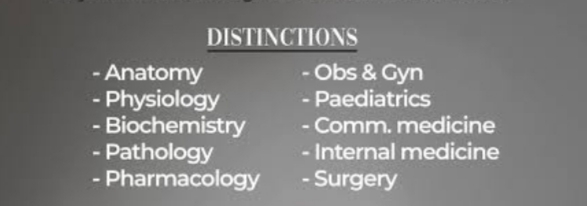
Earning a distinction in any medical school is an extraordinary feat; however, at the University of Ibadan, where the distinction benchmark is 80, the achievement takes on an even more striking hue. This year, the 2k27 class recorded an exceptional result: 15 distinctions in Anatomy, 1 in Physiology, and 1 in Biochemistry.
Beyond the numbers are students who prepared in different ways, faced different challenges, and ultimately crossed the same demanding benchmark. UIMSA Press spoke with five of the distinction holders about their experiences: from the moment they saw their results to how they prepared, what challenged them, and what they would tell the students coming behind them.
Seeing the Result
What was your first reaction when you saw your result, and did you expect to earn a distinction?
For Bazeet, the result was a pleasant confirmation rather than a complete surprise. “I was delighted, but in a way, there wasn’t much dopamine rush. I could say I had anticipated it because my viva went really well. However, I still had to keep praying until it was finally in the bag.”
Yinka, on the other hand, described her reaction as one of relief and gratitude. Although she had high expectations for herself, she wasn’t completely certain that she would earn a distinction.
For Ariel, the result was considerably more unexpected; “Since the viva day, I had honestly given up.” When he checked the results and saw the star beside his name indicating a distinction in Anatomy, he was shocked enough to wonder whether the distinction had been assigned to someone else. “Till today, every day I wake up, I check the MB results again to see if the star is still there.” He said.
Zainab knew she was a distinction candidate because of how the viva process had been conducted, but self-doubt remained; “Seeing my results was more of a satisfying feeling; everything eventually paid off, and I won.”
For Charles, the feeling was one of fulfilment. He had expected the result since the beginning of preclinicals and was happy to finally see that expectation become reality.
Approaching the 80% Benchmark
With UI’s distinction threshold standing at 80%, how did these students approach the examination?
For Bazeet, the preparation began with the Continuous Assessments; “I think the very first thing is to have very good CA scores.” He also sought advice from seniors who had previously earned distinctions. One piece of advice stayed with him:“It is mental, ensure you don’t get defeated within yourself.” That mindset became central to his preparation. He approached the examination believing there was no other possible outcome but success.
Yinka took a slightly different approach. Rather than constantly focusing on the 80% benchmark, she focused on understanding the material well enough to reproduce it under examination conditions.“I focused on making sure that I actually understood what I was studying to a point where I could reproduce it under examination conditions. She also emphasised aiming high in every CA, while recognising that examination preparation sometimes requires strategic prioritisation.
For Ariel, a strong CA score was equally important. He actively participated in lectures and practicals, including dissection, histology and neuroanatomy practicals.
Zainab’s approach began even earlier. For her, understanding the examination itself from the beginning of pre-clinicals was crucial. “I needed to first understand the exam early enough, as early as the first day of pre-clinicals.” She also focused on building a strong foundation through her In-courses and approaching different sections of the examination according to the lecturers and question formats.
For Charles, the approach was built around consistency, discipline, and faith. “I approached the exam with God’s grace and guidance… I also gave myself to intense and consistent studying and preparation.” He said.
What Did Preparation Actually Look Like?
There was no single formula. Bazeet began serious preparation about a month before the examination dates were announced. He created a calendar, distributed his topics across the available days, and used it to track his progress. He also relied on past questions, textbooks, group discussions, and teaching others. His conclusion was simple: “Reading is still the best strategy. No other way.”
For Yinka, preparation began from the beginning of pre-clinicals rather than when the examination timetable was released. “There is really no time for serious preparation by the time the MB timetable is out; the only thing one can do at that point is revision because there are three courses involved.” Her approach combined consistency, understanding and active recall. She attended classes, used different resources depending on the topic, and gradually learned what worked best for her.
Ariel did not have a perfectly stable timetable, but he combined several approaches. He attended classes and practicals, participated in group study with his study group, Circle of Willis, used reading jottings and past questions, consulted textbooks when necessary, and taught others. For him, teaching was particularly useful. While preparing, he had to teach someone cerebellar circuitry—a topic he did not initially understand very well. He went back to study it properly, only for it to appear as an essay question in the examination.
He gave a big shout-out to Ireoluwa, Gloria, Eniola, and Oluwaseun — his study partners and a special one to Dr. Tes, Bazeet, Oladunjoye, and Anyinam-Uzo Tochi for being with him through the journey.
Zainab’s preparation was more structured. She began serious preparation 43 days before MB and created a 36-day plan covering the preclinical material. Her intended routine was divided into four hours in the morning, three in the afternoon, and four at night, although she acknowledged that she did not always follow it perfectly; “Read, pray, brainstorm, sleep, rinse and repeat.” Her notes became her primary resource, alongside past questions, textbooks, videos, group study, and teaching others.
Charles described his preparation as consistent from the beginning, averaging about four hours of study daily. He attended lectures regularly and punctually, paid attention in class, read textbooks, wrote essays, solved past questions, studied with friends, and taught others.
The Hardest Part
For several of the students, the biggest challenge was not knowing what to study, but facing the sheer amount of material within a limited period.
Bazeet described the difficulty of constantly remembering how much remained to be covered. His response was straightforward: the material would not cover itself.
Yinka also identified time as her greatest challenge. With a large volume of material remaining close to the examination, she had to create a strategy table based on past questions and her understanding of individual lecturers.
Ariel similarly struggled with time. As the examination approached, he realised that he had forgotten some things he once knew well, particularly in Physiology and Biochemistry.
For Zainab, one of the hardest realisations was simply being human; “I’m just human, and I’m bound to get tired.” She said.
She found herself struggling with the feeling that time spent eating, sleeping or attending to other basic needs was time lost from studying. Support from friends, family and a mentor helped her navigate that period.
For Charles, the biggest challenge was internal: believing that he could actually break a record that had stood for years. He credits the teaching and prayers of his pastors with helping him overcome that doubt.
So, What Makes a Distinction Holder Different?
Interestingly, their answers point less towards some extraordinary secret and more towards a combination of preparation, understanding, and mindset.
Yinka’s observation came from studying previous distinction holders herself. She noticed that they possessed something in common: “Understanding.” Having now earned a distinction himself, she said her perception was confirmed.
Bazeet believes the Continuous Assessments leading up to MB were particularly important, while Zainab emphasised starting early and defining one’s goal from the beginning. Charles highlighted self-belief, quality work, humility in seeking guidance and trust in God. For Ariel, there was no special category of people to point to. “I think everyone gave it their best; they went all in.” He said.
Advice to Those Coming Behind
When asked what they would tell students preparing for MB I, their advice converged around a few themes: start early, be consistent, understand yourself and the examination, use past questions, attend practicals, and do not try to navigate the process entirely alone.
Bazeet kept his advice brief:
“There’s always more, go for it.”
Yinka’s three were:
“Be consistent, solve a lot of past questions before and after reading, and be patient with yourself.”
Ariel emphasised the importance of doing well in in-course assessments, having a study or accountability group, and actively participating in practicals.
Zainab’s advice was to understand how you learn best, understand the examination itself, and have a reliable support system; someone who can guide you, explain difficult concepts, encourage you, and help you navigate the system.
Charles offered four principles: trust that success is possible with God, put in the right amount and quality of work while avoiding distractions, build healthy relationships with friends and seniors, and remain disciplined.
Breaking the Biochemistry Record
Among the achievements recorded by the class, one distinction carried additional significance. According to records available to the class, Biochemistry had not recorded a distinction at UI in over a decade.
The student — Charles who earned it knew about the history before the examination and deliberately set out to change it. “I approached it with the full intention to break the record.” He said.
Interestingly, however, he did not adopt a completely different method for Biochemistry. “No difference, I gave my best to all my subjects as I believe that every course requires full dedication.”
He also earned a distinction in Anatomy and maintained the same principle across both subjects; no course was placed above another.“I do not place one subject above another. I was also very intentional about breaking records, giving more time, more focus, and diligence to preparation.”
Perhaps the clearest thread running through all five experiences is that there was no single formula for earning a distinction. Their approaches differed, but consistency, preparation, understanding, support, strategic use of past questions, and the willingness to keep going appeared repeatedly.
For the students coming behind them, perhaps the most important lesson is not simply that distinction — which is now 70% is attainable, even though the path to it does not necessarily look the same for everyone.
And sometimes, as Ariel’s experience shows, you may even walk into the result convinced you did not make it, only to discover that the star is right beside your name.
Romlah Abdulazeez.