


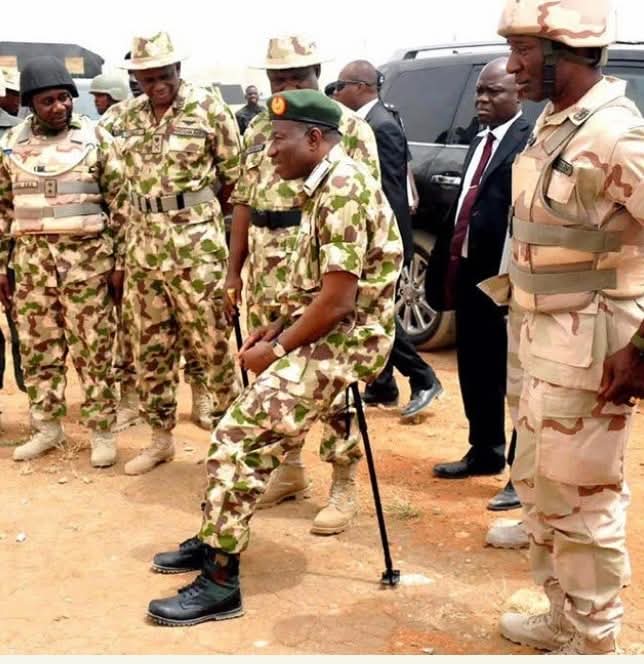
“No one’s ambition is worth the blood of Nigerians.” This was said by Former President Goodluck Ebele Jonathan after calling to congratulate Late General Muhammadu Buhari on his victory in the 2015 general elections. A month ago, the former President was seen talking to reporters and addressing youths who were calling on him to throw in his hat for the 2027 presidential elections. He said, “The most important thing we need right now is peace,” and later on, he added, “I have heard you, and I will consult widely.” More importantly, a week ago, the Kabiru Turaki-backed faction of the People’s Democratic Party (PDP) ratified Jonathan as its presidential candidate. This series of events has got many Nigerians asking, “Is Jonathan going to contest for President in 2027?”
However, Jonathan’s repeated mention of ‘peace’ is something worth taking a closer look at. Nigeria is currently facing a crisis of insecurity, but there is a citizen, with five years of presidency experience, who loves to use the word peace; that’s something many Nigerians, who want peace to reign, will be interested to hear. Considering the various election observation missions Jonathan has undertaken across Africa, it is safe to call him the ‘peace-man’. And now comes the real question: if Jonathan was so obsessed with tagging Nigeria with the word ‘peace’, how peaceful was his time as the President of the country?
Jonathan was sworn in as President of the Federal Republic of Nigeria on May 6, 2010, becoming the nation’s 14th President and the third since the inception of the Fourth Republic in 1999. He assumed office following the death of President Umar Musa Yar’Adua, who passed away a day earlier after a prolonged illness. In his inauguration speech, he said, “…the security of life and property around the entire country would be of topmost priority in the remaining period of this administration.” And again, Jonathan hinted that peace was of priority to him.
October 1, 2010, marked 50 years of Nigeria’s independence from the colonial masters. On what was meant to be a day of celebration for Nigerians—marking the nation’s 50th anniversary as a sovereign state—twin car bombings occurred near Eagle Square in Abuja. The tragic attack, which claimed the lives of 8 people and left 36 injured, was the start of a series of incidents that signaled an absence of security of life and property in Jonathan-led Nigeria. However, an hour before this incident, the Movement for the Emancipation of the Niger Delta (MEND) had warned about the potential bombings, adding that “nothing is worth celebrating after 50 years of failure.” This marked the group’s biggest attack outside of Delta State. Mr Charles Okah, the individual responsible for the planning of the attack, received a life sentence on the 7th of March, 2018. This legal resolution followed a trial that spanned seven and a half years, concluding nearly a decade after the initial events.


The militant group, led by Mr Charles Okah, was said to advocate for better living conditions for the impoverished communities of Nigeria’s oil-rich southern region. However, a year before the Abuja bombings, the group accepted the federal government’s amnesty offer, with several members surrendering their weapons in exchange for stipends and vocational training provided under President Umar Musa Yar’Adua’s administration. President Goodluck Ebele Jonathan condemned the attack carried out by the militants as a “wicked act of desperation by criminals and murderers,” yet only days later, on November 12, 2010, the residence of Mr Timi Alaibe was bombed. He was the Special Assistant to the President on the Niger-Delta, the southern oil-rich region. The assault occurred early in the morning, resulting in the death of his police guard. The incident was particularly perplexing, as Alaibe had been actively involved in rehabilitating repentant militants, leaving the motive behind the attack shrouded in speculation and rumour.
Just a day before the attack on Mr Timi, the house of a governorship aspirant under the umbrella of Action Congress of Nigeria (ACN, now APC) in Delta state, Mr Jude Ukusare, was set on fire with dynamite. It happened that Mr Jude wasn’t at home during this incident, and returned to see two of his family members dead. At that point, the tenure of Jonathan was already far from being peaceful. A month later, as the 25th of December draws near and preparations for Christmas intensify, a series of explosions occurred in different states in Nigeria. One, in a village at the centre of Jos city and the second, a bomb blast in two churches in the northeastern state of Borno. These two tragic incidents claimed the lives of 38 people, including a Baptist pastor, and left many injured. A few days later, the Islamist extremist group, Boko Haram, claimed responsibility for the bombings.
As Jonathan’s inherited term neared its end and the preparation for the 2011 presidential election was underway, he was faced with the challenge of the unwritten ‘zoning’ system in the People’s Democratic Party (PDP). This system, which requires that power be rotated between the Northern and Southern parts of Nigeria every eight years, had hit a snag in that Yar’Adua, a Northerner, never finished his full term of eight years after Olusegun Obasanjo, a Southerner, left power. Jonathan, from Bayelsa state, South-South Nigeria, was in a difficult position.
Yet, the PDP Primaries came, and Jonathan won, securing the presidential ticket to contest in the coming April 16, 2011, general elections. In the buildup to the elections, Jonathan encouraged Nigerians to participate in the election and shun political apathy. In a February 1st event that year, Jonathan continued his advocacy for peace. “Without security, there is no government. So it is not debatable, it is something we have to address, and we are working towards that with vigour.”
The election came, and Jonathan emerged as the president of Nigeria after securing 59% of the total votes in the election that saw a 54% voters turnout, the third highest in Nigeria’s history, behind only the 2003 and 2007 Presidential elections, with 69% and 57% voters turnout respectively. He was sworn in on the 29th of May, 2011, to start his second shot at restoring and maintaining peace to every part of Nigeria. On the night of the same day, three bomb blasts rocked an army barrack near Mamy market, Bauchi state and Zuba outskirts of Abuja, claiming the lives of 18 people and injuring at least 31. By the 3rd of June, days following the tragedy, the National Emergency Management Agency (NEMA) had dispatched relief materials to those affected by the explosions. However, peace had already vanished from the province where the President had secured 16% of the ballots cast.
Boko Haram had existed before June 16, 2011, but suicide bombings had never been recorded in Nigeria. On that day, however, the country witnessed its first suicide attack—an indicator that peace was slipping further out of reach. The bomber drove a car toward the police headquarters in Abuja. When security personnel attempted to stop him at the checkpoint, he accelerated into the parking lot and detonated the explosives hidden in the vehicle. According to police reports, the blast killed the attacker and one officer, whose charred remains were later recovered. The explosion also caused extensive property damage, destroying at least 33 vehicles and severely compromising security within the premises.
The Boko Haram extremist group boasted of being the mastermind behind this attack, marking Nigeria out as one of the countries with suicide attacks inscribed in their history. Although Nigeria had continually experienced acts of terrorism, recording a suicide attack clearly shows how extreme and illogical the acts of terrorist groups can be. And when terrorism reaches the point where individuals take their own lives to advance an ideology, those in power can no longer be reasoned with—no matter how persuasive their justifications may sound.
The United Nations (UN), an Intergovernmental organisation with the mission of maintaining international peace and security, experienced a breach in its own security on the 27th of August, 2011. Boko Haram launched another one-of-a-kind attack on the UN headquarters in Abuja—the first suicide bombing on an international organisation in Nigeria. A vehicle loaded with explosives rammed through two security barriers and into the building reception area, killing 18 people in the process. This incident gained international attention to further cement Nigeria as a country battling terrorism, as two foreign workers had just been abducted in Birni Kebbi three months earlier.


The abduction of a British surveyor and an Italian Engineer by Boko Haram took place on the 12th of May, 2011, and after a series of failed negotiations to free them, a military operation was planned and carried out by the British Special Boat Service (SBS) commandos and the Nigerian army on the 8th of May, 2012. This operation failed, seeing the two foreign nationals executed after a year of being held as hostages.
Between August, 2011 and May 14, 2013, Boko Haram carried out several attacks on various parts of Northern Nigeria: an attack in Damaturu, a series of bombings in December 2011, a suicide bombing in a Kano station and others, with those alone killing more than one hundred people and leaving more injured. Then on the 14th of May, the former president took a bold step as the Chief Security Officer (CSO) of the Federal Republic of Nigeria; he declared a state of emergency in Borno, Yobe and Adamawa states after a continued rise in terrorist attacks in the states. Although the governors of these states protested against it, Jonathan’s administration stood by the decision as the way forward for Nigeria against Boko Haram, after many failed attempts to negotiate with them.
Just like Jonathan, Nigerian Presidents, past and present, have resorted to declaring a state of emergency as a last resort to address escalating conflicts in a state. In 2004, President Olusegun Obasanjo declared a state of emergency in Plateau State, which led to the sacking of Governor Joshua Dariye. He did the same thing in Ekiti State, leading to the suspension of Governor Ayo Fayose. In 2025, President Bola Tinubu also declared a state of emergency in Rivers State, and a subsequent suspension of Governor Siminalayi Fubara. Unlike them, though, Goodluck Ebele Jonathan neither suspended nor sacked the Governors of the three states: Yobe, Borno and Adamawa.
Then came another bold step by the Chief Security Officer (CSO) of the Federal Republic of Nigeria on January 16, 2014, when he sacked all military chiefs and appointed new ones. Three months later, 276 girls were abducted from the Government Girls’ Secondary School in Chibok, Borno State. This happened late into the night of April 14, 2014. About 219 were successfully taken into captivity by Boko Haram after 57 of them managed to escape by jumping off the lorries being used to transport them. This incident sparked nationwide outrage and a campaign, online and offline, was launched with the hashtag #BringBackOurGirls, which intensified following the prolonged silence of Jonathan’s government on the abduction until 19 days later when Jonathan said, ‘they are working on it’ on a live broadcast. Throughout Jonathan’s tenure, none of these 219 girls was able to be rescued, leaving his successor, Late General Muhammadu Buhari, to secure the release of just over half. Buhari’s administration saw 1127 students abducted across ten incidents, highlighting the continued poor shape of ‘property and lives security’ in Nigeria after Jonathan’s tenure had ended.


By January 2015, three months to the 2015 presidential election, Jonathan had already faced political challenges in his administration; two court cases challenging his eligibility to contest in 2015 and two impeachment plots by the members of the House of Assembly. Law suits challenging Jonathan’s eligibility to contest in Nigeria’s presidential election never ended, even after his time as president. For every rumour of Jonathan’s return to the Nigerian political landscape, there has always been a suit, one in 2022 and another recently, in 2026. The rulings of these suits ended in Jonathan’s favour, and damages were ordered to be paid to him. Even if he has been cleared by the court to be eligible, what about the promise he made in 2011? “Four years is enough for anyone in power to make significant improvement, and if I can’t improve on power within this period, it then means I cannot do anything even if I am there for the next four years,” he had said. The Northern part of Nigeria saw no significant peace throughout Jonathan’s five years in office. Will he then be able to restore peace if re-elected for another four years?
Elections drew near, and Jonathan secured the People’s Democratic Party (PDP) Presidential ticket. But, less than a month after this, Boko Haram carried out a series of mass killings of civilians in the Baga Community of Borno State, further heightening the tension surrounding peace in Jonathan’s tenure. From the 3rd to 7th of January, 2015, Boko Haram killed an estimated 150 to 2,000 Nigerian citizens according to reports from official authorities, local media houses and international news outlets.
Two weeks later, Boko Haram came out boldly saying they are behind the massacre and in a video released by them, Abubakar Shekau, the head of the terrorist group, said: “more deaths are coming.” Then, following this, multiple suicide bombings saw more than fifty people dead in various commercial areas in the Borno State capital, Maiduguri, leading to the termination of the then-ongoing political campaigns of the current Vice President of Nigeria, Governor Kashim Shettima. Despite the security challenges Nigeria was facing then, political campaign activities across Nigeria continued simultaneously with several Boko Haram bombings and attacks, a show of priority that has continued in Nigeria’s political landscape till today, where banditry and kidnappings have become a norm.
A day before the 2015 general elections, on the 27th of March 2015, the Nigerian army recorded a significant victory against the Boko Haram insurgency. The year before, Boko Haram had declared the Gwoka town of Borno state as the headquarters of their caliphate, but on the day before the general elections, gallant troops of the Nigerian military, in what was described as a ‘concerted and well-coordinated land and air operations’ by Major General Chris Olukolade, the then Director of Defence Information, retook and liberated the town.
The 2015 Nigerian presidential election came, and Nigerians decided to put Jonathan’s five-year peace work to an end. He lost to the candidate he had defeated – General Muhammadu Buhari – in the 2011 presidential election; this made Jonathan the first and last incumbent president in Nigerian history to lose a re-election. Although Jonathan had mentioned some weeks ago that ‘the most important thing we need right now is peace,’ his time as the Chief Security Officer of the Federal Republic of Nigeria saw several breaches in ‘Security of lives and properties.’ Jonathan has been linked to the possibility of throwing in his hat for the 2027 Presidential race, and the odds continue to rise following Jonathan’s silence and the dismissal of a suit by the Federal High Court, Abuja, challenging his eligibility to contest.
Come January 16 2027, Nigerians will decide who will be the next Chief Security Officer of their lives and properties.
Omoyemi Adeoye Abdulgafar