


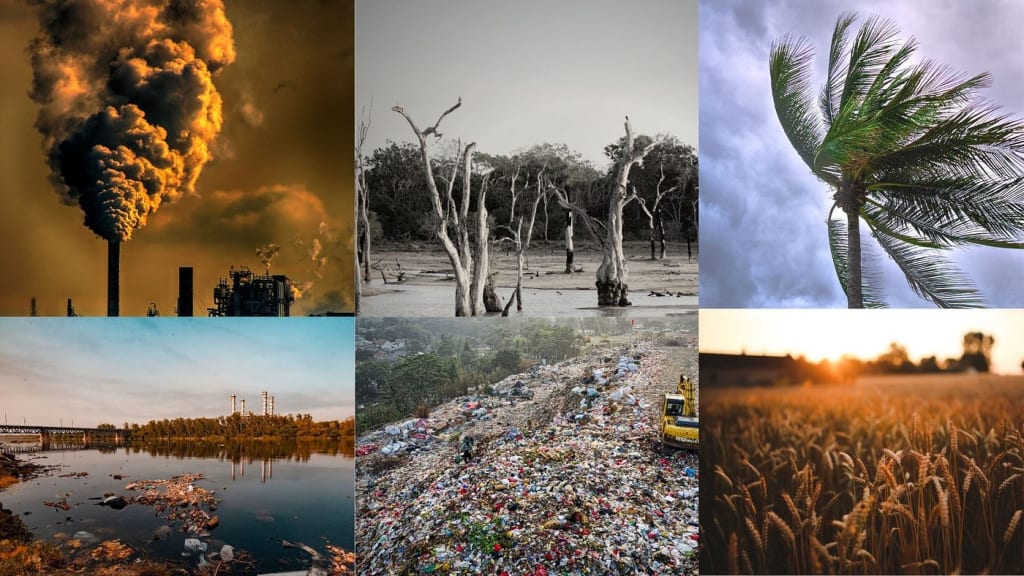
For many years, climate change has been overlooked as an abstract or trivial topic that has nothing to do with our health and well-being. However, it has begun to raise huge concerns with growing issues such as extreme heat, floods, droughts, wildfires, and air, water, and land pollution. What was largely seen as an ‘environmental problem’ is now known to have negative effects on human health either directly or indirectly, from increased spread of heat-borne diseases to displacement, food and water scarcity, and more. As a result, protecting our health and well-being demands that we do the same to our environment, as we cannot afford to stay healthy on a sick planet – the very planet where we grow our food, breathe, and move.
Climate change is a long-term, gradual shift in temperature and weather patterns that leads to adverse events. This shift can be either be natural, due to the sun’s activity or other environmental factors such as volcanic eruptions; or artificial/man-made, due to harmful human activities. Since the 1800s, human activities have been the primary driver of climate change, the most harmful being the burning of fossil fuels — coal, oil and gas – which generates greenhouse emissions (CO2, CH4, N2O and CFCs) that deplete the ozone layer – a thin layer of gas that forms above the Earth’s surface that protects us from the sun’s harmful ultraviolet rays. Greenhouse gases also trap the sun’s heat, raising the Earth’s temperature, thereby contributing to global warming. Global warming is further worsened by deforestation and industrialization, especially the oil and gas industry, to mention a few.


According to the Intergovernmental Panel on Climate Change (IPCC) in its sixth assessment report, it was clear that humans are primarily responsible for the rise in global warming over the last two centuries. This comes as no surprise, as almost all human efforts to improve the quality of life are associated with emissions and pollution, from modernized agriculture to transportation. Even conflicts and wars contribute to this menace through the destructive, and of course careless, use of explosives, which account for 6 per cent of greenhouse gases in the atmosphere.
Every country contributes to climate change, but some produce far more than others. The five largest emitters (China, the United States, India, the European Union, and the Russian Federation) account for about half of global emissions. To put that into perspective, the 45 least developed countries combined constitute less than 5 per cent of global emissions, while the U.S alone emits more than 10 per cent. Glaciers – ice water hidden in heights and mountains, storing about 70% of the Earth’s freshwater – are melting at an alarming rate, having lost about 9,000 billion tons of ice in the past 45 years, with the 21st century accounting for about 273 billion tons of ice every year since 2000. 2023 was a record-breaking year, with 604 billion tons. Consequently, sea level rise is increasing, heightening the risk of flooding, especially in coastal regions worldwide.


Africa is the continent most vulnerable to climate change because it depends heavily on weather-sensitive sectors such as agriculture, herding, and fishing. In Nigeria, for instance, the Harmattan is regulated by weather dynamics such as pressure gradients, wind patterns, and the temperature difference between the Sahara Desert and the Gulf of Guinea. Any disruption in these conditions can shorten the Harmattan season or prevent it from occurring at all, as seen earlier this year.
Impact on Health and Well-being
Climate change has a tremendous impact on human health and well-being. According to the WHO, climate change is expected to cause over 250,000 additional deaths per year between 2030 and 2050 from malnutrition, malaria, diarrhoea, and heat stress alone. It is also putting pressure on the global health landscape by exacerbating over half of all human infectious diseases and pushing our physiological limits to the brink.
At the forefront is the alarming expansion of vector-borne illnesses. Warmer temperatures and erratic rainfall have widened the geographic range for mosquitoes and ticks, allowing diseases like Dengue, Chikungunya, and Zika to threaten half the world’s population. Malaria transmission is also shifting to higher altitudes and new latitudes, while a warming world increasingly supports the survival of vectors for Yellow Fever and West Nile virus. A study conducted by an ecologist from the University of Michigan, based on records from high-altitude regions of Ethiopia and Colombia, concluded that as global warming progresses, malaria will continue to creep up into the mountains and into new, higher-altitude areas. This poses health risks, as people living in such regions lack protective immunity, making them vulnerable to severe morbidity and mortality rates from malaria.
Simultaneously, our water and food supplies are becoming increasingly hazardous. Following extreme floods, there are direct impacts of drowning, building collapse, and injuries from debris and even fast-moving water. This particularly affects the vulnerable populations such as women, elders and children, with spikes in cholera as the commonest health risk. Since 2024, Nigeria has witnessed two devastating floods, with the September 2024 flood killing over 230 people in Borno state and displacing over 600,000 people, while the May 2025 flood in Niger state, especially in Mokwa, resulted in at least 151 confirmed deaths and about 100 missing people.


The air we breathe has also become polluted, with factors like longer pollen seasons and the intensifying smoke from climate-driven wildfires, fueling a global rise in asthma, COPD, and severe allergies. Even more insidious is the emergence of climate-adapted threats like Candida auris, a deadly, drug-resistant fungus that may have evolved its thermal tolerance in response to a heating planet. A study reveals an increasing global asthma prevalence over the past decades, increasing by about 20 per cent from 2007 to 2017, as opposed to 8 per cent from 1997 to 2007, attributing it to climate change factors like indoor and outdoor allergens, tobacco smoke, air pollution, cold air, and rapid urbanization, which are stated as being responsible.
Perhaps most relatable is the direct impact of heat on human physiology. Beyond the immediate danger of heatstroke, recurrent heatwaves cause profound dehydration and electrolyte imbalances, leading to a quiet epidemic of renal distress and chronic cardiovascular disease. Also worthy of mention is how the skin, our first line of defence, develops rashes from extreme heat, and cancer from exposure to the sun’s ultraviolet rays. Global health data indicate that, between 2000 and 2019, approximately 489,000 heat-related deaths occurred each year. Even in Nigeria, where data collection is poor, a record temperature of over 40 degrees Celsius was witnessed in the Northern region.
Furthermore, climate change puts pressure on the healthcare system by contributing to injuries, infectious disease outbreaks, chronic disease exacerbations, mental health disorders, and population displacement, all of which require expanded healthcare services and place additional pressure on already strained health systems. The most recent estimate puts the number of health care workers at about 70 million. This number encompasses medical doctors, dentists, pharmacists, nurses, midwives, e.t.c, given a ratio of 1 health worker per over 150 people. This could get really worse in a low-income country like Nigeria, where the rate is approximately 1.83 per 1000 people, and there are still regional disparities between rural and urban areas. Relative to population growth, the WHO still have a projected shortage of about 10 million health care workers in the 2030s. This is to give a sneak peek at how a slight climate change can have a tremendous impact on an already strained health care system, both globally and domestically.
Despite the growing health risks associated with climate change, investment in climate-health initiatives remains disproportionately low. According to the World Health Organisation, more than 90% of countries have identified health as a priority within their national climate commitments, yet only about 0.5% of multilateral climate finance is directed toward projects that explicitly address human health. The challenge extends beyond healthcare budgets alone. International public adaptation finance to developing countries increased from approximately US $22 billion in 2021 to US $28 billion in 2022. While this represents progress, global assessments continue to conclude that current adaptation financing remains insufficient relative to rapidly increasing climate-related risks and adaptation needs.
Nigeria provides a very clear case study of this challenge. Even before considering the financial demands of climate adaptation and climate-health interventions, the country’s health sector has historically struggled with inadequate funding. More than two decades after signing the 2001 Abuja Declaration, which committed African governments to allocating at least 15% of their national budgets to health, Nigeria continues to fall well short of that target. Recent federal budget allocations have generally remained between 4% and 6% of total government expenditure, reflecting a persistent underinvestment in healthcare. This underfunding becomes even more concerning when viewed against the backdrop of climate change, as challenges such as emergency preparedness, disease surveillance systems, healthcare workforce expansion, and disaster response infrastructure are further worsened by health worker shortages, inadequate facilities, deficits in medical equipment, and the continued migration of healthcare professionals abroad.
Solutions and Recommendations
The health sector is building a two-pronged system to address the challenge of climate change: mitigation and adaptation. At the core of this shift is an aggressive drive toward decarbonization, with healthcare systems globally racing toward net-zero emissions by 2050, as the vast majority of healthcare’s carbon footprint – about 80% – is hidden within its supply chain.
Consequently, a new era of Green Procurement has emerged. Hospitals are now ditching single-use plastics, upgrading to solar-powered microgrids, and even rethinking clinical practice by swapping out high-emission anaesthetic gases like desflurane for greener alternatives. The rise of telemedicine further supports this, thus drastically cutting indirect emissions by reducing the need for patient travel.
The industry is also ‘climate-proofing’ its very foundation. We are seeing a move toward resilient infrastructure — facilities with raised foundations to withstand flooding, off-grid water harvesting, and decentralised supply chains that ensure life-saving medicine remains available even when the system fails. This physical hardening is being paired with digital intelligence; by integrating climate data with epidemiological modelling, health systems can now anticipate outbreaks of malaria or dengue before they occur. These “Early Warning Systems” and “Heat Action Plans” turn data into a diagnostic tool, allowing us to deploy cooling centres and public alerts before extreme temperature spikes translate into emergency room visits.
Ultimately, some movements are also reshaping the medical identity itself through Workforce Education and Policy. The One Health approach is now central to our training, acknowledging the inseparable link between human, animal, and environmental well-being in preventing the next zoonotic spillover. This shift is being codified at the highest levels of government, with nations joining the Alliance for Transformative Action on Climate and Health (ATACH) and the World Bank mobilizing billions in climate finance. By integrating health into their Nationally Determined Contributions (NDCs) under the Paris Agreement, countries are finally recognizing that climate action is not just an environmental policy — it is the ultimate form of preventive medicine.
Playing a role individually begins with a shift from seeing climate change as a global abstraction to treating it as a personal priority. By transitioning to cleaner cooking fuels, we directly reduce the concentration of particulate matter that triggers asthma and chronic respiratory distress in our own neighbourhoods. Furthermore, rigorous and proper waste management — specifically reducing single-use plastics — does more than just lower emissions from making and burning them; it clears drainage systems that would otherwise serve as breeding grounds for malaria-carrying mosquitoes. Thereby making it a chain reaction that positively impacts four environmental challenges.
Finally, adapting our physiology through continuous hydration and eating more fruits and vegetables serves as preventive medicine against the quiet epidemic of renal and cardiovascular stress. By recognizing the inextricable link between environmental health and human health, we can help promote a deliberate shift towards sustainable solutions to climate change. After all, our survival depends almost entirely on a habitable planet.