


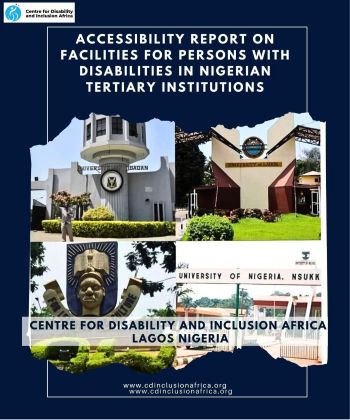
On the 23rd of January, 2019, the Discrimination Against People with Diabilities (Prohibition) Act was put into writing. The act required every public school in the country, from the primary to the tertiary, to be run to be inclusive and accessible, with trained personnel, with special facilities, and with sign language and Braille forming part of school curricula. According to this, public buildings were given five years to put themselves in order. That timeline expired in 2024; let us see the current state of the premier university.
Looking deeper into this premier institution, the promise remains a work in progress. And this is not for lack of goodwill. The university marks the International Day of Persons with Disabilities every December. Its admission forms ask intending students to indicate whether they live with an impairment, and its halls of residence place students with proven medical conditions on ground floors, closer to their faculties. These gestures matter, and the students who benefit from them know that they do. But goodwill is precisely what the Act was meant to retire. What Section 18 envisaged was not a kinder campus; it was a compliant one. And the difference between a compliant university and a kinder campus is the lives of students that actually need these changes.
This is especially important because across hostels, lecture halls, clinical rotations and hospital wards, the daily logistics of these students largely run on the kindness of other people, and for most days, it works. But a system that runs on kindness fails whenever kindness is unavailable, and kindness is not always available. Look at the context; the main educational resource in the university — The Kenneth Dike Library — keeps its e-research library and systems unit on its upper floors, reachable only by stairs. But the issue is that there are no elevators or ramps present in the entire facility; hence, such resources are only accessible by stairs. Moving further, you’ll notice that most of the older faculties and hostels on the campus grounds were built in an era that did not think in ramps. Granted, some of the newer buildings considered that. Among them include the new lecture theatre for technology students and a handful of new private hostels in the school. And the Department of Special Education’s new TETFund building rises four storeys, said to carry ramps all the way to the very top floor. The same building’s lifts, however, are reported never to have quite worked. That last part speaks to the same contradiction this article is about. Compliance over kindness.
The story is the same here in the Alexander Brown Hall. Granted the buildings are old, and has been stated before, built at a time when inclusion was not a factor. It still does not change the fact that the only band-aid for students who have difficulties climbing stairs is to put their rooms on the ground floor. Aisha*, a resident in the hall who needs crutches to move around, knows this problem all too well: “If I were to say it’s a challenge, it would rather be like stairs, a lot of stairs, and there is no elevator.“
Then you have other quality of life issues like access to water and the likes, considering that water rarely runs in the bathrooms in the hall, and so even her water reaches her through coursemates who fetch it whenever she needs it. This happens so reliably that she declines politely to call access to regular water supply a disability. She taught herself to climb the stairs regardless of the difficulty, and she holds herself to a high standard that is very respectable: “If I would rather say I’m not going because of this condition, it’s just an excuse for me, and I know that, deep down.”
But the infrastructure is just the beginning of the story. Moving to the lecture halls, the problems look a little different. The university reportedly operates with a few sign language interpreters for the entire institution, and their obligations sit within the Department of Special Education. What this means is that a deaf student in any other faculty is entitled to none of them; whatever help such a student receives comes from the hearts of the willing, and it goes no further than that. The same pattern repeats in examinations, where visually impaired students write with typewriters older than they are or wait on volunteer readers whose availability is never guaranteed, in arrangements often improvised at the last minute.
Aisha has witnessed a version of this. As someone who is also somewhat visually impaired, she narrates a time during one of her classes, when revision questions were displayed on the board while students called out answers around her, a format her partial sight shuts her out of. “I had to tell the lecturer: Please, tell someone to read it out,” she recalls. Pressed for time, the lecturer eventually read the questions, only the questions, not the options, before moving on. “And that was even after I talked to them,” she adds. Six or seven questions passed that she could not see. Speaking to the Press, she noted that other more visually impaired students would have learned not to complain and just managed. “They move through it every time like it’s normal. It’s not normal circumstances.” And beneath the board, beneath the stairs, is the part of the struggle that no one sees: “It’s not only about the body that people see. There is a lot going on inside.“
Now, none of this is to say that the teaching itself is careless. As far back as 2024, Funto*, then a student in special education, gave the institution a different review altogether: “Access to education is great. UI has a team of the most professional and keenly observant educators, and they have my total respect for doing such a wonderful job in educating us. Particularly in knowing we have differences that need to be catered for.” Both accounts are true, and their being true at the same time is the real finding: the university’s disabled students are held up by individuals who care and let down, reliably, by the structures behind those individuals. Funto’s educators exist. So does Aisha’s board. Kindness, present; compliance, absent.
Let us now come back to UCH: clinic to some, classroom to others, and daily terrain for every resident of ABH out on postings. The official record there is not blank. Since 2019, the hospital’s Special Duties unit has run wheelchair stations at its outpatient drop-off zones, alongside a Patient’s Helper Initiative meant to lighten the burden on carers. But in 2020, a study that interviewed nine deaf pregnant women across Ibadan’s health facilities in sign language found that no facility in the city kept a standby interpreter. Deaf patients communicated by paper and pencil or brought along their own interpreters, and one participant recalled a nurse who called her “aditi”, meaning “deaf one”, rather than her name. The study recommended, modestly, that each facility employ at least two interpreters. Six years later, that recommendation remains what it was on the day it was written: a recommendation.
Then, in April this year, came the detail that reframes the entire conversation. The Joint National Association of Persons with Disabilities (JONAPWD) commissioned access ramps and accessible toilets at the University Health Services (Jaja) of the University of Ibadan. Donated. At the university’s own clinic. “Before now, persons with disabilities often had to be physically assisted into the facility,” the association’s national president, Abdullahi Alli Usman, said at the commissioning. “For instance, a pregnant woman in a wheelchair would need to be carried to access care.” With the ramps, such a patient can now wheel herself into consultations and into maternity care.
The help that came from JONAPWD shows that beneath all of it — the stairs, the boards, and the ramps — sits an issue, which is the lack of reliable help. When Aisha speaks of her visually impaired coursemates, she does not speak of architecture. “They will just get to the class, sit down, record with a recorder, and the person that will come and take them home, and that’s it. People don’t talk to them.” What carried her through her own first year was not a facility but a handful of people who chose her and stayed: “It’s not even about giving me food. Talk to me. Stay with me.” She tells, without names, of a coursemate with a disability who was ignored by her classmates at a milestone moment and cried through her own convocation. “They are going through a lot,” Aisha says of students like her. “They need help. A lot of help. A lot of help.“
The help she has in mind is not vague. Aisha’s proposal is disarmingly specific: a salaried personal aide attached to each student who needs one, employed and paid by the government rather than by parents because “not every parent has the money” and accountable, so that students “can complain about them if they do anything wrong. ” Help, in other words, as staff and as policy, not as favour. JONAPWD’s framing is broader and simpler: “What we want is a Nigeria where persons with disabilities and those without disabilities enjoy equal fundamental human rights,” Usman said in Ibadan.
The Act was signed in January 2019. Its timeline expired in January 2024. Between those dates, what the law required of the premier university was quietly converted into what its community volunteered requirements into appeals, obligation into goodwill. The appeals have been answered generously. But it’s not just about being generous. It’s about the lives of the students that actually need these changes. Students who have been carried this far by other people and who are owed, at last, a university that does not require them to be. The university has proven, session after session, that it can be kind. The Act simply asks it to be compliant.
*Names have been changed, upon request.