


One beautiful thing about communal living is the variety of experiences, even more evident in the popular saying, ‘Variety is the spice of life.’ We really can’t talk about university life without its variety, starting from having someone with a totally different background from a far-distant geo-political zone staying nextdoor to sharing your bunk as a Law Student in Sultan Bello Hall with someone from far-distant Department of Physiotherapy, Faculty of Clinical Sciences. You could talk about how funny it is that your wardrobe allowance is spent on monochromatic fits and they talk about their contrasting experiences of UI and UCH, and both of you could converge at similar struggles with getting a problem sorted at iTeMS. It’s not totally different for folks in private hostels, except when you consider that the third – or probably fourth – roommate isn’t a UTME undergraduate but a Distance Learning Centre student and may not relate as much to the academic crests and troughs.
There are UI Distance Learning Centre students who reside on campus yet are very frequently unnoticed. The UIMSA Press sat with one to inquire about how life is for the average student.
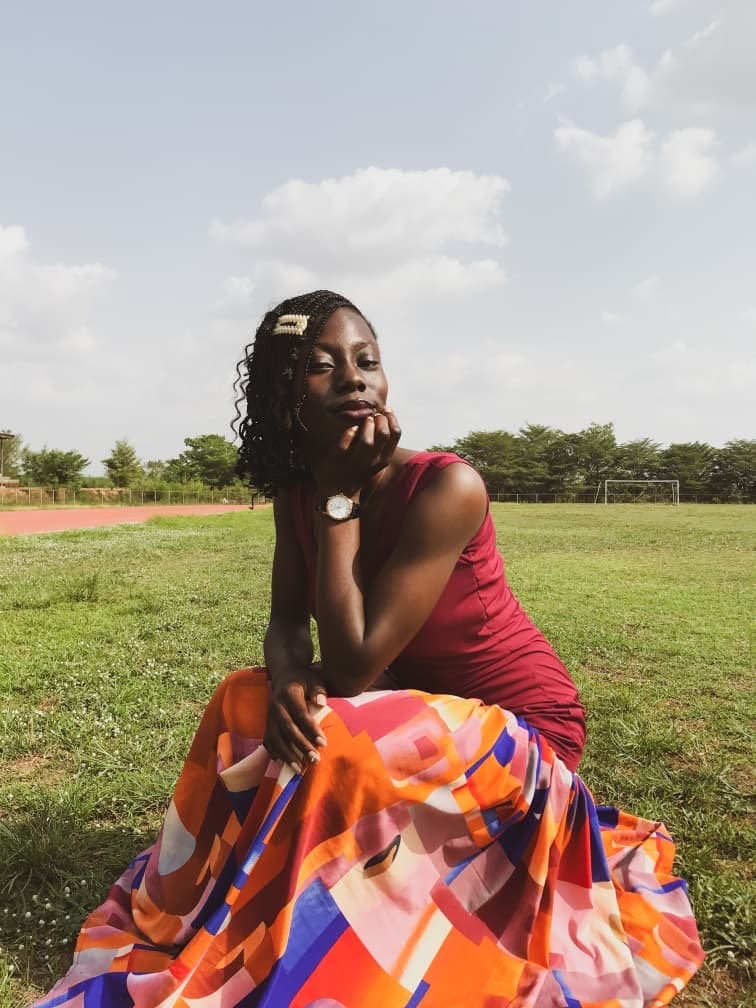
Her favourite day of the week is Wednesday. By 5:30AM on a typical Wednesday, whilst this writer is asleep, Inioluwa Esther Adamolekun gets up. She does her devotions, and begins to consume a certain type of content: self-help books. “I carry a book — I read through, I set a goal for the day. For instance, after today, this is what I want to learn and this is what I want to put in place.” She uses ‘Patience’ as an example of the learning points. Inioluwa is a 300-level student of the Department of Economics under the UI Distance Learning Centre (DLC) Program. She runs a business and participates in other extracurriculars. “I am part of SEIH which is like an entrepreneurial club in UI so we mostly specialise in innovation and entrepreneurship. And I’m also part of an NGO which is UNIV. Finally, I’m also part of a fellowship Ibadan Varsity Christian Union,” she shares.
For most people, business may be reduced to a conquest for some extra cash in the volatile state of the nation’s economics, but not for Inioluwa. When asked what she does for business, she doesn’t simply say hairdressing. “I majorly specialize in helping my clients to grow their hair and maintain their hair better. It’s not just about giving girls beautiful hair, because that’s my passion more than the money. It’s more of making a girl confident in the hair that she’s carrying. It gives me joy when a girl is very confident in her hair,” she says, reflecting a painstaking commitment to what she does. “It’s not a major source of income,” she adds. Running a business though requires mechanisms. She relies on a more passive form of publicity for her business: she makes hair in the corridors of her hostel and through the open salon, other girls see and come — free publicity. Good publicity has its drawbacks. “Lately, my work has been very demanding, because being in 300L, it’s a lot. Today, I was supposed to have a class from 8AM to 5PM and then do a client’s hair by 6PM but because our lecturers were busy, we had to cut the class short. I get really tired sometimes of having to make people’s hair.” In between clients and classes, the answer is always the same. “It’s reading,” she says. More often than not, academic reading.


On June 23rd, 2026, the University of Ibadan Distance Learning Centre held her orientation for about 3000 new intakes into the 2025/2026 session. This is an immensely staggering figure as just 4,430 were admitted into the regular 2025/2026 session through UTME and Direct Entry combined. The Distance learning centre “…was established by the University of Ibadan Adulthood Education department in the Faculty of Education and the purpose of the DLC was to give certain adults who don’t have the opportunity to go to school as a result of their busy schedule to still have an opportunity to go to school. DLC mostly comprises limited departments but it was majorly for people who want to balance worklife and education at the same time,” she begins. “It’s more than that now because we have people finishing from secondary school wanting to go to University but just enter through DLC because when it comes to qualifications for DLC, you mostly just need your SSCE or your A-levels and then you write their entrance exam and if you get admitted, you become a DLC student.” she adds. DLC features both a traditional face to face method of education for about 6 weeks in a semester and then a roughly equivalent amount of virtual lectures creating a hybrid more flexible system of learning. Featuring about 11,000+ active learners, it makes up roughly 17-26% of the entire student population which also include postgraduate learners and enrollees in affiliated institutions. For a population this large, the realities are quite astounding.
First, the remarkable. “It is still under the University of Ibadan cause most of the time, it is mostly the lecturers that take normal school courses that take the DLC students too.” Beyond this, “instead of 4 years, you do five years and for the five-year courses, it’s six years.” Logically, the extra year must be to compensate for the flexibility behind the principles backing DLC. Moreso, “the courses are quite similar and the qualification that makes you what you study is still what you would do. It’s the same degree — no DLC is attached to your certificate,” she shares, painting the beauty of a system that aids the fulfilment of people’s aspirations despite the differing levels of their real-world responsibilities. Now to the not-so-remarkable, “We don’t have a library card. We are allowed to use the library when KDL is open to everyone but we’re allowed to register for Jaja”, she says.
On to the interesting, “there is no ‘Student Union’ in DLC. DLC students are not allowed to protest or else you are risking rustication. It is kind of a strict program between you and the management.” When asked for names of people who have perhaps engaged in the dance of dissent who perhaps serve as warning tales against these acts, she simply says there are none. “There is always this respect that we give to the management and the management gives to us.” But DLC students are not without a system. “We have the CRF (Council of Representatives Forum) executives. They are like the Student Union representatives. It is more of a body of class reps that talk to the management on behalf of the students,” she shares. The 500-level students that understand or have good relationship with the management preside over this body of democratically elected class representatives. For more interesting things like sporting activities, “we have football competitions all round the semester cause they love playing football. They have competitions between departments, faculties, sometimes even between DLC and the main school. So for every level, in every department, they have a Sports Secretary that represents, plays football and arranges people who would play football,” she says. However, this system doesn’t seem to be very inclusive. “Most of the time, it’s always football. Other sports are not really talked about, even though they may be represented.”
Classism refers to the prejudice or discrimination against individuals based on their socioeconomic status, or in this particular case, mode of education and UI DLC students are sometimes on the receiving end of this prejudice. “I feel it is more of a location issue because imagine a medical student within DLC, most people would be like ‘you’re not a DLC student, you’re a med student’, it would be surprising,” Inioluwa paints a relatable picture after mentioning people are usually surprised when they find out she’s a DLC student. “So probably because most DLC students are not on campus, the only time you see DLC students on campus is when they have classes on campus, most of them live outside the school. Probably because of that unfamiliarity to DLC students, there is this foreign lens because ‘we don’t really see people like you all the time’, that’s why it’s weird.” She applies a much larger concept, the familiarity bias, a cognitive bias which describes people’s tendency to gravitate towards familiar things and simultaneously reject the unfamiliar, which in this case tends to create a perception of classism.
Somewhere around 2PM, albeit not on a Wednesday, this writer asks Inioluwa what she wants her life to look like after the roughly 2 years she has left to complete her degree. “For my standard, if I don’t build a life around this degree then I’m wasting my time and I see that as a waste of money. I see myself building a career around economics and outside economics too.” She wants to expand her hair business and have people work under her. “I want to be a boss,” she says, and then chuckles. But life cannot always be perfect, can it? As much as there are ups, sometimes there are accompanying downs.“Being the first daughter, there’s always this pressure that ‘I have to be excellent.’ I have pressure in having to cover up, having a lot to do, having clients to make hair for, having fellowship demands to meet up to, having slides and textbooks to cover and I’m the type of person that if I don’t understand that course, it’s over for me so I try my best to understand,” she shares. She also speaks of a time where she was not consistent and was slack with her goals but now it’s different. She has a routine. On a typical Wednesday, Inioluwa would probably have clients from 8AM to 2PM. A hair appointment according to her estimate takes between 1.5 to 10 hours — 10 hours out of 24 hours seem like a great deal of work. She ends her day this way: “I rewind and check my life: ‘Did I really learn patience today?’ I’m a human being, not every goal goes as planned so we go again.” Inioluwa feels like every mode of education has its advantages and disadvantages. The UI DLC model is not without its own characteristic flaws but it affords people a life without limits; thus, it can only get better.