


Nigerian Politics has always been an arena of high calculation and intense power struggles. And with regards to a nationally inclusive contest, that is, the presidential election, the unfurling dynamics are clearly starting to match its reputation. As of May 30, 2026, fourteen persons have formally thrown their hats in the ring, five of these occupying the seats of major intrigue. Yet, the unexpected occupant of the ‘Big Five’ who most recently announced his presidential ambition is Seyi Makinde, the incumbent Governor of Oyo State.
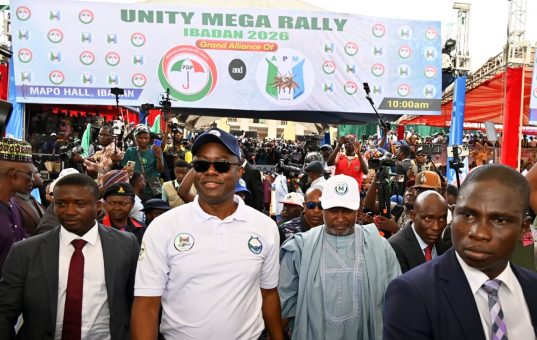
This development unfolded on May 14, 2026, during a ‘Unity Mega Rally’ at the historic Mapo Hall Arcade in Ibadan, where a routine political gathering condensed into a heavier political stir. At a convergence that was originally held to formalise the newly minted alliance between the Allied People’s Movement (APM) and his own faction of the People’s Democratic Party (PDP), Seyi Makinde leveraged the audience to announce his candidacy for the upcoming 2027 Presidential election.
There is no doubt that Seyi Makinde has placed unwavering trust in the people of Oyo State. As he approaches the end of his constitutionally permitted second consecutive term in early 2027, he remains visibly enthusiastic about ascending to greater heights in his political journey. However, this comes with a glaring shift in the cohesive structure of the People’s Democratic Party, as Makinde’s Alliance with APM signals a formal fracture from the union.
This rift arises from the fact that the PDP has, in recent times, been anything but united—beyond the shared name that loosely binds its factions. In essence, two distinct camps have emerged, each fiercely claiming to embody the true spirit of the party. The first, known as the Wike faction, stands out as arguably the most assertive, well-resourced, and structurally entrenched bloc within the PDP. It is led by Abdulrahman Mohammed and anchored by Nyesom Wike, the Minister of the Federal Capital Territory (FCT), who, interestingly, continues to serve under the APC-led federal administration while maintaining a firm hold on a significant portion of the PDP’s internal machinery.
Wike’s conspicuous involvement in the affairs of two opposing parties has created a paradox—one that inevitably demands resolution, with one side bound to bear the brunt of this political duality. Unfortunately, the PDP has not enjoyed any momentum from this arrangement. The party has, instead, been mired in an identity crisis, steadily losing its collective influence and cohesion. This decline has prompted its factions to retreat into loyal clusters in a bid to regain any relevance. It was under this understanding that Makinde’s faction gravitated toward the APM, an alliance perceived less as a genuine ideological convergence and more as a calculated marriage of convenience.
APM was founded in 2018 under its founding national chairman, Yusuf Mamman Dantalle. It first surged into the national spotlight in 2019 when Ibikunle Amosun, the erstwhile Governor of Ogun State, utilised its platform to sponsor his political structure during a bitter fallout with his core party’s national leadership. Although the alliance did not produce the intended effect of helping his hand-picked successor win the election, a reputation had been carved for the APM movement right from then on. Seyi Makinde has recognised their potential yet again in the face of the 2027 elections, and ‘anticipation’ doesn’t begin to capture the fervour around this alliance. Still, one eventuality remains certain—political reciprocity. Peradventure Makinde secures the ultimate prize and becomes the president of Nigeria, there is an implicit package of massive political returns awaiting the Allied People’s Movement.
Hence, Makinde’s faction forms the second PDP faction, operationally defined as the Anti-Wike Coalition. It is a much more loose faction, but bonded by their unanimous resistance to the leadership of Nyesom Wike, because they refuse to surrender the soul of PDP to an APC cabinet member. Unfortunately, it appeared unfeasible for them to challenge the Wike’s faction heads-on, as a large portion of their National Working Committee (NWC) is legitimately represented by members from Wike’s faction. This led Seyi Makinde and Atiku Abubakar to leave the main house and establish support systems in ‘calmer’ parties.
Speaking of Atiku Abubakar, who chose to formally dissolve his long-standing marriage with the PDP, his exit serves as the definitive proof of the party’s institutional decay. To prevent his perennial presidential ambition from being suffocated by the party’s unhealthy chokehold, the former two-term vice president (1999-2007) chose to abandon the ruins of the house he historically helped build.
Rather than fighting an exhausting, predetermined battle inside a compromised headquarters, Atiku migrated his national grassroots machinery into the African Democratic Congress (ADC). ADC, founded in 2005, presents itself merely as an alternative, minor platform. In reality, it has functioned as a clean slate for political relocation, offering a safe, legally secure platform that is completely free from the messy infighting of big-party godfathers. Under this newly secured refuge, he has successfully clinched the party’s ticket to contest for the presidency once again.
This double exodus leaves the traditional PDP quarters at Wadata Plaza in an unprecedented state of isolation. While it appears that Wike and his loyalists now have an undistracted administrative control of PDP, the implication of this division is a sheer loss of actual voters and political engines that can actually win a presidential election. Their most fascinating representation of this is the emergence of Senator Sandy Onor as the PDP’s consensus presidential candidate.
In comparison to the other contenders, Sandy Onor sits at the least viable vantage point of winning the presidential seat. Given this reality which his own sponsors are quietly well aware of, it is much more accurate to label his candidacy as only a localised defensive play engineered to secure the legal rights to the PDP brand, and shield the remaining party structure from a total takeover. Because the Independent National Electoral Commission (INEC) structurally recognizes whichever faction holds the official NWC machinery and successfully submits a validly nominated candidate, Sandy Onor’s ticket effectively anchors the legal legitimacy of the party name, locking out external rivals.
However, just when it seemed the sequence of tactical counter-moves had exhausted itself, the closing days of May introduced an entirely new layer of intrigue into the picture. On the 30th of May, 2026, despite intense venue disruptions and fierce political pushback from Wike’s camp, the Turaki-led PDP held a Special National Convention and unanimously affirmed former President Goodluck Jonathan as their presidential candidate for the 2027 election.
Even though Jonathan himself has maintained a calculated silence regarding this draft, Turaki’s faction choice has heightened the tension surrounding the legitimate ownership of PDP. By placing a national figure of Jonathan’s stature at the top of their ticket—should he eventually decide to heed this relentless persuasion—they will have handed themselves massive political leverage in the ongoing battle over which faction holds the true mandate of the party.
Ultimately, the 2027 presidential race belongs to the “Big Five” powerhouses: Bola Ahmed Tinubu, Atiku Abubakar, Peter Obi and his running mate, Rabiu Kwankwaso, and Seyi Makinde. Perhaps by now, it is clear that a sixth force has emerged, but the rise of this frontline proves that the traditional PDP structure has receded into an empty shell. In 2027, historical party loyalty will no longer be enough; instead, the election will be entirely decided by the sheer weight of these individual political networks and the tactical moves they make outside of the old party walls.
Ifeoluwa Omotesho