


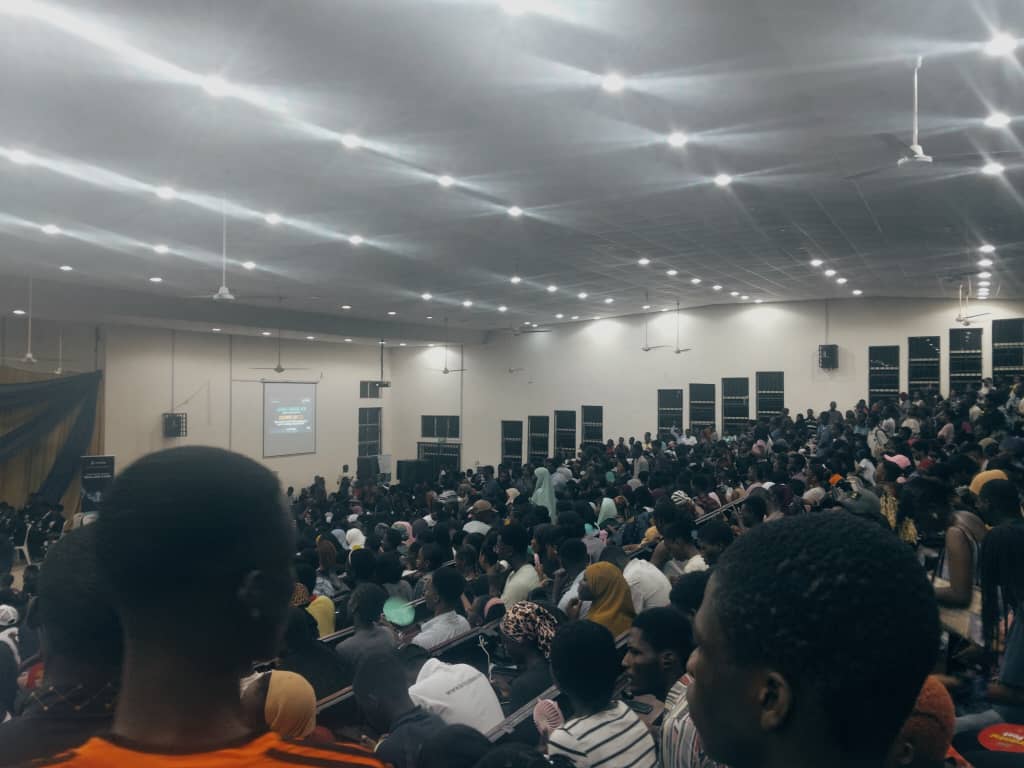
Second semester in the University of Ibadan has quite unnerved a general banality this institution has been operating on since the beginning of the academic session, and its infamous Jaw War event has been the reason behind this atmosphere shift. For the old students accustomed to the tradition, it is another season to drive themselves down to the New Faculty Lecture Theatre (NFLT) to chant aloud in support of their representatives, expect the inevitable banters or occasional giveaways, or as a chance for lovers to checklist another event they both attended. But for freshers like me who have only recently become acquainted with the buzz of the event which commenced on the 1st of September, 2026, the excitement sits fresh on our lips as we watch the ordinary rhythm of campus life surrender to the overwhelming momentum of the debates.
Speaking on whether the debate matched their expectations, the event seemed to have only produced positive impressions from freshers alike. Solomon, a Veterinary Medicine student from Sultan Bello Hall, rated the event a 7 out of 10, stating that he walked into the venue with zero expectations having not known even little about it beforehand, except the obvious fact that it was going to be a debate. Damilola, a Computer Science student from Lord Tedder Hall, also attested to this, echoing Solomon’s sentiments about stepping into the hall with a blank slate, yet his final statement “It was worth every second” speaks volumes. Even though Miracle,, a Law student from Queen Elizabeth Hall, had been privy about the event months before resumption, aided by the multiple fliers, video recordings and links that had circulated, when she finally attended, she affirmed there was no discrepancy in quality between what had been brewing up in the preparations and the magnitude of the event itself.
Yet, no one spoke without extending their observations to the extreme heat and the inconvenient choice of venue. With every passing minute on each day the debates are held, more people who retire from classes and several other commitments keep trooping in. This further compounds the congestion in the already strained hall. Personally, I have never felt heat as though it was a fabric and had tangibility to it, until Jaw War. Solomon said he couldn’t find a seat when he arrived, additionally expressing the state of the hall in the most unvarnished words he could string together: “An absolute oven with hundreds of bodies trapped in heat with little airflow.” A Communication and Language Arts Student from Obafemi Awolowo Hall, Maryam, said the state of the place was inevitable, pointing out that there is no way a crowd like that will turn up and it will be conducive for everyone. While most of them proposed the venue could be changed to a much bigger venue, a much more feasible solution suggested by Miracle as well as Mosinmiloluwa, a Linguistics student from Queen Idia Hall, remains thorough air-conditioning. The issue with these problems is that they aren’t one-off complaints. Two sessions ago, the UIMSA Press released a similar article where freshers complained over and over again on the stuffiness of these same centres the debates were held, amidst other limitations. The question remains: do these complaints fall on deaf ears?
Away from the stuffiness, the need to contrast the style of debating freshers were used to during their secondary school education to the dynamics of Jaw War proved to be a paramount question. The difference was a clear one. Temidayo, a Science and Technology Education student claimed that she was left at a loss of words due to the overwhelming showdown of intellect and tenacity the speakers defended their notions with. According to her, “The topics were complex and required a lot of critical thinking to be able to analyse and dissect each point perfectly.” Mosinmiloluwa said she has participated in a debate in secondary school, but the crowd was no way near what her eyes graced her with at Jaw War. Adebayo, a dental student who resides in the Great Independence Hall, praised the event, stating that Jaw War is by far better than any he has witnessed. For Miracle, the difference was particularly in the increased intensity and the rigidity of speakers’ movement.
There is no doubt the peculiar culture of debate event stripped the freshers of the composure they thought they would need, especially in light of the tireless bants and audacious savagery the debaters embellished their speeches with. Pertaining that tendency of the debaters though, Moustapha, an Arabic and Islamic Student from Ransome Kuti Hall, admitted it was an entertaining highlight to look forward to, but added that there could also be negative effects as well. Miracle shared similar sentiments, stating that while the bants are funny and a great way to make the audience react, they could come off as excessive, unoriginal and often deter from the purpose of a debate. She particularly tagged it to tug at the borders of a term called argumentum ad hominem, noting that while it might not be a direct mirror of it just yet, it is the kind of slippery slope that could eventually turn out like that if unchecked. Solomon, on the other hand was in full support of the bant tradition, his view stemming from the fact that the energy gives Jaw War its unique flavour. His defence was: “Take it away, and it becomes another standard debate.” In the end, all their final views remained that the bants and wordplay are a unique tradition and should therefore be kept.
For the interhall debates, it is another means for the residents of these respective halls to exemplify oneness and support for as long as the outcome favours their sustenance in the tournament. When asked the reason they showed up for the event, it was to simply support either their Hall or faculty. Those who resided off campus or in private hostels did not leave themselves out of the experience as one might have thought, as some still attended to rally behind their officially assigned halls of residence. Ayomide, a Medicine and Surgery student, admitted that living away from campus hasn’t affected her interest in any way, noting that her default reaction is always to support the hall she was originally given. Another Medicine and Surgery student, Precious, who stays in a private hostel, added that there were no movement restrictions, noting that the hostel gate would always be open whenever she finally made it back. However, Miracle admitted she had friends that reside off campus and because of that, they are not motivated to attend Jaw War because of timing and location, especially considering the fact that late night walks outside the jurisdiction of the least measure of security could be dangerous.
Speaking on the verdict the judges have issued so far, it is very much normal to not have the whole audience nod in full agreement to the results. While certain sessions could be accurately predicted before the official announcement, a couple of them hung in an air of uncertainty or slight comments of advantage. Solomon admitted he wasn’t neutral, and said Veterinary Medicine deserved higher scores than what they received. Damilola, who had some experience with public speaking in the past, explained that such type of judgements could be quite subjective and it is often very normal for personal bias to colour how an audience receives a score. Because of the possible existence of judge biases, Jaw War uses more than one judge, and that multiplicity of eyes is precisely what saves a fierce contest from collapsing into pure sentiment.
When the conversation shifted toward predictions and what hall and faculty actually stood a chance of taking the trophy home, the responses were anything but decentralised. The two legs concluded have been able to converge the predictions to a narrow group of contenders, leaving students to weigh in on who they actually believe will go all the way. Ayomide calculated that the potential hall victors was between ABH, Bello and Indy Hall. Gloria, from Accounting mentioned Awo Hall and the Faculty of Economics and Management Sciences, Adebayo threw Indy hall, Education and Clinical Sciences in the winning circle; Moustapha nominated Kuti Hall and Clinical Sciences; Precious only had Tedder Hall in view; and Damilola put up Tedder Hall and the Faculty of Education.
For a couple of them, the debate didn’t end in pure wonder; it even lured them closer to the possibility of exploring different forms of public speaking. Damilola and Miracle had in fact joined their respective halls’ debating societies since they became aware it existed, and somehow the event has only strengthened their convictions. Temidayo concluded that her interest stopped at watching and learning from the speakers rather than trying it out. Oluwatobi, from Medicine and Surgery admitted it was an inspiring event to watch but unsure if the effect it had on her could take her as far as joining a debating society. Precious’s response was an unyielding “No” while Solomon’s exact words were: “Not really. I enjoyed watching from the crowd, but I’m in no rush to sign up for a debate team myself.”
Ifeoluwa Omotesho