


Nobody tells you that pain can become background noise. That a person can hollow it out and pretend very hard that it isn’t present. That a person can learn to tune it out the way you tune out a fan whirring in the corner of a room: constant, yet unremarkable. Hafsoh, a 200 Level Law student of the University of Ibadan, calls her daily life “routine.” I have a sense of just what that word costs her.
Before the sun rises over the University of Ibadan, the campus is already alive. Students spill out of hostels with backpacks slung over one shoulder, clutching handouts and IDs, squinting as the first rays peek past the horizon. There is the familiar chaos of morning: the scramble to beat attendance, the sharp percussion of leather soles on concrete, the low hum of a hive-mind stirring as we move together into the day. From the outside looking in, it’s difficult to tell these students apart, they all appear as well-oiled cogs of an ultra-efficient whole. But therein lies the problem.
For some students on this campus, the morning begins differently. Before they step out, there is a calculation. How far is the lecture hall? Is it cold outside? Did I drink enough water? Can my body make it through the day? These questions, while inapparent to the oblivious observer, permeate the very fabric of being of several in our school. It’s easy to miss.
I know someone who has Sickle Cell Disease (SCD). I have watched them laugh at a joke and wince two seconds later, then laugh again, as though the wince was nothing. As though it cost nothing. It was a long time before I understood that the laughing and the wincing were not contradictions. That for many people living with SCD, the performance of normalcy is not dishonesty, but survival. You learn to carry it quietly, or you spend your whole life explaining yourself to people who will never fully understand anyway.
When UIMSA Press put out a form asking UI students with Sickle Cell Disease to share what their daily lives actually look like, we were not expecting poetry. We got it anyway.
Mercy Abifarin is a 100-level student. On a typical day, she does not trek long distances on campus because her body has a budget, and walking across campus can overdraw it. While her friends move freely between faculties, she maps her day around what she can and cannot afford physically. She is forced to take cab rides to places they walk to, and has learned not to explain this too much. “I always complain that I’m tired and thirsty,” she wrote, “but they think I’m exaggerating.”
For 18-year-old Ayoade Oluwanifemi, the story is much the same. She conserves her energy, venturing out only when necessary—a habit that those around her sometimes mistake for aloofness. To the public, the quiet calculations behind such choices remain invisible; they see only someone who doesn’t show up.
Hafsoh paces herself. She drinks water, monitors how cold it is, and spaces out demanding tasks, lest they compound into something her body cannot handle. She is always tired, the deeper kind, the kind that lives underneath everything else and does not leave.
This is what sickle cell looks like on a good day: a constant, quiet negotiation between what you want to do and what your body will allow. The disease is present even when the pain isn’t. It shapes the smallest choices—the seat you take in a lecture hall, whether you join your friends for a walk, even whether you admit to anyone that you’re not okay. It is a disease that demands management even in its mildest moments, and those doing so act largely in silence, surrounded by people who do not notice.
Management, of course, is not always enough. Mercy describes her pain crises: when they begin, she drinks plenty of water and takes painkillers—at twice the recommended dose. Because, as she puts it, the normal dosage does nothing.
There is a particular kind of exhaustion that comes from pain that will not respond to the things that are supposed to help it. From lying on a bed waiting for relief that arrives late, or not at all, while life outside continues without you.
Ayoade describes pain crises as moments where you feel like you might die. Where you want to do anything, anything to make it stop.
Consider Mercy’s experience during her CHM 101 examination. Despite suffering from chronic rib pain, she remained in the Distance Learning Centre as the air conditioning kept the room at a low, biting temperature. She chose not to speak up or depart; instead, she persevered through the worsening pain and the cold, silently completing her test.
“We need AC in times of heat,” she acknowledged. “But the school should consider how low the temperature of the AC is. It’s really not conducive for sickle cell patients.” She did not sound angry when she wrote that, merely like someone who has long accepted that the environment was not designed with her in mind, and has simply learned to survive it anyway.
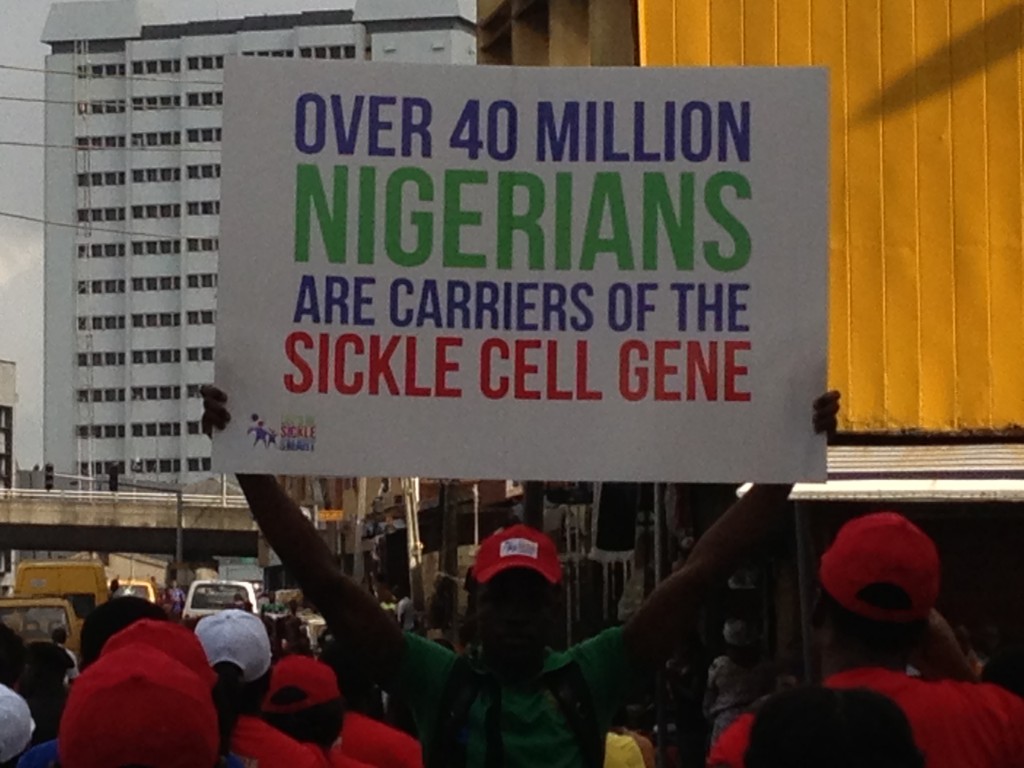
Nigeria has one of the highest rates of sickle cell disease in the world, with an estimated 150,000 children born with the condition every year. On university campuses, where stress, irregular meals, and physical exertion are daily realities, managing SCD becomes exponentially harder. Yet the infrastructure: lecture halls, health centers, institutional policies, rarely accounts for students navigating this reality.
The pain eventually ends. What it leaves behind is harder to name.
Mercy describes the aftermath of a pain crisis. Each one, she writes, carries its own trauma—the dread of facing another just after recovering from the last. The pain itself is brutal, but the fear that follows—the anticipation, the waiting, the wondering when it will return—is its own kind of suffering. You stop trusting your body completely. You are always, in some small way, bracing.
Imagine being ill in a way no one can see. Ayoade has met health practitioners—people trained to help—who have implied she was being dramatic, exaggerating her pain to gain access to relief. She is eighteen, and she has already learned that her suffering is something she will sometimes have to defend.
“Some health practitioners often feel that I’m being dramatic,” she wrote, “or that I’m pretending to be sick to get access to pain relief.”
Hafsoh, on her part, described the mental toll of hypervigilance, the way SCD makes her overly cautious, the way that caution has its own cost. She cannot do strenuous things. She has to calculate, always. And in all of that calculating, there is a quiet grief for the version of herself that might have just done things without thinking.
This is what warriors do. They fight the illness, the doubt and the grief of limitations, and they smile, showing up to take their exams in freezing halls, and they keep going. Most people around them will never know how much that costs.
It would be easy to end the story here, in the weight of it. But that would not be the full truth.
Ayoade said she does not like to see SCD as a barrier. She does every task assigned to her to the best of her ability. She would really like to do sports, as she’s stated in plain terms. Yet, she cannot, because of her health. But that desire for competition remains, and that does matter.
There are good days. Days when the body cooperates, when the sun is not too hot, and the water is not too cold, and the energy holds. Days when you make it to every class and laugh with your friends and forget, briefly, that there is anything to manage. Those days exist too.
Sickle cell warriors are not defined by their illness, even when their illness defines so much of their days. They are students, friends, people with strong opinions and large ambitions and bad days for reasons completely unrelated to their genotype. The disease is part of their story. It is not the whole of it.
By the time evening falls on this campus, the walkways are quieter. Students are back in their rooms, some reviewing notes, some already asleep. The day is over. For most people, it was just another day.
For a student with SCD, it was a series of calculations that ended well. Or didn’t. Either way, tomorrow there will be more calculations. More pacing, more water, more watching the temperature, more physical economy.
Hafsoh calls this routine. Ayoade calls it manageable.
I have been thinking about those two words since I read them. These are not the words of people who have given up. They are the words of people who have made peace, not with suffering, but with the fact that suffering is part of their journey, and life is still to be lived.
The campus will wake up again tomorrow. The students will rush to lectures, squint against the bright rays, and move through their days. Most of them will look fine. Some will be calculating.
Responses have been edited for clarity and length.
Ayomide Bello